
Short Answer
Definition of Rutherford’s Gold Foil Experiment
The gold foil experiment, conducted by Ernest Rutherford in 1909, was a pivotal scientific investigation that revealed the internal structure of the atom. This experiment demonstrated that atoms contain a small, dense, positively charged center known as the nucleus, fundamentally altering the understanding of atomic composition.
Historical Context and Prevailing Atomic Models
At the turn of the 20th century, atomic theory was dominated by J.J. Thomson’s plum pudding model, which depicted the atom as a diffuse sphere of positive charge with negatively charged electrons embedded throughout, much like raisins in a pudding. This model suggested a relatively uniform distribution of charge and mass within the atom. However, experimental evidence was needed to validate or challenge this conception.
Experimental Setup and Procedure
Rutherford, along with Hans Geiger and Ernest Marsden at the University of Manchester, designed an experiment to probe atomic structure by directing a beam of alpha particles-helium nuclei emitted from a radioactive source-at an ultra-thin sheet of gold foil. The alpha particles were expected to pass through the foil with minimal deflection if the plum pudding model were accurate.
- Alpha Particles:
Positively charged particles with high kinetic energy used as probes to investigate atomic structure. - Gold Foil:
A very thin layer of gold atoms, chosen for its malleability and atomic properties, allowing alpha particles to interact with individual atoms. - Detection Screen:
A fluorescent screen surrounding the foil to detect and measure the scattering angles of alpha particles after passing through the foil.
Observations and Unexpected Results
Contrary to expectations, while most alpha particles passed through the foil with little or no deflection, a small but significant number were scattered at very large angles, some even rebounding almost directly backward. This was inconsistent with the plum pudding model, which predicted only minor deflections due to the diffuse positive charge.
Interpretation and Theoretical Implications
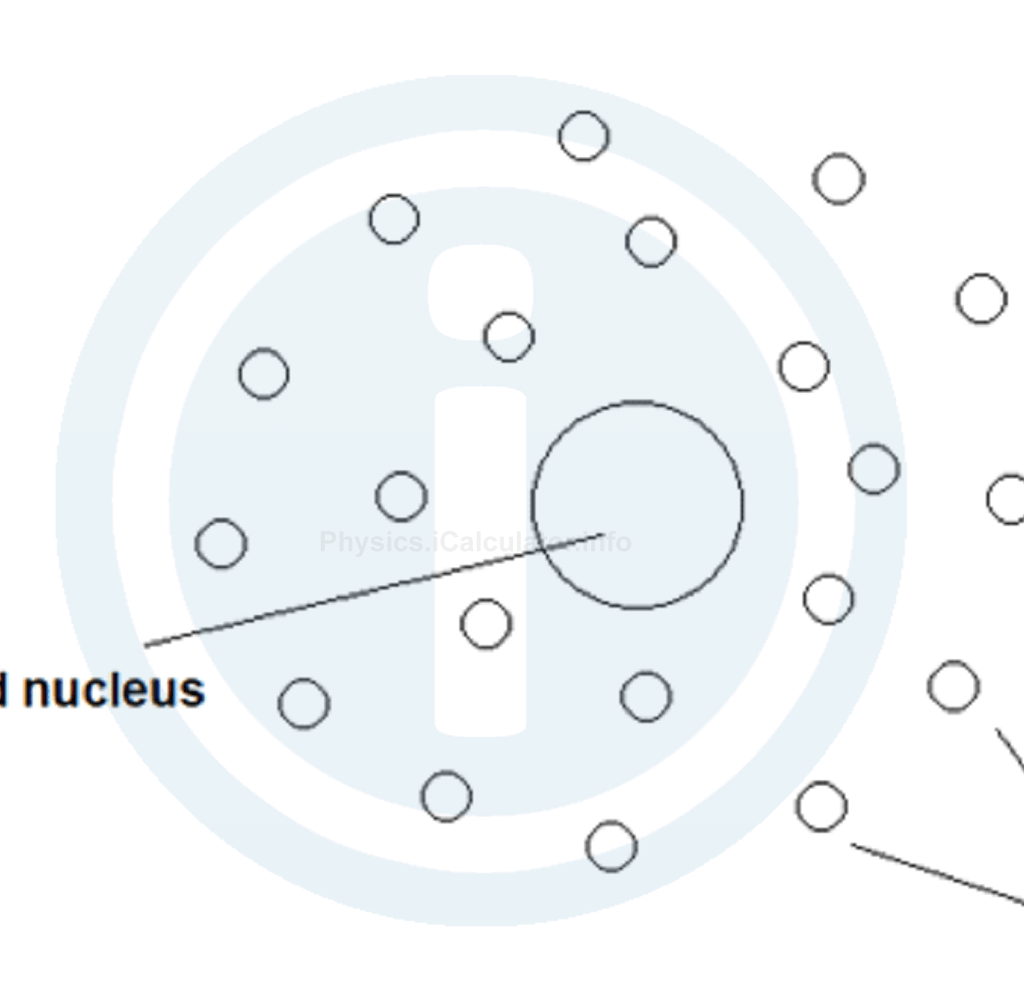
Rutherford proposed that the atom must contain a tiny, dense core carrying a positive charge-the nucleus. This nucleus was responsible for the strong electrostatic repulsion that caused the large-angle deflections of some alpha particles. The analogy Rutherford used compared the alpha particles to bullets fired at a large, solid object, which would occasionally ricochet due to the object’s density and charge.
- Dense Nucleus:
A compact region containing most of the atom’s mass and positive charge. - Electron Cloud:
Electrons orbiting the nucleus, occupying most of the atom’s volume but contributing little to its mass.
Mathematical Explanation: Scattering and Coulomb’s Law
The deflection of alpha particles can be quantitatively described using Coulomb’s law, which governs the electrostatic force between charged particles. The scattering angle depends on the impact parameter and the repulsive force between the positively charged alpha particle and the nucleus.
Formula:
[
F = frac{1}{4piepsilon_0} frac{Z_1 Z_2 e^2}{r^2}
]
- F: Electrostatic force between charges
- Z₁, Z₂: Atomic numbers (charge numbers) of the alpha particle and nucleus
- e: Elementary charge
- r: Distance between the charges
- ε₀: Permittivity of free space
This force causes the alpha particles to scatter at various angles depending on their proximity to the nucleus.
Scientific Impact and Subsequent Developments
Rutherford’s discovery challenged the existing atomic paradigm and laid the groundwork for modern atomic physics. It inspired Niels Bohr to develop his model of the atom, incorporating quantized electron orbits around the nucleus, which explained atomic stability and spectral lines. This progression marked the transition from classical to quantum physics.
Challenges in Acceptance and Paradigm Shift
Despite compelling evidence, the scientific community initially resisted abandoning the plum pudding model due to its intuitive appeal and longstanding acceptance. Rutherford’s findings required a fundamental shift in atomic theory, illustrating the difficulty of overturning entrenched scientific beliefs. Over time, accumulating experimental data and theoretical advancements facilitated widespread acceptance of the nuclear model.
Legacy and Importance in Modern Science
The identification of the nucleus as a positively charged core revolutionized the understanding of matter’s fundamental structure. It paved the way for nuclear physics, including the discovery of protons and neutrons, and advanced research into nuclear reactions and particle physics. Rutherford’s experiment remains a cornerstone example of how empirical evidence can transform scientific knowledge.
Common Misconceptions About Rutherford’s Experiment
The gold foil experiment proved electrons orbit the nucleus like planets.
Rutherford’s experiment revealed the nucleus but did not describe electron behavior; Bohr later introduced quantized orbits.
All alpha particles were deflected at large angles.
Only a small fraction experienced significant deflection; most passed through with minimal deviation.
Real-World Applications and Examples
The principles derived from Rutherford’s experiment underpin technologies such as nuclear energy, medical imaging, and radiation therapy. Understanding atomic structure is essential for fields ranging from chemistry to materials science, influencing the development of semiconductors, nuclear reactors, and particle accelerators.






Leave a Reply