
Short Answer
Understanding Beam Brightness in Particle Accelerators
The concept of beam brightness in particle accelerators extends far beyond simple visual brightness. It encompasses the concentration, energy, and intensity of charged particle streams, reflecting complex interactions governed by electromagnetic and quantum physics. To fully grasp this topic, one must explore the principles of particle acceleration, the physics of beam focusing, and the practical significance of beam brightness in scientific research and technology.
Definition of Beam Brightness
Beam brightness refers to the density and intensity of charged particles within a beam, typically quantified as the number of particles passing through a unit area per unit time. It is a critical parameter that determines how concentrated and energetic a particle beam is, influencing its effectiveness in experiments and applications.
- Particle Density:
The number of particles contained within a specific cross-sectional area of the beam. - Intensity:
The energy delivered by the beam per unit area, which affects the beam’s interaction with matter. - Focus:
The degree to which the beam is concentrated into a narrow, well-defined path.
Principles of Particle Acceleration
Particle accelerators are sophisticated devices designed to propel charged particles, such as electrons or protons, to velocities nearing the speed of light. This acceleration is achieved through the manipulation of electromagnetic fields within evacuated tubes, minimizing collisions with air molecules and allowing particles to gain substantial kinetic energy. The result is a tightly confined, high-energy beam capable of probing the fundamental nature of matter.
Types of Particle Accelerators
- Linear Accelerators (Linacs):
Accelerate particles along a straight path, often producing beams with high brightness and precise control. - Circular Accelerators:
Use magnetic fields to bend particle trajectories into loops, enabling repeated acceleration cycles to reach higher energies, though with increased challenges in maintaining beam focus and stability.
Mechanisms of Beam Focusing
Focusing a particle beam involves concentrating charged particles into a narrow, intense stream. Unlike optical focusing of light, particle beam focusing relies on electromagnetic forces and quantum effects. Magnetic lenses and collimators are employed to counteract the natural tendency of particles to repel each other, a phenomenon known as the space charge effect, which causes beam spreading.
Space Charge Effect and Beam Stability
As particles within the beam carry like charges, they exert repulsive forces on one another, leading to beam divergence. To maintain a stable, focused beam, accelerators use complex magnetic focusing systems that continuously adjust the beam’s trajectory and confinement. Balancing beam intensity with stability remains a central engineering challenge.
Quantifying Beam Brightness
Beam brightness is mathematically expressed as the particle flux density, combining particle count, beam cross-sectional area, and time. For example, the Large Hadron Collider (LHC) achieves beam brightness levels comparable to concentrating the sun’s luminosity into a beam narrower than a human hair, illustrating the extraordinary precision and power of modern accelerators.
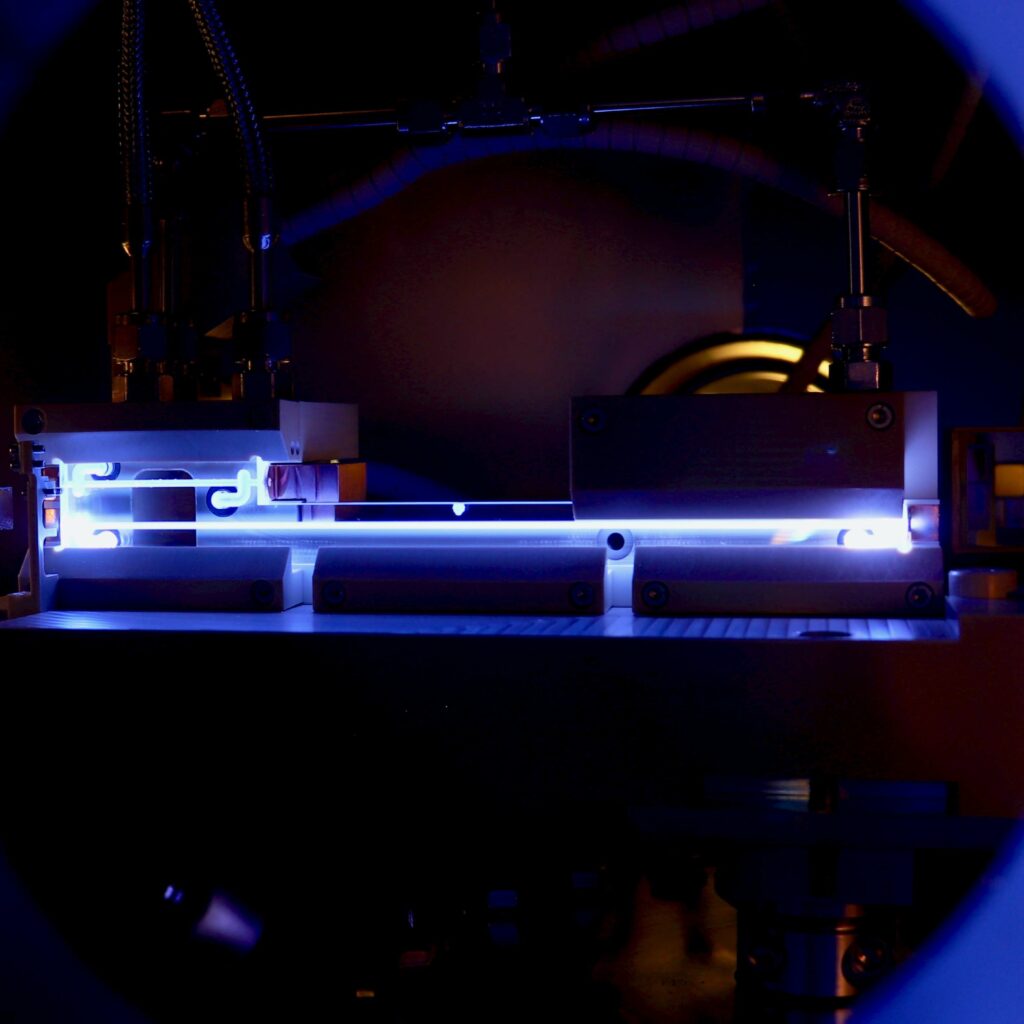
Synchrotron Radiation and Its Role
When charged particles are forced to travel along curved paths in circular accelerators, they emit synchrotron radiation-highly intense electromagnetic waves. This radiation is not only a byproduct but also a valuable tool, providing extremely bright X-rays used in fields such as materials science and medical imaging. The interplay between particle acceleration and light emission highlights the multidisciplinary nature of beam brightness.
Applications of High-Brightness Particle Beams
High-brightness beams are indispensable in advancing scientific knowledge and technology:
- Fundamental Physics:
Collisions at extreme energies recreate conditions similar to those just after the Big Bang, enabling discoveries about the universe’s fundamental forces and particles. - Medical Treatments:
Particle therapy uses focused beams to target cancer cells precisely, minimizing damage to surrounding healthy tissue. - Material Science and Imaging:
Synchrotron radiation facilitates detailed structural analysis of materials at the atomic level.
Emerging Technologies Enhancing Beam Brightness
Future advancements aim to produce even brighter and more stable beams through innovative approaches:
- Plasma Wakefield Acceleration:
A cutting-edge technique that uses plasma waves to accelerate particles over shorter distances with high intensity. - Artificial Intelligence:
Real-time monitoring and adjustment of beam parameters using AI improve stability and performance. - Advanced Materials:
Development of new materials for beamline components enhances durability and precision.
Common Misconceptions About Beam Brightness
Beam brightness is the same as visible light brightness.
Beam brightness in accelerators refers to particle density and energy concentration, not visible luminosity.
Higher brightness always means better beam quality.
Increasing brightness can lead to instability due to repulsive forces, requiring careful balance.
All particle accelerators produce equally bright beams.
Beam brightness varies significantly between linear and circular accelerators due to their design and operational principles.
Significance of Beam Brightness in Science and Technology
The brightness of particle beams is a cornerstone of modern physics and applied sciences. It enables researchers to explore the subatomic world, develop advanced medical therapies, and innovate in materials research. The continuous pursuit of brighter, more focused beams drives technological progress and deepens our understanding of the universe’s fundamental laws.
Frequently Asked Questions (FAQ)
What does beam brightness mean in particle accelerators?
Beam brightness measures how densely packed and intense a stream of charged particles is, indicating the beam’s focus and energy delivery per unit area.
How are particle beams focused in accelerators?
Electromagnetic fields and magnetic lenses are used to concentrate charged particles into a narrow, stable beam, counteracting forces that cause dispersion.
Why is it difficult to maintain beam stability?
Repulsive forces between like-charged particles cause the beam to spread out, requiring sophisticated magnetic control systems to keep the beam focused.
What practical uses do high-brightness beams have?
They are essential for fundamental physics experiments, recreating early universe conditions, and medical applications such as targeted cancer treatments.
Which future technologies could improve beam brightness?
Innovations like plasma wakefield acceleration and AI-driven beam control promise to enhance beam intensity and stability significantly.
FAQ
What is beam brightness in a particle accelerator?
Beam brightness is a measure of the number of particles passing through a unit area per unit time, indicating the intensity and focus of the particle beam.
How do particle accelerators focus beams?
Particle accelerators use electromagnetic fields and magnetic focusing systems to concentrate charged particles into a narrow, intense beam.
Why is maintaining beam stability challenging?
Repulsive forces between particles cause beam divergence, making it difficult to keep the beam focused and stable, which requires sophisticated magnetic focusing and control techniques.
What are the applications of high-brightness particle beams?
Applications include fundamental physics research, recreating early universe conditions, and medical therapies such as targeted cancer treatment.
What future technologies may improve beam brightness?
Innovations like plasma wakefield acceleration and AI-based real-time beam adjustments are promising advancements for achieving brighter, more stable beams.






Leave a Reply