
Short Answer
Understanding the Hydrogen Atom
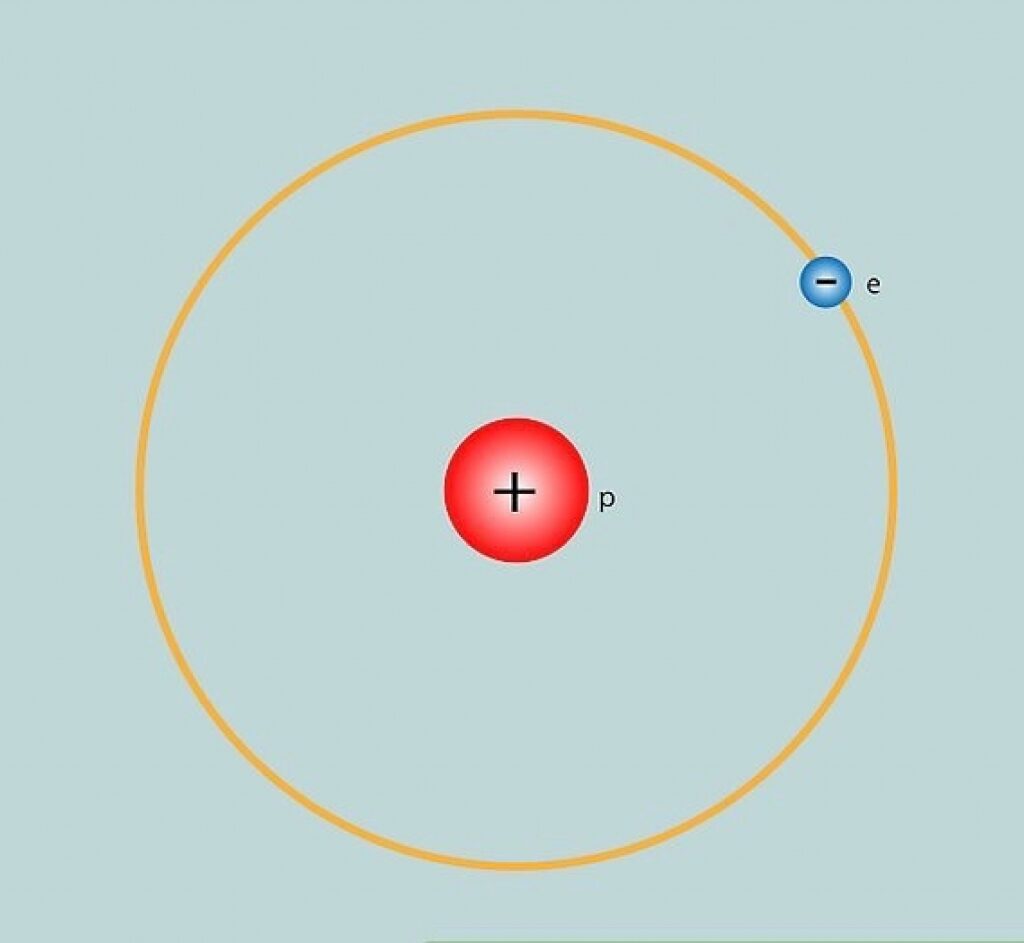
The hydrogen atom, the simplest and most prevalent atom in the universe, offers a fascinating glimpse into the fundamental nature of matter. At its core, a hydrogen atom comprises a single proton forming the nucleus, orbited by one electron. This minimalistic structure serves as a foundational model in atomic physics, inviting us to explore the concept of atomic size and the complexities underlying it.
Definition and Components of a Hydrogen Atom
A hydrogen atom consists of two primary parts:
- Proton (Nucleus):
The nucleus is a compact, positively charged particle approximately 1 femtometer (1 × 10-15 meters) in diameter, representing an incredibly small scale beyond everyday perception. - Electron Cloud:
Surrounding the nucleus is a diffuse region where the electron is likely to be found. This electron cloud defines the effective size of the atom and extends far beyond the nucleus itself.
Scale and Size: Visualizing the Hydrogen Atom
To grasp the vast difference in scale between the nucleus and the electron cloud, imagine the nucleus as a tiny marble placed at the center of a football field. The electron’s probable locations would then span the entire field, illustrating that the atom is mostly empty space. This analogy highlights the disproportionate dimensions within the atom and challenges traditional ideas of size.
Quantum Mechanics and Atomic Dimensions
The behavior of the electron in a hydrogen atom is governed by quantum mechanics, which replaces the classical notion of a fixed orbit with a probabilistic distribution of positions. Instead of a precise location, the electron exists within a cloud of probabilities, making the atom’s size a statistical concept rather than a fixed measurement.
Measuring the Size of a Hydrogen Atom
The effective diameter of a hydrogen atom, determined by the extent of its electron cloud, is roughly 0.1 nanometers (1 × 10⁻¹⁰ meters). To put this into perspective, lining up about 10 million hydrogen atoms side by side would cover only a few centimeters, underscoring their minuscule yet fundamental presence.
Significance of Atomic Size in Chemistry and Physics
The dimensions of hydrogen atoms have profound implications across various scientific fields:
- Chemical Interactions:
Hydrogen atoms play a crucial role in molecular formation and chemical reactions, influencing the properties and behaviors of countless substances, from water to complex organic molecules. - Spectroscopy and Astrophysics:
The unique size and electron transitions of hydrogen atoms produce characteristic emission and absorption spectra. These spectral lines enable astronomers to analyze the composition and physical conditions of stars and galaxies. - Thermonuclear Fusion:
Hydrogen atoms are the primary fuel in fusion reactions powering stars, including our sun, demonstrating their significance on a cosmic scale despite their tiny size.
Philosophical and Scientific Reflections on Atomic Size
The concept of size at the atomic level challenges conventional spatial understanding. As atoms combine to form molecules and materials, the interplay of their dimensions reveals the intricate nature of chemical bonding and biological structures. This complexity invites deeper contemplation about the nature of reality and the limits of human perception.
Technological Advances in Atomic Scale Exploration
Modern tools such as atomic force microscopy have revolutionized our ability to observe and manipulate matter at the atomic scale. These innovations not only enhance our understanding of atomic dimensions but also open new frontiers in nanotechnology, enabling precise control over materials at the smallest scales.
Summary: The Profound Impact of the Hydrogen Atom’s Size
Asking “how big is a hydrogen atom?” transcends a simple measurement inquiry, serving as a gateway to exploring the fundamental principles of physics, chemistry, and the universe itself. The hydrogen atom’s tiny scale belies its immense influence, from shaping molecular interactions to powering stars. Understanding its size enriches our appreciation of the delicate balance between the infinitesimal and the cosmic, revealing the profound interconnectedness of all matter.
FAQ
What determines the size of a hydrogen atom?
The size of a hydrogen atom is determined by the extent of its electron cloud, which is the probabilistic region where the electron is likely to be found.
How big is the nucleus of a hydrogen atom?
The nucleus of a hydrogen atom, which is a single proton, is approximately 1 femtometer (1 × 10^-15 meters) in diameter.
Why is the hydrogen atom mostly empty space?
Because the electron orbits far from the tiny nucleus, the atom is mostly empty space, with the electron cloud spanning a much larger volume than the nucleus.
How does quantum mechanics affect the size of the hydrogen atom?
Quantum mechanics describes the electron’s position as a cloud of probabilities rather than a fixed orbit, making the atom’s size a statistical concept.
Why is understanding the size of the hydrogen atom important?
It helps explain molecular formation, chemical reactions, spectroscopy, astrophysics, and processes like thermonuclear fusion that power stars.





Leave a Reply