
Short Answer
Definition of Classical Bits and Qubits
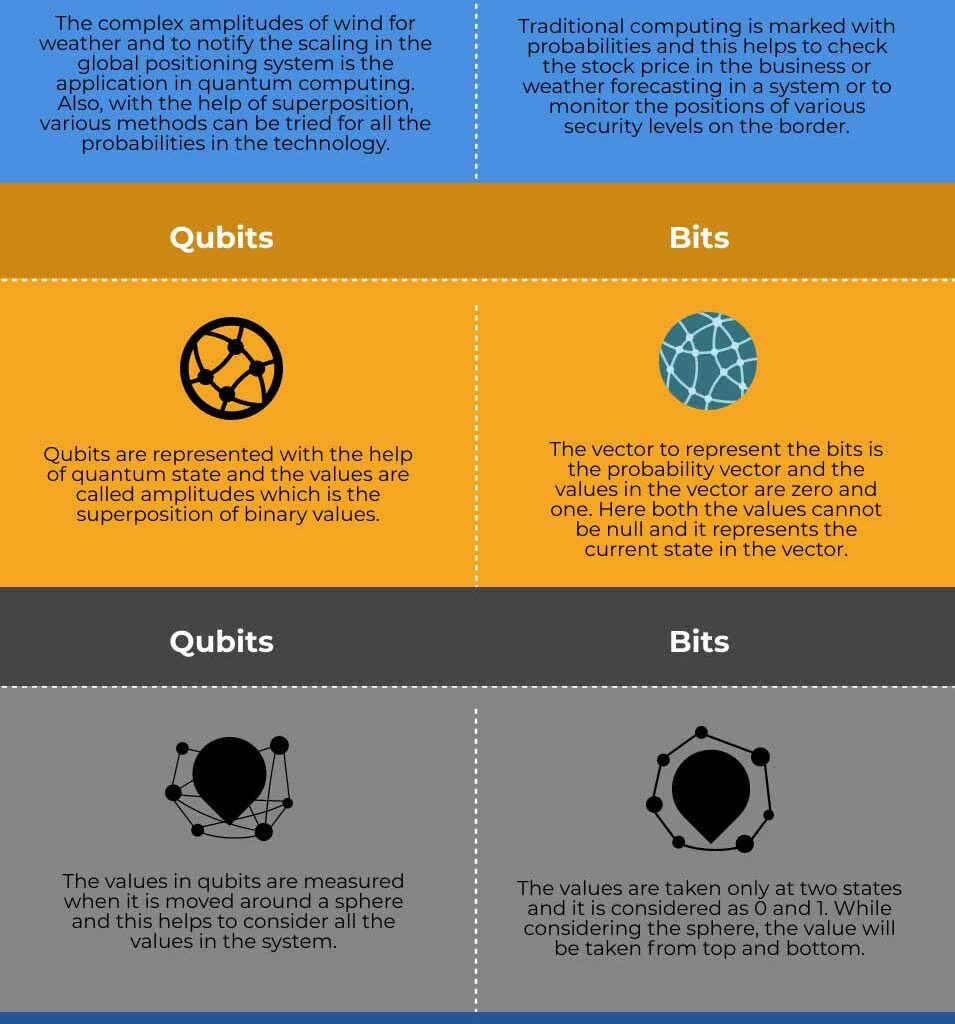
In computing, the fundamental units of information are classical bits and quantum bits, commonly known as qubits. These two forms represent distinct paradigms in information processing, each underpinning different computational frameworks. Classical bits form the foundation of traditional computing systems, while qubits are central to the emerging field of quantum computing, which promises to transcend the limitations of classical approaches.
- Classical Bits:
Represent binary states of either 0 or 1, with a definite value at any given time. - Qubits:
Quantum units that can exist simultaneously in multiple states (0, 1, or both) due to quantum superposition.
Fundamental Characteristics of Classical Bits
Classical bits are binary units that exist exclusively in one of two states: 0 or 1. This binary nature is the cornerstone of conventional computing, where bits are manipulated through electronic components such as transistors and logic gates. The information processed by classical bits scales linearly, which means that as the number of bits increases, the computational capacity grows proportionally. However, this linear scaling often encounters challenges when addressing complex problems or large datasets, limiting the efficiency of classical systems.
Quantum Mechanics Behind Qubits
Qubits operate based on the principles of quantum mechanics, which allow them to exist in superpositions of states. Unlike classical bits, a qubit can represent 0, 1, or any quantum combination of these states simultaneously. This property arises from the phenomenon known as quantum superposition, enabling qubits to encode a richer set of information. Upon measurement, a qubit collapses to a definite state of either 0 or 1, but before measurement, it embodies a spectrum of probabilities for these outcomes. This unique feature significantly enhances the computational potential of quantum systems by allowing parallel exploration of multiple possibilities.
Entanglement: A Quantum Phenomenon Enhancing Computation
Another pivotal quantum property is entanglement, where two or more qubits become interconnected such that the state of one instantly influences the state of another, regardless of the distance separating them. This non-local correlation enables entangled qubits to operate as a unified system, vastly improving the efficiency of information processing. Entanglement is instrumental in quantum algorithms that achieve exponential speedups for specific tasks, including integer factorization and database searching.
Physical Realizations of Bits and Qubits
The physical embodiment of classical bits and qubits differs significantly due to their distinct operational principles. Classical bits are implemented using well-established electronic components such as resistors, capacitors, and transistors, which form the hardware of everyday computers. In contrast, qubits require sophisticated physical systems to maintain their quantum properties. Common implementations include superconducting circuits, trapped ions, quantum dots, and topological qubits. Each approach presents unique technical challenges and advantages, reflecting ongoing research efforts to develop scalable and reliable quantum computing hardware.
Information Stability and Error Correction
Classical bits maintain their state reliably over time, assuming the system is stable and free from external interference. Qubits, however, are vulnerable to decoherence-a process where interaction with the environment causes the quantum state to degrade, resulting in information loss. This fragility necessitates advanced quantum error correction techniques and fault-tolerant designs to preserve qubit integrity. Developing robust qubit architectures is a critical hurdle in realizing practical quantum computers.
Computational Advantages of Qubits
Qubits offer remarkable computational benefits in certain algorithmic contexts, enabling tasks that are infeasible for classical computers. For instance, Grover’s algorithm leverages qubits to perform database searches in approximately the square root of the number of entries, a significant improvement over classical linear search methods. Similarly, Shor’s algorithm uses qubits to factor large integers efficiently, posing profound implications for cryptography and data security. These algorithms exemplify the transformative potential of quantum computing to solve complex problems more effectively than classical systems.
Ethical and Societal Considerations of Quantum Computing
As quantum computing technology advances, it raises important ethical and societal questions. The enhanced computational power enabled by qubits could impact privacy, security, and the responsible use of technology. The concept of quantum supremacy-where quantum computers outperform classical counterparts on specific tasks-underscores the need for careful governance and ethical frameworks to guide the development and deployment of quantum technologies. Balancing innovation with societal responsibility is essential as this field evolves.
Conclusion: The Future of Computation with Qubits
The contrast between classical bits and qubits highlights a profound shift in computational paradigms, ushering in an era defined by quantum mechanics. The unique properties of qubits-superposition, entanglement, and the necessity for novel error correction-illustrate the complexity and promise of quantum computing. Ongoing research continues to explore the vast potential of qubits, representing not only a scientific challenge but also a fundamental exploration of the universe’s underlying principles. This fusion of physics and computation signals a new chapter in technological innovation, filled with both opportunities and challenges that demand thoughtful investigation and stewardship.
FAQ
What is a classical bit?
A classical bit is the basic unit of information in traditional computing that can be either 0 or 1.
How does a qubit differ from a classical bit?
A qubit can exist in a superposition of states, representing 0, 1, or both at the same time, unlike a classical bit which is strictly 0 or 1.
What is quantum superposition?
Quantum superposition is the ability of a qubit to be in multiple states simultaneously until measured.
What is quantum entanglement?
Entanglement is a phenomenon where qubits become linked such that the state of one affects the state of another, regardless of distance.
Why is error correction important in quantum computing?
Because qubits are prone to decoherence and errors due to environmental interactions, error correction is necessary to maintain reliable quantum computations.






Leave a Reply