
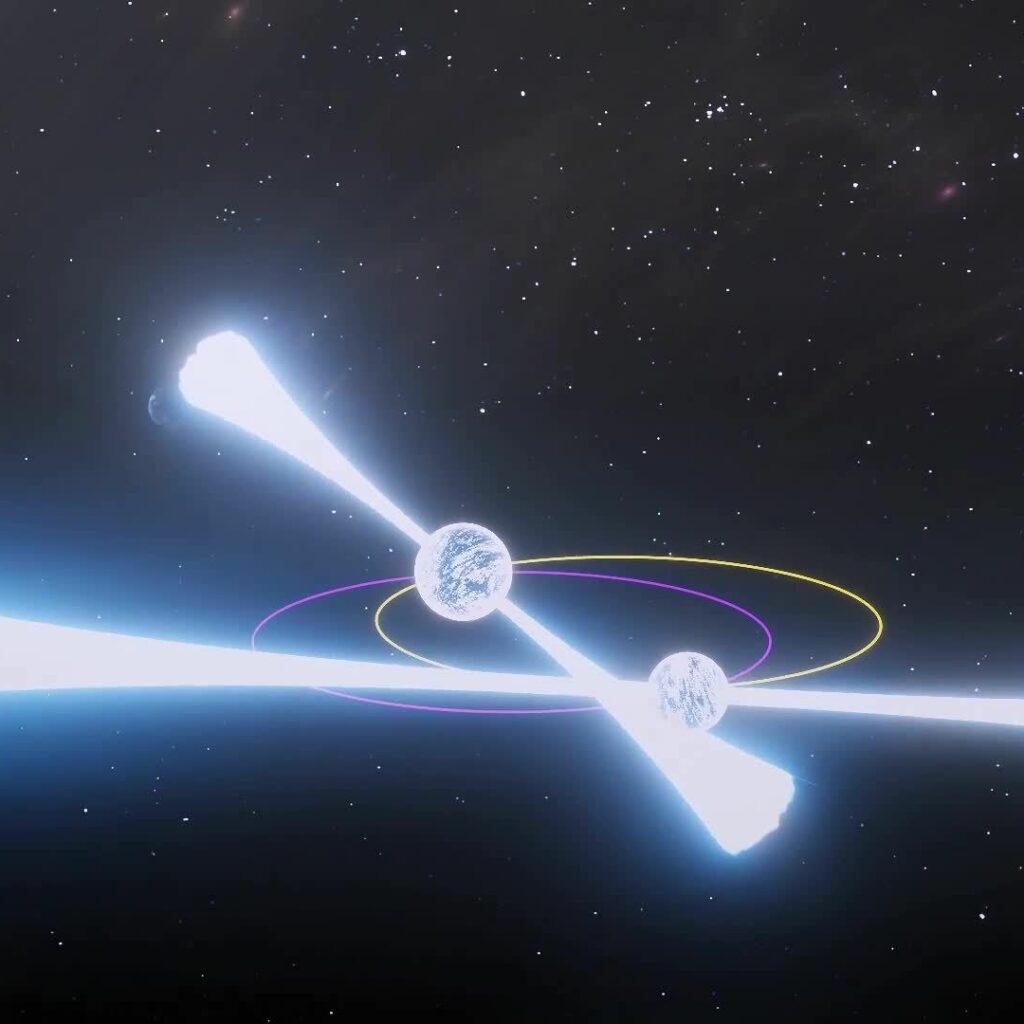
Short Answer
Definition of General Relativity
General Relativity is a groundbreaking theory formulated by Albert Einstein that revolutionized our understanding of gravity and the structure of the universe. Unlike classical Newtonian gravity, which views gravity as a force acting at a distance, General Relativity describes gravity as a consequence of the curvature of spacetime caused by mass and energy. This theory fundamentally altered how scientists perceive the interaction between matter and the fabric of the cosmos.
- Gravity as Geometry:
Gravity is not a force but the warping of spacetime geometry by mass and energy. - Spacetime Fabric:
The universe is a four-dimensional continuum where space and time are interwoven and influenced by matter.
Principles Behind General Relativity
At its core, General Relativity posits that mass and energy influence the shape of spacetime, causing it to curve. Objects moving within this curved spacetime follow paths called geodesics, which appear to us as gravitational attraction. This conceptual shift from force to geometry explains phenomena that classical physics could not, such as the bending of light near massive bodies.
Gravitational Lensing: A Key Phenomenon
One of the most striking manifestations of General Relativity is gravitational lensing, where light from distant celestial objects is deflected by the gravitational field of an intervening mass, such as a galaxy or galaxy cluster. This bending of light can produce multiple images, arcs, or even complete rings of the original source, providing a natural cosmic lens.
- Light Deflection:
Light rays curve as they pass near massive objects due to spacetime distortion. - Visual Effects:
The resulting images can appear magnified, duplicated, or distorted, revealing the presence and distribution of mass.
Recent Research on Galaxy Clusters and General Relativity
Recent astronomical investigations have focused on galaxy clusters located billions of light-years away to test the predictions of General Relativity. By analyzing the patterns of light bending around these massive structures, scientists have confirmed Einstein’s theory with remarkable accuracy. These observations demonstrate how light trajectories are influenced by the intense gravitational fields of galaxy clusters, validating the theoretical framework under extreme cosmic conditions.
Implications for Dark Matter Studies
Galaxy clusters not only serve as testbeds for General Relativity but also provide critical insights into the elusive nature of dark matter. Although dark matter cannot be observed directly, its gravitational effects on visible matter and light are measurable. The interplay between visible galaxies and dark matter within clusters creates complex gravitational fields that influence light paths, helping researchers map the distribution of both known and unknown mass components in the universe.
Philosophical and Scientific Significance
The confirmation of General Relativity’s predictions invites profound reflection on the nature of reality and our place within the cosmos. The idea that spacetime is a dynamic, malleable entity shaped by mass challenges traditional notions of a fixed, absolute universe. This paradigm encourages a deeper philosophical inquiry into existence, highlighting the intricate relationship between observation, theory, and the underlying fabric of reality.
Interdisciplinary Collaboration in Modern Cosmology
The study of General Relativity and its cosmic implications exemplifies the collaborative spirit of contemporary science. Astrophysics, mathematics, and cosmology converge to unravel the mysteries of the universe, demonstrating that progress arises from the integration of diverse scientific disciplines. This synergy enhances our ability to interpret complex phenomena and drives the continuous expansion of human knowledge.
Why General Relativity Remains Vital
The recent empirical validation of General Relativity through galaxy cluster observations underscores its enduring relevance in astrophysics. Far from being a historical milestone, Einstein’s theory remains a dynamic framework essential for understanding gravitational phenomena, guiding research in cosmology, and inspiring ongoing exploration of space and time. Its principles continue to illuminate the cosmic dance of mass and light, fueling humanity’s quest to comprehend the infinite universe.
FAQ
What is General Relativity?
General Relativity is a theory by Albert Einstein that describes gravity as the curvature of spacetime caused by mass and energy.
How does General Relativity relate to dark matter?
General Relativity helps explain the gravitational effects of dark matter through its impact on the paths of light in galaxy clusters.
What is gravitational lensing?
Gravitational lensing is the bending of light from distant objects due to the gravitational field of a massive body, confirming predictions of General Relativity.
Leave a Reply