
Short Answer
Definition of the Zeeman Effect and Its Fluid Dynamics Analogy
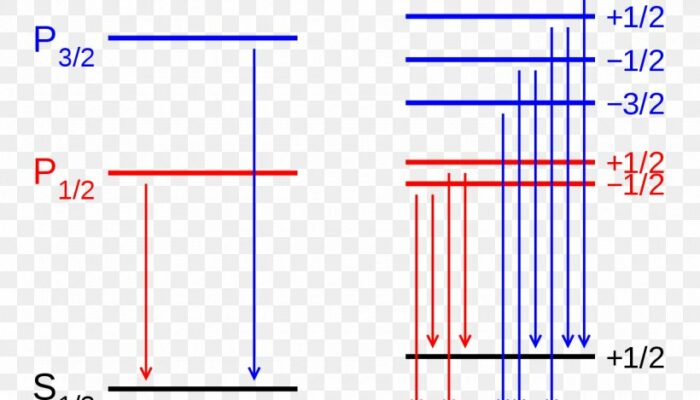
The Zeeman effect, first identified by Pieter Zeeman in 1896, refers to the splitting of atomic spectral lines when atoms are exposed to an external magnetic field. This phenomenon occurs because the magnetic field alters the energy levels of electrons, causing previously identical (degenerate) states to separate into distinct energy states. Interestingly, similar patterns of behavior can be observed in fluid dynamics, particularly in the way liquid droplets respond to external forces. This analogy bridges the microscopic quantum world and macroscopic fluid systems, revealing unexpected parallels between atomic physics and droplet behavior.
Fundamental Principles of the Zeeman Effect
- Energy Level Splitting:
The presence of a magnetic field modifies the electron energy states within an atom, causing spectral lines to split into multiple components. - Electron Transitions:
Electrons moving between these split energy levels emit or absorb photons at different frequencies, producing the characteristic spectral line patterns. - Magnetic Influence:
The strength and orientation of the magnetic field determine the degree and nature of the splitting.
Droplet Dynamics as a Macroscopic Parallel
Liquid droplets can be viewed as miniature systems where various forces-gravity, surface tension, and external perturbations-interact to shape their behavior. Much like electrons in an atom, droplets respond to environmental changes such as temperature, pressure, and applied fields, resulting in phenomena like oscillation, coalescence, and fragmentation. This dynamic interplay creates a rich platform for drawing analogies to quantum mechanical effects.
Forces Governing Droplet Behavior
- Surface Tension:
Acts to minimize the droplet’s surface area, influencing its shape and stability. - Gravity:
Affects droplet deformation and interaction with surfaces. - External Fields:
Electric or magnetic fields can induce droplet deformation and alter interaction dynamics.
Cluster Interactions and Energy State Analogies
When droplets aggregate, their collective behavior can be likened to the formation of new energy states in atoms under magnetic influence. The merging of droplets results in larger entities whose properties differ from individual droplets, mirroring how electron states split and combine in the Zeeman effect. These interactions can produce complex patterns and behaviors that resemble quantum phenomena, such as spectral line splitting.
Resonance and Oscillation in Droplet Systems
Droplets exhibit resonant frequencies during collisions or oscillations, analogous to the discrete energy levels in quantum systems. These resonances lead to predictable and repeatable behaviors, such as droplet fission-where a droplet divides into smaller droplets-paralleling the quantum leaps electrons make between energy states when influenced by magnetic fields.
Impact of External Electric Fields on Droplet Morphology
Applying an electric field to droplets causes deformation and alignment according to the field gradient. This effect is comparable to the Zeeman effect’s modification of atomic energy states by external magnetic fields. Changes in droplet shape and stability under electric fields have practical significance in various scientific and technological domains, including materials science and biotechnology.
Emergent Phenomena in Droplet Assemblies
Just as collective quantum behaviors give rise to macroscopic quantum states like Bose-Einstein condensates, groups of interacting droplets can display emergent properties. These include organized oscillations, intricate dynamic patterns, and altered material characteristics when subjected to external stimuli. Such emergent behaviors highlight the complex interplay between individual droplet dynamics and collective system properties.
Applications in Soft Matter Physics and Material Science
Insights gained from studying droplet dynamics enrich the understanding of complex fluids and soft matter physics. By harnessing quantum-like behaviors in droplets, researchers can innovate in designing materials with customized properties based on microstructural arrangements. This knowledge has broad applications, from improving emulsions in food technology to optimizing drug delivery systems in pharmaceuticals.
Challenges and Advances in Experimental Observation
Fully elucidating the connections between droplet behavior and quantum phenomena requires precise experimental techniques. Advances in high-speed imaging and computational modeling have significantly enhanced the ability to observe and analyze droplet interactions in real time. These tools enable researchers to capture subtle dynamics and validate theoretical analogies between fluid mechanics and quantum physics.
Significance of the Droplet-Quantum Analogy
The comparison between droplet dynamics and the Zeeman effect underscores the profound interconnectedness of physical phenomena across scales. By exploring these analogies, scientists gain a deeper appreciation of how classical and quantum systems can reflect similar underlying principles. This interdisciplinary perspective fosters novel approaches to understanding the fundamental nature of matter and energy, expanding the horizons of both physics and applied sciences.
FAQ
What is the Zeeman effect?
The Zeeman effect is the splitting of atomic spectral lines due to the influence of an external magnetic field on electron energy levels.
How do droplets mimic the Zeeman effect?
Droplets exhibit behavior similar to atomic electrons, responding to external forces and showing patterns akin to energy state transitions.
What are the implications of this analogy?
Understanding droplet dynamics through the lens of quantum mechanics can lead to innovations in material design and applications in various scientific fields.






Leave a Reply