

Short Answer
Definition of Light Speed in Different Media
Light is an electromagnetic wave that travels at an extraordinary speed in a vacuum, approximately 299,792 kilometers per second (186,282 miles per second). This speed is considered a fundamental constant in physics, often referred to as the ultimate speed limit of the universe. However, when light passes through various substances, such as crystals or other transparent materials, its velocity changes due to interactions with the medium.
- Speed in Vacuum:
The maximum speed at which light propagates, unaffected by any material. - Speed in Medium:
The reduced velocity of light as it travels through materials like glass, water, or diamond.
Refractive Index and Its Role
The concept that explains the change in light speed within materials is the refractive index. This dimensionless number quantifies how much a medium slows down light compared to its speed in a vacuum. Mathematically, the refractive index (n) is expressed as:
n = c / v
- c: Speed of light in vacuum
- v: Speed of light in the medium
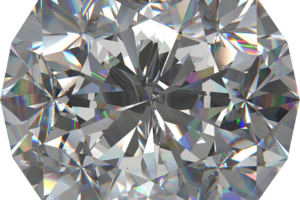
For example, diamond has a refractive index of about 2.42, meaning light travels 2.42 times slower in diamond than in a vacuum. This high refractive index is responsible for diamond’s characteristic brilliance and optical properties.
Interaction Between Light and Atomic Structure
When light enters a medium like diamond, it does not simply slow down in a straightforward manner. Instead, the electromagnetic waves interact with the atoms within the material. Diamond’s crystal lattice is composed of tightly bonded carbon atoms. The electric field of the incoming light wave causes electrons in these atoms to oscillate, which in turn generates secondary electromagnetic waves.
This process results in a cumulative delay, as the original light wave is effectively re-emitted multiple times by the atoms. Although individual photons maintain their intrinsic speed between interactions, the overall propagation of the light wave through the medium is slower due to these repeated absorptions and re-emissions.
Wave-Particle Duality and Light Propagation
Light exhibits a dual nature, behaving both as a wave and as discrete particles called photons. This duality complicates the understanding of how light moves through materials. Classical physics models light as a continuous wave governed by Maxwell’s equations, which describe how electromagnetic waves propagate and interact with matter.
On the quantum level, photons interact with the electronic structure of the medium, leading to phenomena such as absorption, scattering, and re-emission. These quantum interactions contribute to the effective reduction in the speed of light within the material, highlighting the complex interplay between wave and particle characteristics.
Experimental Evidence of Light Speed Reduction in Diamond
Scientific experiments have consistently demonstrated that light takes longer to traverse a diamond than the same distance in a vacuum. By precisely measuring the transit time of light pulses through diamond samples, researchers confirm that the effective speed is reduced in accordance with the material’s refractive index.
These findings not only validate theoretical predictions but also deepen our understanding of light-matter interactions. Such experiments have paved the way for innovations in optics and photonics, influencing technologies like lasers, fiber optics, and high-resolution imaging.
Optical Applications of Diamond
Diamond’s exceptional optical properties, including its high refractive index and transparency, make it invaluable in various technological fields. It is widely used in precision instruments such as microscopes and laser systems, where controlling and manipulating light is essential.
Additionally, diamond exhibits non-linear optical effects, enabling it to alter the frequency and phase of light waves. This capability is exploited in advanced photonic devices, including frequency converters and optical circuits, which are critical components in telecommunications and medical diagnostics.
Common Misconceptions About Light Speed in Media
Photons slow down inside a medium.
Individual photons always travel at the speed of light in a vacuum between interactions; the apparent slowdown is due to absorption and re-emission processes within the material.
Light speed reduction means energy loss.
The energy of photons remains constant; the delay is caused by interactions with the medium’s atoms, not by energy dissipation.
Significance of Understanding Light Speed Variations
Grasping how and why light slows down in materials like diamond is crucial for both fundamental physics and practical applications. It enriches our comprehension of electromagnetic theory, quantum mechanics, and material science. Moreover, this knowledge underpins the development of cutting-edge technologies in communication, imaging, and quantum computing.
By studying light’s behavior in different media, scientists continue to unlock new possibilities for manipulating light, leading to innovations that impact everyday life and expand the horizons of scientific exploration.
FAQ
Does light actually slow down inside a diamond?
While photons always travel at the speed of light in vacuum, the effective speed of the light wave reduces inside diamond due to interactions with its atomic structure.
What causes light to slow down in materials like diamond?
Light interacts with electrons in the material's atoms, causing oscillations and secondary wave emissions that delay the overall wave propagation.
What is the refractive index and how does it relate to light speed?
The refractive index is the ratio of light speed in vacuum to that in a medium; a higher refractive index means slower effective light speed in the material.
How do experiments confirm light slows in diamond?
By measuring transit time of light through diamond versus vacuum, experiments show longer travel times in diamond, confirming slower effective speed.
What practical uses do diamond's optical properties have?
Diamond is used in precision optics such as microscopes, lasers, and photonic devices due to its high refractive index and nonlinear optical effects.



Leave a Reply