
Short Answer
Definition of Dark Matter and Its Mass
Dark matter is a mysterious and invisible substance that permeates the universe, profoundly influencing the structure and dynamics of galaxies and the cosmic web. Unlike ordinary matter, it does not emit, absorb, or reflect light, making it undetectable through conventional electromagnetic observations. The central question in astrophysics is whether dark matter possesses mass and exerts gravitational forces, given that gravity is intrinsically linked to mass in classical physics.
- Mass:
Traditionally, mass refers to the amount of matter contained in an object, representing both its resistance to acceleration (inertial mass) and its ability to generate gravitational attraction (gravitational mass). - Dark Matter:
An unseen form of matter inferred from gravitational effects on visible matter, radiation, and the large-scale structure of the universe.
Evidence Supporting Dark Matter’s Mass
Multiple astrophysical observations strongly suggest that dark matter has mass, primarily through its gravitational influence on visible matter and light.
- Galactic Rotation Curves:
Stars in the outer regions of galaxies orbit at unexpectedly high speeds that cannot be explained solely by the gravitational pull of visible matter. This discrepancy implies the presence of a substantial amount of unseen mass holding galaxies together. - Gravitational Lensing:
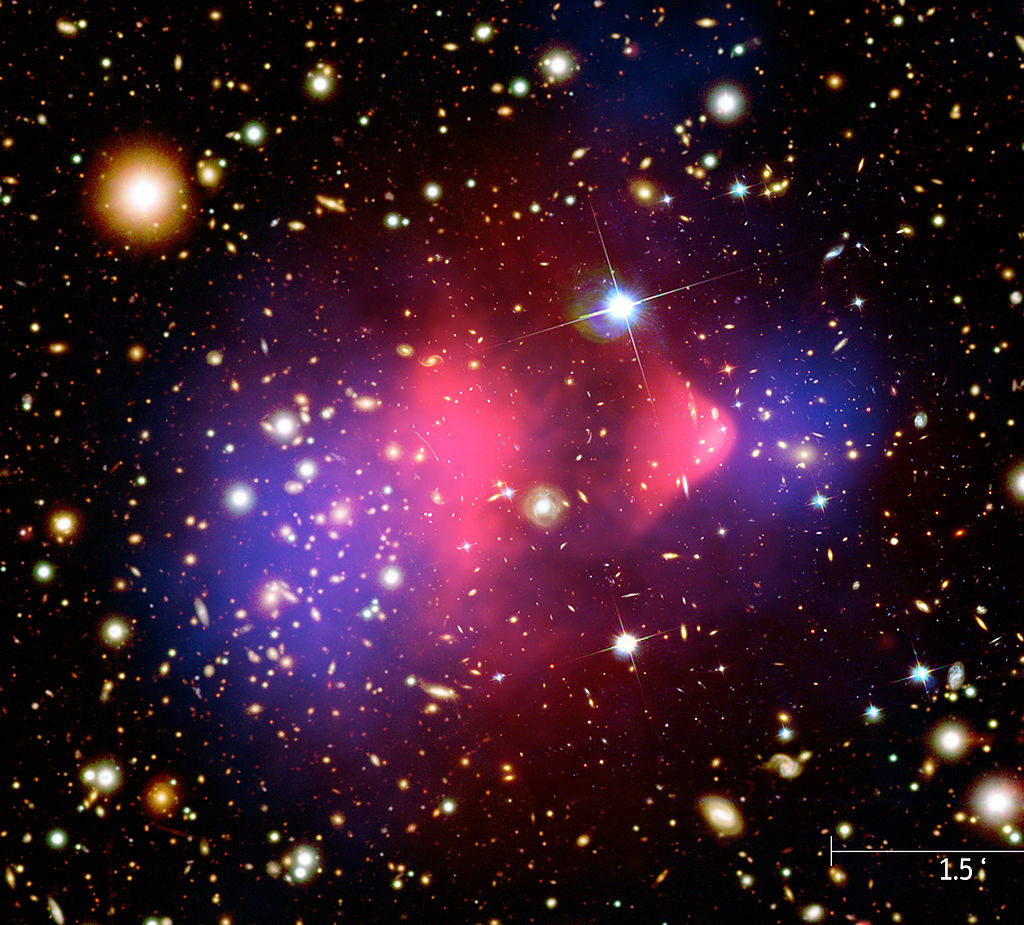
Massive objects bend and distort light from background sources, a phenomenon predicted by general relativity. Observations of galaxy clusters reveal lensing effects far greater than what visible matter alone can produce, indicating additional mass in the form of dark matter.
Physical Principles Linking Mass and Gravity
The relationship between mass and gravity is foundational in physics, governed by the equivalence principle, which states that gravitational mass and inertial mass are indistinguishable. Therefore, any entity that exerts gravitational force must inherently possess mass, even if it differs fundamentally from ordinary baryonic matter.
- Equivalence Principle:
The principle that gravitational and inertial masses are equivalent, ensuring that gravity acts uniformly on all forms of mass. - Exotic Nature of Dark Matter:
Unlike atoms and molecules, dark matter is hypothesized to be composed of particles that interact very weakly with electromagnetic radiation, making it invisible but still massive.
Leading Candidates for Dark Matter Particles
Scientists have proposed several hypothetical particles to explain dark matter’s properties, all of which would have mass and generate gravitational effects while remaining elusive to direct detection.
- Weakly Interacting Massive Particles (WIMPs):
Hypothetical particles that interact via the weak nuclear force and gravity but not electromagnetically. - Axions:
Ultra-light particles proposed to solve certain problems in quantum chromodynamics, potentially constituting dark matter. - Sterile Neutrinos:
Hypothetical neutrinos that do not interact via the standard weak force, making them difficult to detect.
Alternative Theories: Modified Gravity
Some theoretical frameworks challenge the necessity of dark matter by proposing modifications to the laws of gravity at galactic or cosmological scales. These models attempt to explain observed gravitational phenomena without invoking unseen mass.
- Modified Newtonian Dynamics (MOND):
Suggests that Newton’s laws change behavior at very low accelerations, potentially accounting for galaxy rotation curves without dark matter. - Extensions to General Relativity:
Propose alterations to Einstein’s theory to explain gravitational anomalies without additional mass.
Despite these alternatives, the gravitational effects that prompt these theories remain undeniable, underscoring gravity’s critical role in cosmic structure.
Philosophical and Scientific Significance
The inquiry into whether dark matter has mass transcends pure science, touching on profound questions about the nature of reality and the limits of human knowledge. Dark matter’s invisible presence shapes the universe’s destiny and challenges our understanding of the cosmos.
- Cosmic Dialogue:
Gravity acts as a messenger, revealing the hidden mass through the motion of galaxies and the bending of light. - Human Curiosity:
The quest to detect and understand dark matter drives technological innovation and deepens philosophical reflections on existence.
Methods of Detecting Dark Matter
Efforts to uncover the nature of dark matter involve a variety of experimental and observational techniques designed to detect its subtle interactions or gravitational signatures.
- Direct Detection Experiments:
Underground laboratories aim to observe rare collisions between dark matter particles and atomic nuclei. - Astrophysical Observations:
Telescopes and observatories monitor gravitational lensing, galaxy dynamics, and cosmic microwave background fluctuations. - Particle Accelerators:
High-energy collisions attempt to produce dark matter candidates under controlled conditions.
Summary: The Role of Mass in Dark Matter’s Gravitational Influence
In summary, the gravitational effects attributed to dark matter strongly imply that it possesses mass, albeit of a non-baryonic and exotic nature. This mass is not directly observed but inferred through its impact on cosmic structures and light propagation. While alternative theories propose modifications to gravity itself, the prevailing consensus supports the existence of a massive, invisible component essential for explaining the universe’s large-scale architecture. Understanding dark matter’s mass and properties remains a central challenge in astrophysics, promising to unlock deeper insights into the fundamental workings of the cosmos.
FAQ
What is dark matter?
Dark matter is a mysterious substance that does not emit, absorb, or reflect light, making it undetectable by conventional means, yet it influences the structure of the universe through its gravitational effects.
Does dark matter have mass?
Yes, dark matter is believed to have mass, inferred from its gravitational influence on visible matter and light.
What are the main candidates for dark matter particles?
Leading candidates include Weakly Interacting Massive Particles (WIMPs), axions, and sterile neutrinos.
What are alternative theories to dark matter?
Some theories propose modifications to gravity, such as Modified Newtonian Dynamics (MOND), to explain galactic phenomena without invoking dark matter.

Leave a Reply