
Short Answer
Definition of Dark Energy
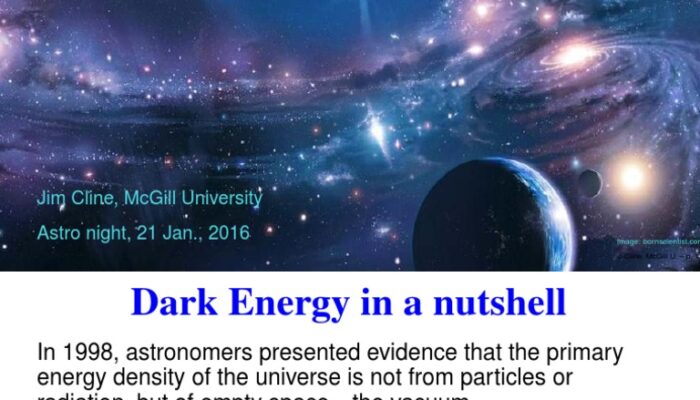
Dark energy is a mysterious and invisible force that permeates the universe, playing a pivotal role in its accelerated expansion. Despite being a central concept in modern cosmology, its true nature remains largely unknown. It is estimated to constitute about 68% of the total energy content of the cosmos, vastly outweighing ordinary matter, which accounts for only around 5%. Dark energy is the term used to describe the unknown cause behind the observed acceleration in the universe’s expansion rate.
Historical Discovery and Significance
The concept of dark energy emerged in the late 1990s when astronomers studying distant Type Ia supernovae made a groundbreaking observation: instead of slowing down due to gravitational forces, the universe’s expansion was speeding up. This unexpected finding challenged previous assumptions and required the introduction of a new component in cosmological models to explain the acceleration. Dark energy thus became a fundamental element in understanding the large-scale dynamics and ultimate fate of the universe.
Theoretical Perspectives on Dark Energy
The Cosmological Constant
One of the most widely accepted explanations for dark energy is the cosmological constant, originally proposed by Albert Einstein. This concept envisions dark energy as a constant energy density uniformly filling space and remaining unchanged over time. If accurate, this would imply that dark energy is an intrinsic property of spacetime itself. However, this theory faces a significant challenge known as the “cosmological constant problem,” where quantum field theory predicts a vacuum energy density vastly larger-by many orders of magnitude-than what is observed. This discrepancy highlights a fundamental gap in our understanding of the relationship between quantum mechanics and gravity.
Dynamic Dark Energy Models
Alternative hypotheses suggest that dark energy might not be constant but rather a dynamic field that evolves over time and varies across space. These models, often referred to as quintessence, propose that the acceleration of the universe could be a temporary phase driven by a slowly changing scalar field. Such theories imply a more complex cosmic evolution and open the door to new physics beyond the standard cosmological model.
Modifications to Gravity
Another avenue of research explores the possibility that the observed acceleration arises not from a new form of energy but from modifications to the laws of gravity themselves. These theories attempt to adjust or extend Einstein’s general relativity to account for cosmic acceleration without invoking dark energy as a separate entity. This approach challenges foundational principles and requires rigorous testing through observations.
Observational Efforts and Experimental Advances
To unravel the enigma of dark energy, astronomers and physicists have launched several ambitious observational programs. Projects such as the Dark Energy Survey, the Euclid mission, and the Nancy Grace Roman Space Telescope are designed to map the universe’s expansion history with unprecedented precision. By analyzing the distribution of galaxies, the cosmic microwave background, and other cosmological signals, these missions aim to constrain the properties of dark energy and distinguish between competing theoretical models.
Challenges in Understanding Dark Energy
Despite significant progress in measuring the effects of dark energy, its fundamental nature remains elusive. The primary difficulty lies in its invisibility-it neither emits nor absorbs light, making it detectable only through its gravitational influence on cosmic structures. Additionally, the theoretical complexities and observational limitations create a barrier to fully comprehending this phenomenon. This ongoing mystery underscores the limits of current scientific knowledge and the need for innovative approaches.
Why Dark Energy Is Crucial
Dark energy is not just a theoretical curiosity; it is essential for explaining the large-scale behavior of the universe. Its presence affects the formation and evolution of cosmic structures, influences the ultimate fate of the cosmos, and challenges our understanding of fundamental physics. Studying dark energy pushes the boundaries of science, potentially leading to revolutionary insights that could unify quantum mechanics and gravity and reshape our conception of reality.
Common Misconceptions About Dark Energy
Dark energy is the same as dark matter.
Dark energy and dark matter are distinct; dark matter exerts gravitational attraction and helps form structures, while dark energy drives the accelerated expansion of the universe.
Dark energy is well understood because we can measure its effects.
Although its influence is measurable, the fundamental nature of dark energy remains unknown, and current models are largely speculative.
The cosmological constant fully explains dark energy.
While the cosmological constant is a leading candidate, it faces significant theoretical challenges, and alternative models continue to be explored.
Future Prospects and the Quest for Understanding
The pursuit of knowledge about dark energy is ongoing and dynamic. As observational technologies improve and theoretical frameworks evolve, scientists hope to uncover deeper insights into this cosmic mystery. The resolution of dark energy’s nature could herald a new era in physics, bridging gaps between quantum theory and cosmology and enhancing our comprehension of the universe’s origin, structure, and destiny.
FAQ
What is dark energy?
Dark energy is a mysterious force that permeates the universe and is responsible for its accelerated expansion.
How does dark energy differ from dark matter?
Dark energy drives the accelerated expansion of the universe, while dark matter exerts gravitational attraction and helps form cosmic structures.
What are the main theories about dark energy?
The main theories include the cosmological constant, dynamic dark energy models, and modifications to gravity.
Leave a Reply