
Short Answer
Definition of the Higgs Boson
The Higgs boson is a fundamental particle associated with the Higgs field, an energy field that permeates all space. It plays a crucial role in the Standard Model of particle physics by explaining how particles acquire mass. Without the Higgs field and its corresponding boson, many elementary particles would remain massless, traveling at the speed of light like photons.
- Higgs Field:
A pervasive quantum field responsible for imparting mass to particles through their interaction with it. - Higgs Boson:
The quantum excitation or particle manifestation of the Higgs field, detected as a massive boson.
Historical Background and Theoretical Foundations
The concept of the Higgs boson emerged in the 1960s through the pioneering work of physicist Peter Higgs and others who proposed the existence of a field that endows particles with mass. This theoretical framework addressed one of the most profound questions in physics: the origin of mass. The Higgs mechanism elegantly resolved inconsistencies in the Standard Model by introducing a scalar field whose nonzero vacuum expectation value breaks electroweak symmetry, thereby giving mass to W and Z bosons and other particles.
Discovery at CERN and Experimental Verification
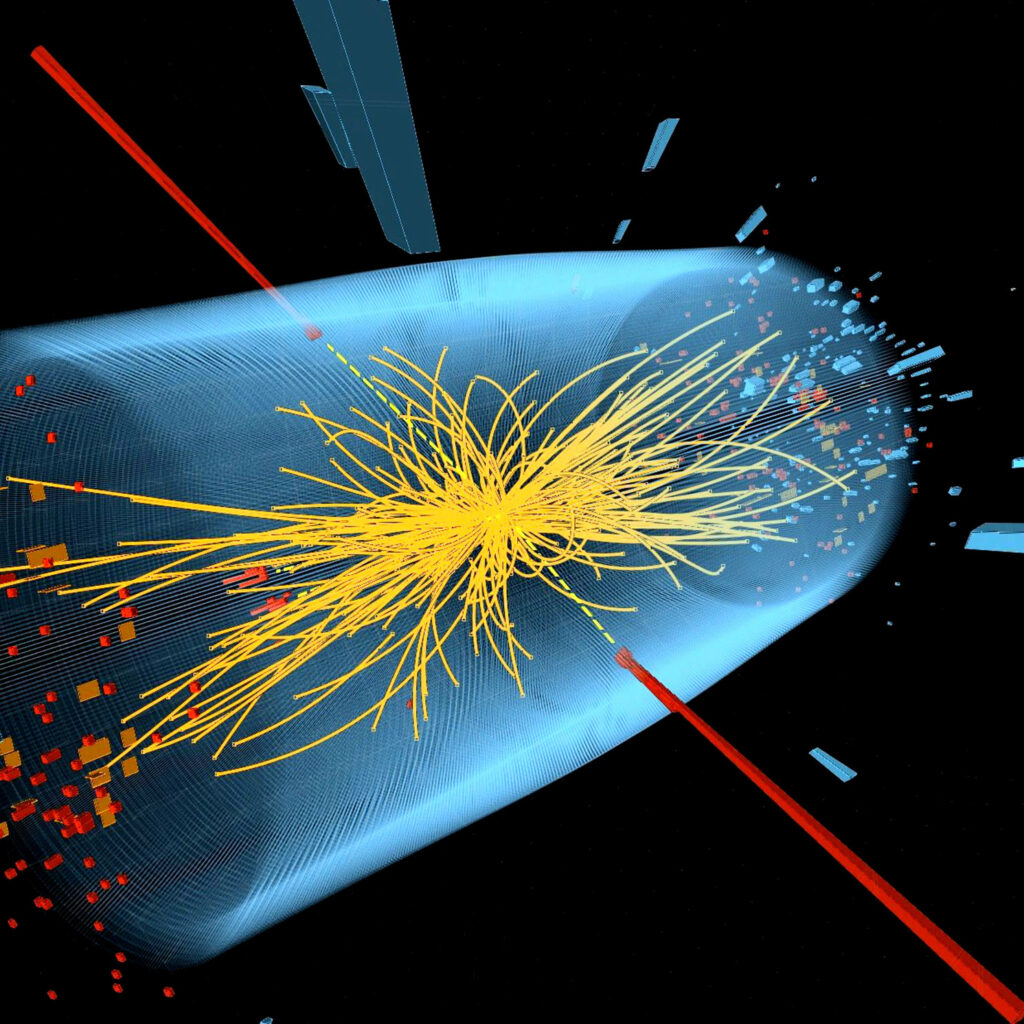
In July 2012, the Large Hadron Collider (LHC) at CERN announced the observation of a new particle with a mass near 125 giga-electronvolts (GeV). This particle exhibited properties consistent with those predicted for the Higgs boson. Two major experiments, ATLAS and CMS, independently confirmed signals corresponding to the particle’s decay patterns and interaction strengths, lending strong support to its identification as the Higgs boson.
- Mass Measurement:
Approximately 125 GeV, aligning with theoretical predictions. - Decay Channels:
Observed decay modes matched expected signatures for the Higgs boson. - Coupling Constants:
Interaction strengths with other particles were measured to test conformity with the Standard Model.
Scientific Skepticism and Open Questions
Despite the excitement surrounding the discovery, the scientific community remains cautious. Some observed properties of the particle differ slightly from Standard Model expectations, prompting questions about whether this is the sole Higgs boson or part of a more complex spectrum of Higgs-like particles. These discrepancies fuel ongoing research into physics beyond the Standard Model, including theories that predict multiple Higgs bosons or exotic interactions.
Philosophical and Conceptual Implications
The identification of the Higgs boson carries profound philosophical significance. It challenges and enriches our understanding of reality by revealing the mechanism behind mass, a fundamental property that shapes the universe. This discovery bridges the microscopic quantum world with the macroscopic cosmos, inviting reflection on the nature of existence and the limits of human knowledge.
Impact on Cosmology and Dark Matter Research
The Higgs boson’s discovery extends beyond particle physics, influencing cosmological models and the study of dark matter and dark energy. Understanding how mass arises may provide insights into the mysterious components of the universe that do not emit light but exert gravitational effects. Some hypotheses suggest that Higgs-like particles could interact with dark matter through unknown forces, opening new avenues for exploration.
Advancements in Experimental Techniques and Collaboration
Ongoing investigations into the Higgs boson’s properties demand continual improvements in experimental apparatus and data analysis methods. Enhanced detection technologies and refined measurement techniques are essential to unravel the particle’s full characteristics. International collaboration among physicists and institutions plays a vital role in pooling expertise and resources to advance this frontier of knowledge.
Scientific Progress and the Evolution of Theories
The journey to discovering the Higgs boson exemplifies the dynamic nature of scientific progress. Physics has historically undergone cycles of theory formulation, validation, and revision. Each breakthrough, including the Higgs boson, reflects a moment in this evolving narrative, reminding scientists to balance confidence in established models with openness to new evidence and ideas.
Communicating Complex Science to the Public
The discovery of the Higgs boson captivated audiences worldwide, from experts to laypersons. Effectively conveying such intricate scientific concepts remains a challenge, necessitating clear and accurate communication to prevent misconceptions. Bridging the gap between technical detail and public understanding fosters informed dialogue and appreciation of fundamental research.
Conclusion: The Continuing Quest for Understanding
The detection of a Higgs-like boson marks a monumental achievement in physics but also serves as a catalyst for further inquiry. Scientists continue to probe whether this particle fully aligns with the Standard Model or hints at deeper layers of reality. Each new finding invites us to delve deeper into the quantum fabric of the universe, seeking the fundamental truths that govern existence.
FAQ
What is the Higgs boson?
The Higgs boson is a fundamental particle associated with the Higgs field, which gives mass to other particles.
How was the Higgs boson discovered?
It was discovered through particle collisions at CERN's Large Hadron Collider by the ATLAS and CMS experiments in 2012.
Why is the Higgs boson important for physics?
It validates the Standard Model's explanation for how particles gain mass and helps address fundamental questions about the universe.
Are there uncertainties about the Higgs boson?
Yes, some properties differ slightly from theoretical predictions, and research continues to explore whether more Higgs-like particles exist.






Leave a Reply