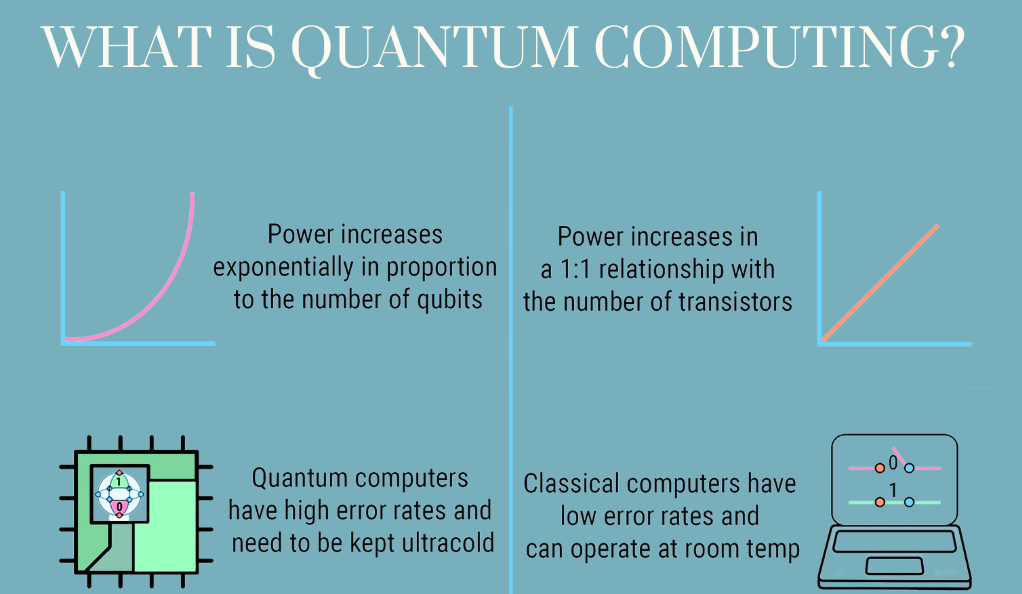
What is a quantum computer? Can anybody describe it?

Understanding Quantum Computing Quantum computing represents a revolutionary shift in the way information is processed, diverging fundamentally from classical computing paradigms. While traditional computers operate using bits that exist strictly as either 0 or 1, quantum computers utilize quantum bits, or qubits, which can simultaneously embody multiple states. This capability arises from the principles of […]

Read More →

Do quantum computers use silicon?

Definition of Quantum Computing and Silicon’s Role Quantum computing represents a revolutionary approach to information processing, harnessing the unique principles of quantum mechanics. Unlike classical computing, which relies on bits existing strictly as 0s or 1s, quantum computing uses quantum bits, or qubits, that can simultaneously occupy multiple states through superposition. This capability enables quantum […]

Read More →

Is all of chemistry computable?

Understanding Computability in Chemistry Chemistry, often regarded as the central science, investigates the complex interactions and behaviors of atoms and molecules. A fundamental question arises within this field: Is every aspect of chemistry amenable to computational analysis? Addressing this inquiry requires examining the theoretical underpinnings, practical implementations, inherent limitations, and emerging computational techniques that shape […]

Read More →

What is the source of the power of quantum computers?

Understanding Quantum Computing Quantum computing represents a groundbreaking advancement in technology and computation, poised to transform numerous disciplines such as cryptography, pharmaceuticals, and materials science. Its extraordinary capabilities arise from the principles of quantum mechanics, which govern the behavior of particles at the smallest scales. To grasp the source of quantum computers’ power, one must […]

Read More →

How much does a 1 million qubit quantum computer cost?

Understanding Quantum Computing Quantum computing represents a groundbreaking advancement in technology, captivating researchers, engineers, and investors worldwide. Unlike traditional computers that use bits as the smallest unit of data, quantum computers utilize quantum bits or qubits. These qubits can exist simultaneously in multiple states due to the principle of superposition, enabling quantum machines to process […]

Read More →

What will be the scope of computer science after 20 years?

Definition and Scope of Future Computer Science Computer science, as a discipline, is set to undergo significant transformation over the next twenty years. This evolution will be driven by the interplay of technological breakthroughs, societal shifts, and economic demands. The field’s future scope encompasses innovation, ethical responsibility, and cross-disciplinary collaboration, all of which are essential […]

Read More →

What is quantum computing more about?

Definition of Quantum Computing Quantum computing represents a groundbreaking advancement in computational technology, merging principles from quantum physics with computer science to create a new paradigm of processing information. Unlike classical computers that rely on binary bits (0s and 1s), quantum computers utilize quantum bits, or qubits, which can exist in multiple states simultaneously. This […]

Read More →

Has Amazon achieved a quantum computer?

Understanding Quantum Computing Quantum computing represents a revolutionary paradigm in the field of computation, diverging fundamentally from classical computing methods. Instead of relying on traditional bits that exist in a state of either 0 or 1, quantum computers operate using quantum bits, or qubits. These qubits possess the unique ability to exist simultaneously in multiple […]

Read More →

Will quantum computing ever be available to consumers?

Definition of Quantum Computing Quantum computing represents a cutting-edge computational approach that harnesses the principles of quantum mechanics to process information. Unlike traditional computers that use bits as the smallest unit of data, quantum computers utilize quantum bits or qubits, which can exist simultaneously in multiple states due to superposition. This unique property enables quantum […]

Read More →

Chaos and the Arms Race: When Disorder Fuels Destruction

Understanding Chaos in International Arms Races In the sphere of global diplomacy, chaos often appears as the antithesis of the structured negotiations and treaties that govern state interactions. However, within the intense competition of arms races, chaos emerges as a significant and sometimes dangerous factor. Exploring how disorder can drive destructive outcomes is crucial. This […]

Read More →