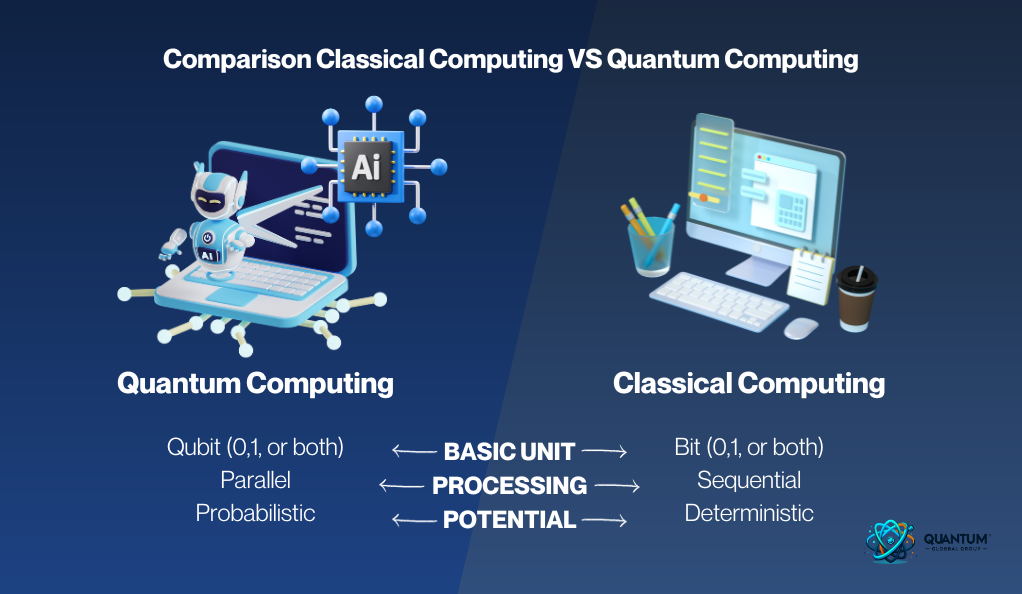
What does AI + quantum computer + 3D printer add up to?

Definition and Overview of Emerging Technologies The convergence of artificial intelligence (AI), quantum computing, and 3D printing represents a groundbreaking fusion of distinct scientific advancements. Each technology has independently transformed its respective field, but their integration heralds a new era of innovation that challenges existing norms in manufacturing, creativity, and even philosophical perspectives on human […]

Read More →

What is a more practical alternative to quantum computing?

Understanding Practical Alternatives to Quantum Computing Quantum computing has captured global attention as a groundbreaking innovation poised to transform computational power. Despite its promising theoretical potential, the practical implementation of quantum computers remains challenging. This has led researchers and industry experts to explore more accessible and immediately applicable alternatives. This article examines several viable computing […]

Read More →

How can deep learning be applied to quantum computing?

Overview of Deep Learning and Quantum Computing The convergence of deep learning and quantum computing represents a cutting-edge fusion of two transformative technological fields. Deep learning, a branch of artificial intelligence focused on neural networks that identify complex patterns, is increasingly being explored as a tool to overcome the inherent difficulties in quantum computing. This […]

Read More →

What’s now the cutting edge of quantum computing?

Definition of Quantum Computing Quantum computing is an advanced computational paradigm that leverages the principles of quantum mechanics to surpass the capabilities of traditional classical computers. By utilizing quantum phenomena such as superposition and entanglement, quantum computers can process information in fundamentally new ways, enabling them to solve certain problems more efficiently than classical systems. […]

Read More →

What is the learning outcome about quantum?

Definition of Quantum Mechanics Quantum mechanics is a fundamental branch of physics that explains the behavior of matter and energy at atomic and subatomic scales. Unlike classical physics, which describes the macroscopic world with deterministic laws, quantum mechanics reveals a probabilistic and often counterintuitive nature of particles and waves. This theory forms the foundation for […]

Read More →

Meet Harsh Pratap Rana: Unleashing the Power of Qubits

Introduction to Harsh Pratap Rana and Quantum Computing In the dynamic fields of modern physics and computational science, Harsh Pratap Rana has emerged as a prominent figure, bridging theoretical insights with practical innovations. His pioneering work in quantum computing leverages the unique properties of qubits to challenge and expand traditional computational frameworks. This article explores […]

Read More →

What are the main goals of quantum cryptography?

Definition of Quantum Cryptography Quantum cryptography represents a groundbreaking field that merges the principles of quantum mechanics with the science of information security. It aims to redefine traditional cryptographic methods by leveraging the unique properties of quantum physics to ensure communication that is fundamentally secure against eavesdropping and unauthorized access. Core Objectives of Quantum Cryptography […]

Read More →

What role will quantum computing play in the future of AI?

Definition of Quantum Computing in Artificial Intelligence Quantum computing represents a groundbreaking advancement in computational technology, leveraging the principles of quantum mechanics to process information in fundamentally new ways. When integrated with artificial intelligence (AI), quantum computing promises to revolutionize AI capabilities by enabling faster data processing, enhanced algorithmic efficiency, and novel problem-solving approaches. This […]

Read More →

How do Photons have Magnetic and Electric Fields?

Definition of Photons and Their Electromagnetic Nature Photons are the elementary particles that constitute light and other forms of electromagnetic radiation. They are unique in that they simultaneously exhibit properties of both particles and waves, a concept known as wave-particle duality. Central to their nature is the presence of oscillating electric and magnetic fields, which […]

Read More →