
Short Answer
Definition of Radioactive Decay and Bismuth’s Role
Radioactive decay is a natural process where unstable atomic nuclei lose energy by emitting radiation, gradually transforming into more stable forms. Among the elements exhibiting this phenomenon, bismuth stands out due to its exceptional stability despite being radioactive. Unlike many isotopes that decay rapidly, bismuth-209, the most abundant isotope of bismuth, possesses an extraordinarily long half-life, challenging traditional views on nuclear stability and decay.
Understanding Half-Life and Its Significance
The concept of half-life refers to the duration required for half of a given quantity of a radioactive substance to decay. This measure is crucial in nuclear chemistry and physics for predicting the longevity and behavior of isotopes. While many radioactive elements have half-lives ranging from fractions of a second to millions of years, bismuth-209’s half-life is estimated at approximately 1.9 × 10¹⁹ years-far exceeding the age of the universe, which is about 1.38 × 10¹⁰ years. This remarkable longevity places bismuth-209 in a unique category of “stable radioactivity.”
Atomic Structure and Nuclear Stability of Bismuth-209
The stability of an atomic nucleus depends on the balance between protons and neutrons and the forces acting within the nucleus. Bismuth-209’s nucleus contains 83 protons and 126 neutrons, a configuration that contributes to its unusual resilience against decay. This isotope lies near the so-called “magic numbers” in nuclear physics, which correspond to complete shells of protons or neutrons that confer extra stability. Despite this, bismuth-209 is not entirely stable; it undergoes alpha decay, albeit at an incredibly slow rate, highlighting the delicate equilibrium between nuclear forces and decay mechanisms.
Physical Characteristics and Aesthetic Appeal of Bismuth
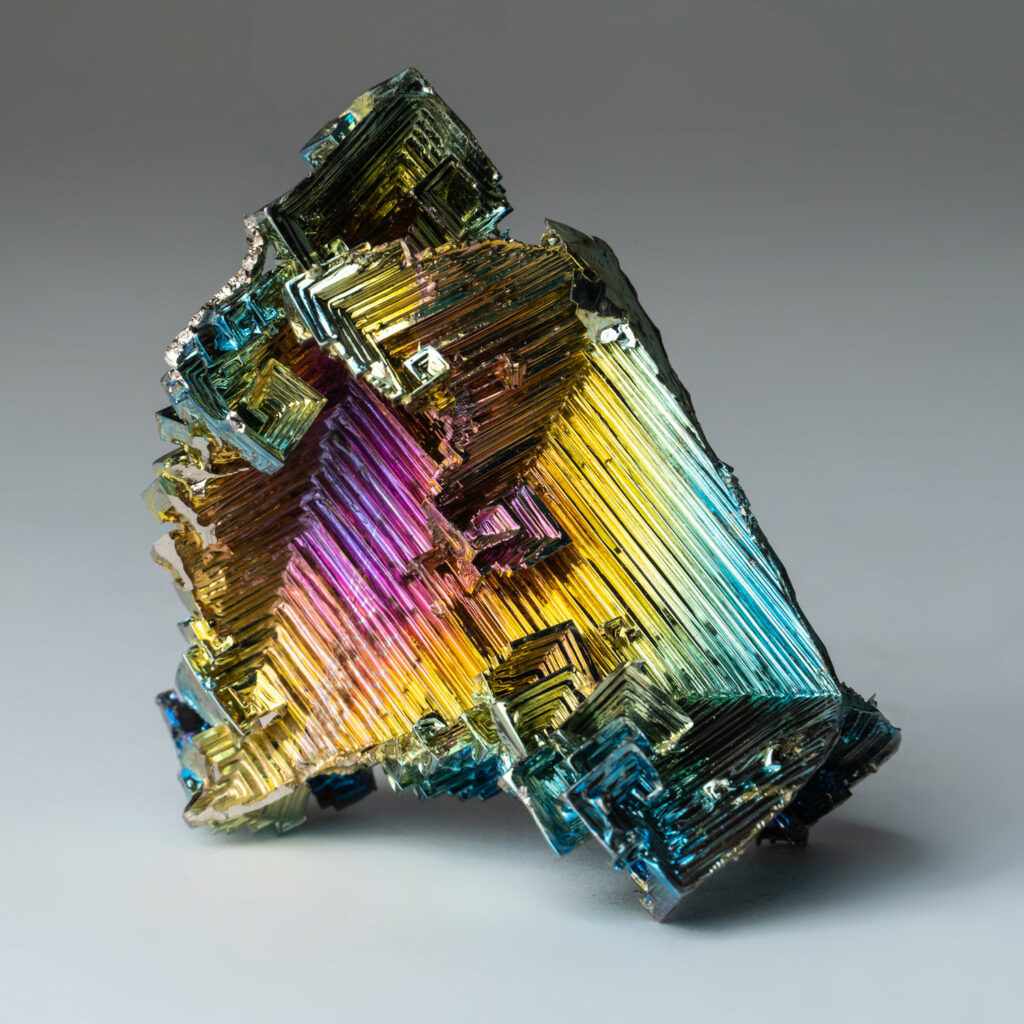
Beyond its nuclear properties, bismuth is notable for its distinctive physical appearance. It forms intricate, geometric crystalline structures that display iridescent colors due to thin oxide layers on its surface. These visually striking formations have made bismuth popular among artists and collectors. The element’s unique crystallization process mirrors the complexity found in its nuclear behavior, symbolizing the intersection of natural beauty and scientific intrigue.
Practical Applications of Bismuth-209
Bismuth-209’s exceptional stability and non-toxic nature have led to diverse practical uses across various fields:
- Medical Imaging:
Its properties make it suitable for use in certain diagnostic techniques, offering safer alternatives to more hazardous materials. - Environmental Safety:
Bismuth serves as a non-toxic substitute for lead in applications such as shotgun pellets, reducing environmental contamination. - Nanotechnology and Electronics:
The element’s unique characteristics are being explored for innovations in nanoscale devices and photonics, potentially advancing future technologies.
Mechanism of Alpha Decay in Bismuth-209
Alpha decay is a type of radioactive decay where an unstable nucleus emits an alpha particle (two protons and two neutrons), transforming into a different element. Although bismuth-209 undergoes alpha decay, the process is extraordinarily slow due to its nuclear configuration. This decay releases energy and gradually changes bismuth into thallium-205. Understanding this mechanism provides insights into nuclear reactions and the potential for manipulating isotopic stability through external influences.
Mathematical Representation of Half-Life
The half-life (t1/2) of a radioactive isotope is mathematically related to its decay constant (λ) by the formula:
t1/2 = ln(2) / λ
Where:
- t1/2: Half-life of the isotope
- λ (Decay constant): Probability per unit time that a nucleus will decay
This relationship allows scientists to calculate the expected time for half of a sample to decay, providing a quantitative framework for studying radioactive materials like bismuth-209.
Common Misconceptions About Bismuth and Radioactivity
Bismuth is completely stable and non-radioactive.
While bismuth-209 is extremely long-lived, it is technically radioactive and undergoes alpha decay, albeit at a rate so slow it is often considered stable for practical purposes.
All radioactive elements are highly dangerous.
The danger posed by radioactivity depends on the type and intensity of radiation. Bismuth-209’s radioactivity is negligible in everyday contexts due to its immense half-life and low emission rate.
Importance of Bismuth’s Half-Life in Science and Technology
The extraordinary half-life of bismuth-209 offers valuable insights into nuclear physics, challenging existing models of atomic stability and decay. Its unique properties have practical implications in medicine, environmental safety, and emerging technologies, making it a subject of ongoing research. Moreover, bismuth exemplifies the intricate balance between permanence and change in nature, inspiring both scientific inquiry and technological innovation.
Future Prospects and Research Directions
Recent discoveries that bismuth-209 can undergo alpha decay open new avenues for exploring nuclear reactions and material science. Researchers are investigating ways to influence its decay rate and harness its stability for advanced applications. These efforts may lead to the development of novel materials with enhanced durability and functionality, reflecting the element’s dual nature of resilience and transformation.
FAQ
What is the half-life of bismuth-209?
Bismuth-209 has an extraordinarily long half-life of approximately 1.9 x 10^19 years, which greatly exceeds the age of the universe.
Why is bismuth-209 considered stable despite being radioactive?
Its alpha decay occurs so slowly that it appears stable on human timescales, making it the heaviest stable isotope known.
What practical uses does bismuth have in industry and science?
Bismuth is used in medical imaging, as an environmentally friendly alternative to lead in ammunition, and in emerging nanotechnology applications.
How does bismuth’s nuclear structure affect its half-life?
The nuclear shell configuration of bismuth-209 provides unusual stability, delaying decay processes and extending its half-life.






Leave a Reply