
Short Answer
Definition of Black Holes and Stellar Evolution
Black holes are extraordinary cosmic objects formed from the remnants of massive stars that have undergone gravitational collapse. These entities possess gravitational fields so intense that nothing, not even light, can escape their pull, rendering them invisible to direct observation. The formation of black holes is a critical phase in the life cycle of certain stars, particularly those with substantial mass.
- Black Hole:
A region in spacetime exhibiting gravitational acceleration so strong that escape velocity exceeds the speed of light. - Stellar Evolution:
The process by which a star changes over time, from its formation in a nebula to its ultimate fate as a white dwarf, neutron star, or black hole.
Stages of Stellar Life Leading to Black Hole Formation
The journey of a star begins within vast clouds of gas and dust known as nebulae. Under the influence of gravity, these clouds condense, triggering nuclear fusion reactions that convert hydrogen into helium, releasing immense energy and stabilizing the star. The star remains in this equilibrium phase for the majority of its life. However, the star’s mass determines its eventual destiny:
- Low to Medium Mass Stars:
Typically end as white dwarfs after shedding outer layers. - Massive Stars:
Undergo more violent ends, culminating in supernova explosions and potentially forming neutron stars or black holes.
When a massive star depletes its nuclear fuel, its core succumbs to gravitational collapse. This implosion triggers a supernova, an explosive event that expels the star’s outer layers into space. The core’s fate depends on its mass; if sufficiently massive, it compresses into a black hole.
Mechanism of Black Hole Formation
The creation of a black hole is a complex astrophysical process initiated by the core collapse of a dying massive star. As nuclear fusion ceases, the outward pressure that counteracts gravity diminishes, causing the core to implode. The resulting supernova explosion ejects the star’s outer material, while the core contracts beyond the neutron star stage into a singularity-a point of infinite density and zero volume-surrounded by an event horizon from which no information can escape.
Observational Techniques and Recent Advances
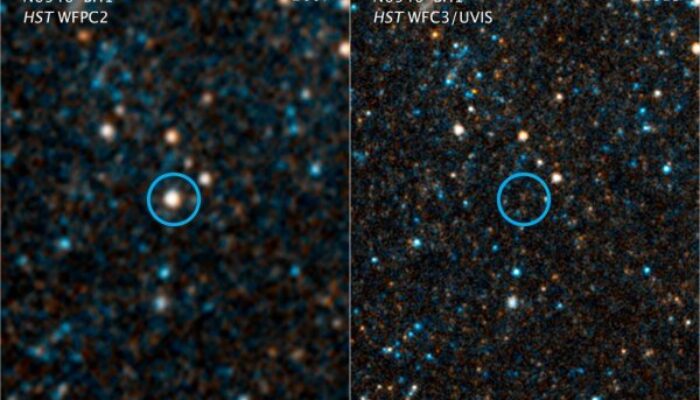
Modern astronomy has achieved remarkable progress in capturing the final moments of stars transitioning into black holes. Instruments such as the Hubble Space Telescope and ground-based observatories enable detection of electromagnetic radiation emitted during these cataclysmic events. Additionally, the advent of gravitational wave astronomy has revolutionized our understanding by detecting spacetime ripples generated by massive stellar collisions and collapses.
- Electromagnetic Observations:
Capture light and other radiation from collapsing stars and supernovae. - Gravitational Wave Detection:
Measures distortions in spacetime caused by massive astrophysical events, providing complementary data to electromagnetic signals.
Mathematical Framework of Black Holes
The properties of black holes are described by solutions to Einstein’s field equations in General Relativity. The Schwarzschild radius (event horizon radius) is a key parameter, defined as:
Rs = (2GM) / c²
- Rs: Schwarzschild radius (meters)
- G: Gravitational constant (6.674×10⁻¹¹ m³·kg⁻¹·s⁻²)
- M: Mass of the black hole (kilograms)
- c: Speed of light in vacuum (approximately 3×10⁸ m/s)
This radius defines the boundary beyond which escape is impossible, marking the event horizon.
Real-World Examples of Black Hole Observations
Several landmark observations have deepened our understanding of black holes:
- GW150914:
The first direct detection of gravitational waves from merging black holes by LIGO in 2015. - Event Horizon Telescope:
Produced the first image of a black hole’s event horizon in the galaxy M87 in 2019. - Supernova 1987A:
Provided insights into the death of massive stars and potential black hole formation.
Common Misconceptions About Black Holes
Black holes act like cosmic vacuum cleaners, indiscriminately sucking in everything.
Black holes exert gravitational pull like any other mass; objects must cross the event horizon to be irretrievably captured.
Black holes are visible because they emit light.
Black holes themselves emit no light; their presence is inferred from effects on nearby matter and radiation.
Significance of Black Holes in Cosmology and Astrophysics
Black holes play a pivotal role in shaping the structure and evolution of galaxies. Acting as gravitational anchors, they influence the dynamics of stars and gas clouds, contributing to galaxy formation and activity. Moreover, studying black holes challenges and refines fundamental physics, including quantum mechanics and general relativity, pushing the boundaries of human knowledge about the universe.
Philosophical and Metaphysical Reflections
The existence and formation of black holes evoke profound questions about the nature of reality, impermanence, and the interplay between creation and destruction. They symbolize the universe’s paradoxical nature, where endings give rise to new phenomena, and the visible cosmos transitions into realms beyond direct human perception. Observing these cosmic events invites contemplation on the transient nature of existence and the mysteries woven into the fabric of spacetime.
FAQ
What is a black hole?
A black hole is a region in spacetime where the gravitational pull is so strong that nothing, not even light, can escape from it.
How are black holes formed?
Black holes are formed from the remnants of massive stars that undergo gravitational collapse after exhausting their nuclear fuel.
What are the observational techniques used to study black holes?
Observational techniques include electromagnetic observations using telescopes and gravitational wave detection to capture signals from cosmic events.




Leave a Reply