
Short Answer
Definition of Gluons and Their Role in Particle Physics
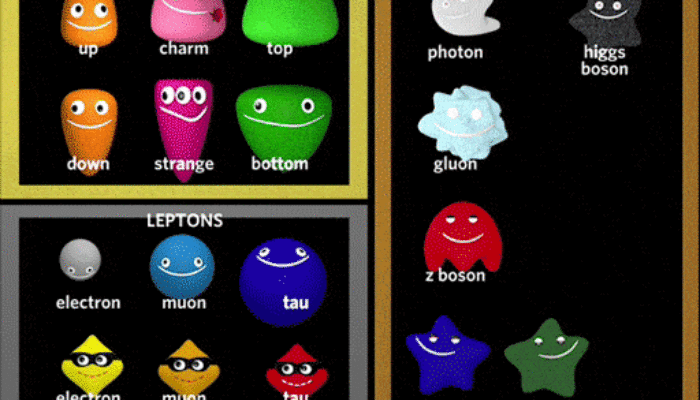
Gluons are fundamental particles that act as the force carriers for the strong interaction, one of the four fundamental forces in nature. This force is responsible for binding quarks together to form composite particles such as protons and neutrons, which in turn make up atomic nuclei. Within the framework of the Standard Model of particle physics, gluons are massless gauge bosons that mediate the color charge, a unique property analogous to electric charge but existing in three types: red, green, and blue. These color charges govern the interactions between quarks, with gluons facilitating the exchange that holds quarks tightly bound.
- Gluons:
Massless gauge bosons responsible for mediating the strong force. - Color Charge:
A quantum property of quarks and gluons, existing in three varieties, that dictates strong interactions. - Strong Force:
The fundamental interaction that binds quarks into hadrons such as protons and neutrons.
Understanding Gluon Confinement
One of the most intriguing aspects of gluons is the phenomenon known as confinement. This principle states that gluons, along with quarks, cannot exist as free, isolated particles under normal conditions. Instead, they are perpetually confined within hadrons-particles composed of quarks held together by the strong force. Attempting to separate quarks or gluons requires an enormous amount of energy, which does not result in free particles but rather in the creation of new quark-antiquark pairs. This process leads to the formation of additional hadrons, maintaining the confinement of color-charged particles.
Confinement can be visualized as a tightly woven network where quarks are the threads interconnected by gluons, the binding force. This ensures that free gluons are never observed in isolation in the natural world.
Asymptotic Freedom and High-Energy Behavior
Contrasting with confinement is the concept of asymptotic freedom, a remarkable property of quantum chromodynamics (QCD). At extremely high energies or temperatures, such as those present shortly after the Big Bang or in particle accelerators, quarks and gluons behave almost as free particles. When quarks are very close to each other, the strong force weakens, allowing them to move more independently. However, this state is transient and only occurs under extreme conditions, reverting to confinement as energies decrease.
Gluons in Extreme Environments: Quark-Gluon Plasma and Neutron Stars
Under extraordinary conditions, such as those found in neutron stars or during the formation of quark-gluon plasma (QGP), gluons may exhibit behavior akin to free particles. The QGP is a highly energetic state of matter theorized to have existed microseconds after the Big Bang, where quarks and gluons are deconfined and move freely within a hot, dense medium. This ephemeral phase provides a unique window into the early universe and the fundamental properties of strong interactions.
Experimental Observations and Gluon Signatures
Although free gluons are not observed under normal circumstances, their presence is indirectly detected through high-energy particle collisions, such as those conducted at the Large Hadron Collider (LHC). These experiments produce fleeting states where gluons can be excited and observed as they interact with quarks, leading to the creation of exotic hadrons and hybrid particles. Such findings deepen our understanding of gluon dynamics and the strong force.
Theoretical Implications and Open Questions
The study of gluons extends beyond their immediate role in particle physics, touching on profound questions about the universe. Theorists explore whether gluon-like particles or interactions could shed light on dark matter, the mysterious substance that constitutes a significant portion of the cosmos. Additionally, the interplay between gluons and other fundamental forces raises questions about the early universe’s evolution, baryon asymmetry, and potential connections to gravitational phenomena.
Historical Context: Gluon Freezing and Cosmic Evolution
As the universe expanded and cooled after the Big Bang, gluons transitioned from a deconfined state within the quark-gluon plasma to a confined state within hadrons. This “freezing out” process was crucial in the formation of stable matter, leading to the atomic structures that compose the observable universe today. Understanding this transition provides insight into the fundamental processes that shaped cosmic evolution.
Common Misconceptions About Gluons
Gluons can exist freely like photons.
Unlike photons, gluons are confined within hadrons and cannot be isolated under normal conditions due to color confinement.
The strong force weakens with distance.
The strong force actually becomes stronger as quarks move apart, which is why quarks remain confined.
Why Understanding Gluons Is Crucial
Gluons are central to the structure of matter and the fundamental forces that govern the universe. Their unique properties, such as confinement and asymptotic freedom, not only explain the stability of atomic nuclei but also provide a framework for exploring new physics beyond the Standard Model. Research into gluon behavior informs our comprehension of the early universe, the formation of matter, and the potential discovery of novel particles, making them indispensable to both theoretical and experimental physics.
FAQ
Why can't gluons exist freely like photons?
Unlike photons, gluons carry color charge and are subject to color confinement, preventing them from existing as free particles.
What is quark-gluon plasma?
A state of matter at extremely high temperature and density where quarks and gluons are deconfined and move freely.
How does the strong force behave over distance?
The strong force becomes stronger as quarks move apart, which is why quarks and gluons remain confined within particles.






Leave a Reply