
Short Answer
Understanding Fundamental Particles: Quarks and Electrons
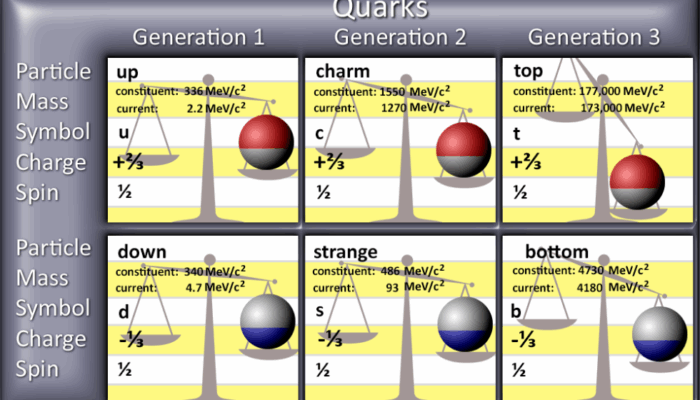
Quarks and electrons represent the most basic building blocks of matter, situated at the frontier of our understanding of the cosmos. Within the framework of the Standard Model of particle physics, quarks serve as the constituents of composite particles such as protons and neutrons, while electrons belong to a family of fundamental particles called leptons. This distinction raises a compelling question: could quarks and electrons themselves be composed of even more elementary components? Investigating this possibility leads us into the complex and evolving realm of theoretical physics.
Characteristics and Classification of Quarks and Electrons
To explore whether quarks and electrons have substructures, it is essential to first grasp their defining properties. Quarks are never observed in isolation; instead, they exist confined within hadrons due to a property known as color charge, which is analogous to electric charge but governed by the principles of quantum chromodynamics (QCD). Electrons, conversely, are considered elementary particles, characterized by intrinsic attributes such as mass, electric charge, and spin, with no experimental evidence to date indicating any internal composition.
- Quarks:
Fundamental constituents of hadrons, bound by the strong force mediated through color charge. - Electrons:
Elementary leptons with well-defined mass and charge, exhibiting no detectable substructure.
Theoretical Perspectives on Substructure
Speculation about the reducibility of quarks and electrons has inspired several advanced theoretical models. Among these, string theory and loop quantum gravity offer distinct conceptual frameworks for understanding the fundamental nature of particles and spacetime.
String Theory
This theory proposes that the universe’s fundamental entities are not zero-dimensional points but one-dimensional strings whose vibrational patterns correspond to different particles. Under this paradigm, quarks and electrons could be interpreted as specific vibrational states of these strings, providing a unified description of all particles and forces.
Loop Quantum Gravity
Loop quantum gravity suggests that spacetime itself is quantized at the Planck scale, composed of discrete loops of gravitational flux. In this view, particles such as quarks and electrons emerge from these quantized structures. While this approach reconciles quantum mechanics with general relativity, it does not explicitly claim that quarks and electrons have smaller constituents, but it encourages further investigation into their fundamental nature.
Experimental Investigations and Technological Advances
Modern particle accelerators, notably the Large Hadron Collider (LHC), have been instrumental in probing the properties of quarks and other elementary particles by recreating conditions of extremely high energy. These experiments have deepened our understanding of quark interactions and behaviors, yet so far, no evidence has emerged to suggest that quarks possess an internal structure. Nevertheless, ongoing research remains vigilant for any anomalies that might hint at deeper layers of complexity.
Search for Supersymmetry
Supersymmetry (SUSY) is a theoretical extension of the Standard Model that predicts a partner particle for every known particle. The discovery of such supersymmetric particles could provide insights into the limitations of current models and potentially reveal new aspects of quarks and electrons. Although SUSY remains unconfirmed experimentally, its validation would profoundly impact our understanding of particle physics.
Philosophical and Scientific Implications
The inquiry into whether quarks and electrons are composed of smaller entities touches on profound philosophical questions about the nature of reality. If these particles are indeed reducible, it raises the issue of whether there is a fundamental limit to this subdivision or an infinite regress of ever-smaller constituents. Such considerations blur the lines between physics, metaphysics, and epistemology, challenging our conceptual frameworks about existence and knowledge.
Expanding Horizons: Neutrinos and Dark Matter
Beyond quarks and electrons, research into elusive particles like neutrinos and the enigmatic dark matter broadens the scope of fundamental physics. Neutrino observatories and dark matter detection experiments are uncovering phenomena that may extend or revise the Standard Model, potentially influencing our understanding of all fundamental particles, including quarks and electrons.
Summary and Future Directions
Currently, quarks are regarded as fundamental components of matter with no confirmed substructure, while electrons remain elementary particles without detectable internal parts. However, the field of particle physics is dynamic, with continuous theoretical and experimental advancements that may one day reveal deeper layers of reality. The ongoing quest to decipher the true nature of quarks and electrons exemplifies the broader scientific endeavor to unravel the universe’s most profound mysteries.
Conclusion
The question of whether quarks and electrons are made up of smaller particles encapsulates the essence of scientific exploration. As cutting-edge technologies and innovative theories advance, the interplay between experimental data and theoretical models continues to refine our understanding. Each discovery contributes to a richer, more intricate picture of the universe, underscoring the ever-evolving nature of knowledge about the fundamental constituents of matter.
FAQ
Are quarks and electrons truly fundamental particles?
Current experimental evidence supports that quarks and electrons are fundamental particles with no smaller constituents, though some theoretical models suggest possible substructures.
What experimental methods are used to investigate quark and electron substructure?
High-energy particle accelerators like the Large Hadron Collider probe quark and electron properties, searching for signs of internal structure or new particles.
How do theoretical frameworks like string theory view quarks and electrons?
String theory models quarks and electrons as different vibrational states of one-dimensional strings, potentially implying they are not point-like but have internal dynamics.
What is the significance of supersymmetry in particle physics?
Supersymmetry predicts partner particles to known fundamental particles, which could help explain unanswered questions and refine our understanding of particle substructure if discovered.




Leave a Reply