
Short Answer
Definition of Quarks
Quarks are elementary particles that constitute the fundamental components of matter. They exist within protons, neutrons, and other hadrons, playing a crucial role in the structure of the atomic nucleus. These particles are never found in isolation due to the strong force that binds them together, making them essential building blocks in the subatomic realm.
- Quarks:
Fundamental constituents of matter that combine to form hadrons such as protons and neutrons. - Hadrons:
Composite particles made of quarks, including baryons (like protons and neutrons) and mesons. - Color Charge:
A property of quarks analogous to electric charge, existing in three types-red, green, and blue-ensuring that observable particles are color-neutral.
Historical Development of Quark Theory
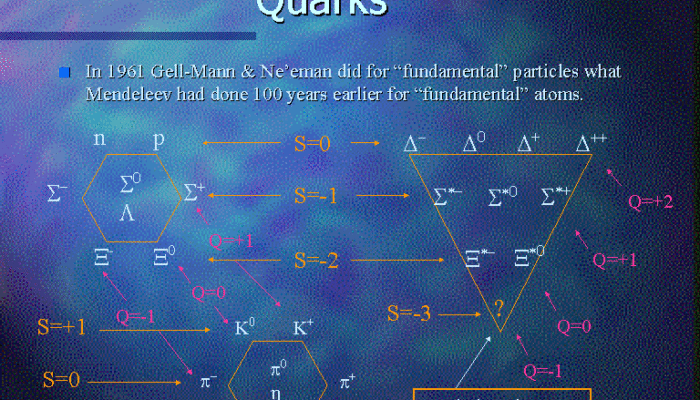
The concept of quarks was independently introduced in 1964 by physicists Murray Gell-Mann and George Zweig to simplify the classification of hadrons, which were numerous and complex. They proposed that hadrons are composed of smaller, more fundamental particles-quarks-each carrying a “color” charge. This innovative model likened quarks to the primary colors of light, which combine to produce a wide spectrum of particles. This framework became a cornerstone of the Standard Model, revolutionizing particle physics by providing a systematic understanding of subatomic particles.
Experimental Evidence Supporting Quarks
Direct observation of quarks is impossible due to a phenomenon called confinement, which prevents quarks from existing freely outside hadrons. However, experimental physicists have developed indirect methods to investigate their presence. One of the most significant breakthroughs came from deep inelastic scattering experiments at the Stanford Linear Accelerator Center (SLAC) in the late 1960s. By bombarding protons with high-energy electrons, researchers observed scattering patterns that indicated the presence of smaller constituents within protons. These findings provided compelling evidence that quarks are real particles carrying fractional charges and momentum fractions inside hadrons.
Quark-Gluon Plasma and Extreme States of Matter
Further validation of quark existence arises from studies of quark-gluon plasma, a state of matter created under extreme temperatures and densities, such as those produced in heavy-ion collisions at the Large Hadron Collider (LHC) and the Relativistic Heavy Ion Collider (RHIC). In this plasma, quarks and gluons are no longer confined within hadrons but move freely in a hot, dense medium. Phenomena like jet quenching-where high-energy particle jets lose energy passing through the plasma-serve as strong indicators of this exotic state, offering insights into the behavior of quarks under conditions similar to those just after the Big Bang.
Astrophysical Significance of Quarks
Quarks also have profound implications beyond terrestrial experiments, particularly in astrophysics. Neutron stars, the dense remnants of supernova explosions, may contain matter so compressed that neutrons break down into their constituent quarks, potentially forming quark stars. These hypothetical stars represent a novel phase of matter and are subjects of ongoing research. Observations of gravitational waves from neutron star mergers provide valuable data that could confirm the existence of such exotic states, linking quark theory to cosmic phenomena and expanding our understanding of the universe.
Quark Flavors and the Standard Model
Quarks exist in six distinct types, known as flavors: up, down, charm, strange, top, and bottom. Each flavor possesses unique characteristics such as mass and charge, contributing to the diversity of matter observed in the universe. The Standard Model incorporates these flavors but also highlights unresolved questions and anomalies, such as discrepancies in proton charge radius measurements and unexpected behaviors in charm quark interactions. These challenges motivate ongoing research aimed at refining the quark model and exploring physics beyond the current theoretical framework.
Theoretical Pursuits: Unifying Forces and Quarks
The study of quarks is intertwined with the broader scientific endeavor to unify the fundamental forces of nature-gravitational, electromagnetic, weak, and strong interactions-into a single comprehensive theory. Approaches like string theory propose that quarks and other elementary particles are manifestations of one-dimensional vibrating strings in higher-dimensional space. Although still speculative, these theories underscore the central role of quarks in the quest to understand the universe’s underlying principles and the interconnectedness of all physical phenomena.
Common Misconceptions About Quarks
Quarks can be observed directly.
Due to confinement, quarks cannot exist freely and are only detected indirectly through high-energy experiments.
Quarks are just theoretical constructs without experimental support.
Multiple experiments, including deep inelastic scattering and quark-gluon plasma studies, provide strong empirical evidence for quark existence.
Importance of Quarks in Science and Technology
Understanding quarks is fundamental to modern physics, as they form the basis of matter and govern the interactions within atomic nuclei. Insights into quark behavior have advanced particle physics, informed cosmology, and influenced technologies such as particle accelerators and detectors. Moreover, the study of quarks continues to drive innovation in theoretical physics, pushing the boundaries of knowledge about the universe’s origin, structure, and fundamental laws.
Summary: Quarks as Essential Elements of Reality
Quarks are not mere theoretical ideas but are substantiated by extensive experimental data and theoretical frameworks. From their initial proposal to the latest discoveries in high-energy physics and astrophysics, quarks remain central to our comprehension of matter and the cosmos. Their study exemplifies the dynamic interplay between theory and experiment, highlighting humanity’s relentless pursuit to decode the universe’s most profound mysteries. As research progresses, quarks will continue to illuminate the intricate fabric of reality and inspire deeper exploration into the nature of existence.
FAQ
What are quarks?
Quarks are elementary particles that combine to form hadrons, such as protons and neutrons, and they are fundamental constituents of matter.
Can quarks be observed directly?
No, quarks cannot be observed directly due to confinement; they are detected indirectly through high-energy experiments.






Leave a Reply