
Short Answer
Understanding Quantum and Classical Computing
The debate over whether quantum computers outperform classical computers remains a captivating and complex topic. To appreciate this discussion, it is essential to first distinguish the fundamental differences between these two computing paradigms.
Definition of Classical Computing
Classical computers have been the cornerstone of technology for decades, operating based on classical physics principles. They process data using bits, which exist strictly as either 0 or 1. This binary framework underpins all classical computation.
- Binary Bits:
Classical bits represent information in two distinct states, enabling logical operations through sequences of on/off transistor switches. - Deterministic Processing:
Calculations follow a fixed sequence of instructions, with performance influenced by hardware capabilities and software optimization.
Introduction to Quantum Computing
Quantum computing represents a revolutionary shift by utilizing quantum bits, or qubits, which leverage the principles of quantum mechanics such as superposition and entanglement. Unlike classical bits, qubits can exist in multiple states simultaneously, vastly expanding computational possibilities.
- Superposition:
A qubit can be in a combination of 0 and 1 states at the same time, allowing quantum computers to process many possibilities concurrently. - Entanglement:
Qubits can become entangled, meaning the state of one qubit instantly influences another, regardless of distance, enabling complex correlations beyond classical reach.
How Quantum Computing Works
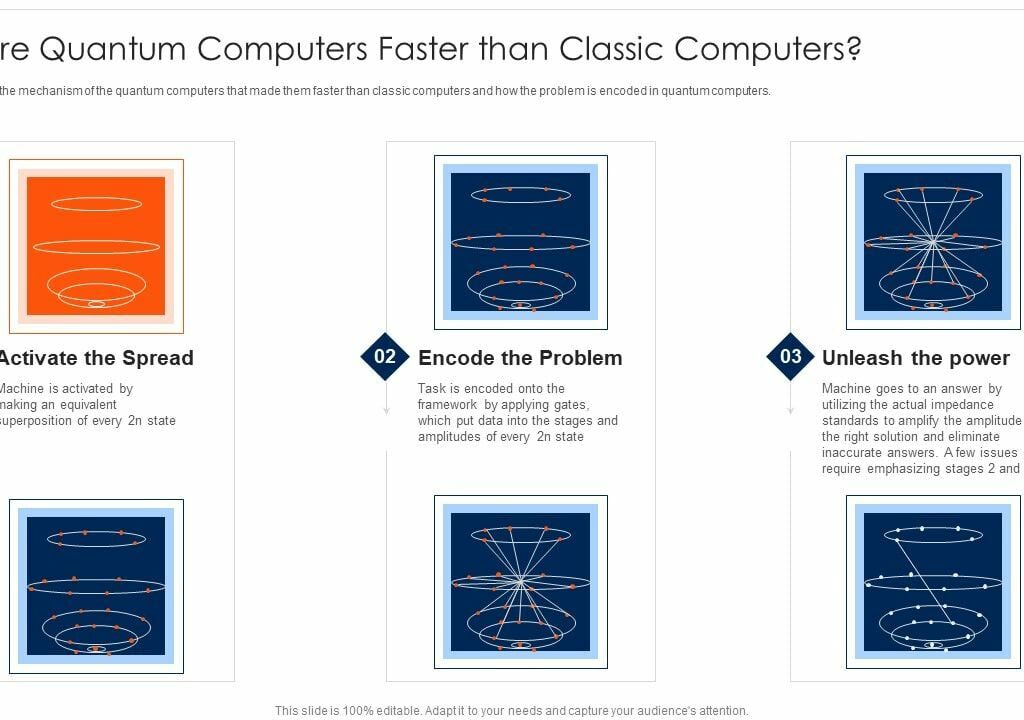
Quantum computers harness superposition to explore multiple computational paths simultaneously, while entanglement links qubits to perform coordinated operations. This dual mechanism allows quantum algorithms to tackle problems that are infeasible for classical machines.
Key Quantum Algorithms and Their Impact
Several quantum algorithms demonstrate the potential advantages of quantum computing:
- Shor’s Algorithm:
Efficiently factors large integers, threatening classical cryptographic systems by solving problems that classical computers find prohibitively difficult. - Grover’s Algorithm:
Provides a quadratic speedup for searching unsorted databases, offering improvements in optimization and data retrieval tasks.
Evaluating Quantum Speed and Efficiency
It is important to differentiate between raw speed and computational efficiency. Quantum speedup is highly problem-dependent; quantum computers excel in specific domains such as quantum simulations and optimization, while classical computers remain superior in many well-established applications due to decades of algorithmic refinement.
Challenges Facing Quantum Computing
Despite its promise, quantum computing faces significant hurdles:
- Decoherence:
Qubits are extremely sensitive to environmental disturbances, causing loss of quantum information and complicating sustained computation. - Error Correction:
Developing fault-tolerant quantum systems requires advanced error-correcting codes to maintain coherence and reliability. - Technological Maturity:
Quantum hardware and software ecosystems are still emerging, necessitating substantial research and investment to reach practical usability.
Comparing Classical and Quantum Computing Ecosystems
Classical computing benefits from a robust infrastructure, extensive software libraries, and widespread accessibility, making it the default choice for most applications. In contrast, quantum computing remains in an experimental phase, with ongoing efforts to scale and stabilize the technology.
Ethical and Security Considerations
The rise of quantum computing introduces profound implications for data security:
- Cryptographic Vulnerabilities:
Quantum algorithms like Shor’s threaten to break widely-used encryption methods, raising concerns about privacy and information protection. - Quantum Key Distribution:
Leveraging quantum mechanics to create secure communication channels, this emerging technology aims to counteract potential quantum threats.
Defining Computational Speed in Context
Speed in computing can be interpreted in various ways, including raw processing power, data access speed, or the ability to efficiently solve complex problems. The interplay between classical and quantum systems challenges traditional notions of speed, suggesting a future where both paradigms complement each other.
Real-World Applications and Future Outlook
Quantum computing holds promise in fields such as logistics, supply chain management, and scientific simulations, where quantum algorithms can outperform classical methods. However, the coexistence of classical and quantum technologies is likely to persist, each serving distinct roles based on their strengths.
Conclusion: The Path Forward in Computing
While quantum computers have the potential to surpass classical machines in targeted scenarios, the broader landscape of computational performance is nuanced and multifaceted. Ongoing research aims to bridge the gap between theoretical quantum advantages and practical implementations, ultimately enriching our understanding of computation and unlocking transformative technological breakthroughs.
FAQ
What is a qubit?
A qubit is the basic unit of quantum information that can exist in multiple states simultaneously due to superposition.
What is quantum supremacy?
Quantum supremacy is the point at which a quantum computer can perform a task that classical computers practically cannot.
Why is decoherence a problem in quantum computing?
Decoherence causes qubits to lose their quantum state due to environmental interference, making reliable quantum computation difficult.






Leave a Reply