
Short Answer
Understanding Photonic and Quantum Computing
As computational technology advances, the comparison between photonic and quantum computing intensifies. Both approaches leverage unique physical phenomena to address complex computational problems, yet they operate on fundamentally different principles. This article explores the operational strengths and limitations of each technology, assessing whether photonic computers can outperform quantum computers in terms of speed and overall efficiency.
Definition and Core Principles
Photonic and quantum computers differ primarily in how they process and transmit information:
- Photonic Computers:
Utilize photons-particles of light-to carry and manipulate data. This enables information processing at the speed of light, offering exceptional bandwidth and low latency. - Quantum Computers:
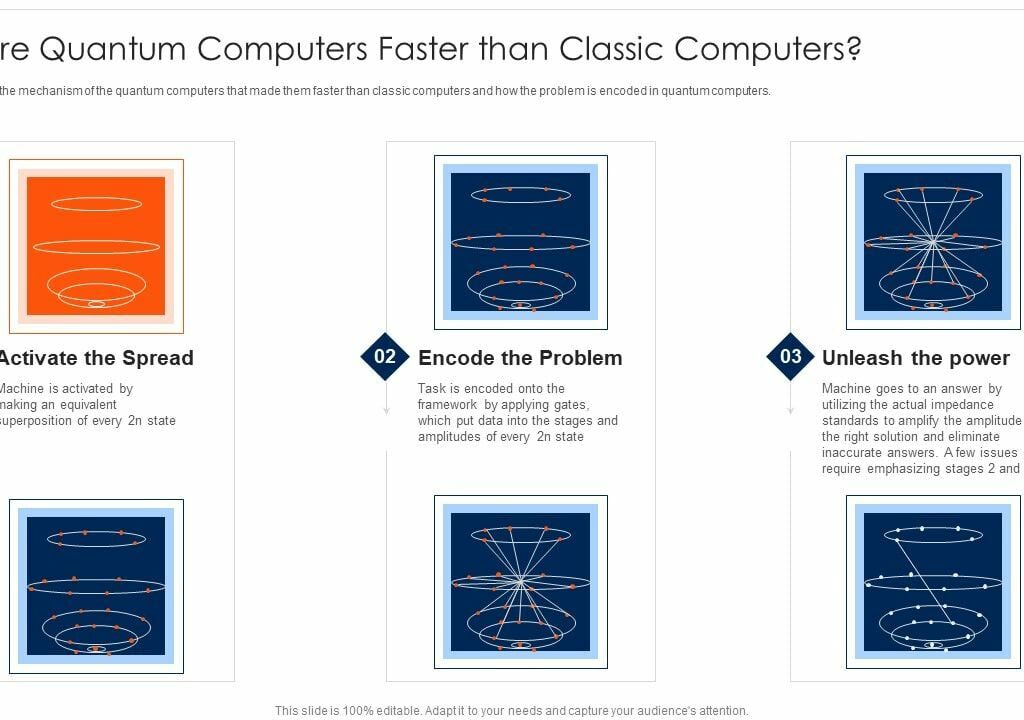
Employ quantum bits or qubits, which can exist in multiple states simultaneously due to quantum superposition and entanglement. This allows quantum systems to perform complex calculations by exploring many possibilities at once.
Operational Mechanisms
Photonic computers harness the properties of light to transmit data rapidly and with minimal energy loss. Their architecture supports high-speed linear data processing, making them ideal for applications requiring swift data transfer and bandwidth efficiency.
Quantum computers, on the other hand, exploit quantum mechanical phenomena to solve problems that are computationally intensive for classical systems. By manipulating qubits, quantum machines can perform parallel computations, enabling breakthroughs in fields such as cryptography, optimization, and quantum simulations.
Advantages and Limitations
- Photonic Computing Advantages:
High-speed data transmission at light speed, superior energy efficiency, and robustness against environmental disturbances. These features make photonic systems scalable and practical for real-world deployment, especially in data-heavy environments like telecommunications. - Quantum Computing Strengths:
Exceptional at solving specific complex problems, including integer factorization, combinatorial optimization, and simulating quantum systems. However, maintaining qubit coherence requires sophisticated error correction and controlled environments, which can limit operational speed and scalability.
Speed and Performance: A Nuanced Comparison
Evaluating speed between photonic and quantum computers involves multiple dimensions beyond raw processing rates. Photonic systems excel in rapid linear data handling, while quantum computers offer transformative performance in solving multidimensional and combinatorial problems through specialized algorithms. Therefore, determining which technology is “faster” depends heavily on the nature of the computational task and the efficiency of the algorithms applied.
Emerging Hybrid Technologies
Recent research trends focus on integrating photonic and quantum computing elements to create hybrid systems. These innovations aim to combine the rapid data transmission capabilities of photonics with the powerful computational potential of quantum mechanics. Such hybrid architectures could pave the way for next-generation computers that surpass current limitations, offering unprecedented speed and problem-solving capacity.
Significance and Future Implications
The exploration of photonic and quantum computing holds profound implications for science and technology. By pushing the boundaries of computational speed and complexity, these technologies promise to revolutionize fields ranging from artificial intelligence and materials science to climate modeling and secure communications. Their development could democratize access to advanced computational tools, addressing global challenges with enhanced precision and efficiency.
Summary and Outlook
In summary, photonic computers provide remarkable advantages in speed and energy efficiency for specific data-intensive tasks, while quantum computers excel in addressing complex, high-dimensional problems that are beyond the reach of classical and photonic systems. The choice between these paradigms should be guided by the specific computational challenges at hand rather than a simplistic comparison of speed. As both fields evolve, their convergence may unlock new horizons in computational power, deepening our understanding of physics and expanding the frontiers of technology.
FAQ
What are photonic computers?
Photonic computers utilize photons, or particles of light, to carry and manipulate data, enabling high-speed data processing.
How do quantum computers work?
Quantum computers use quantum bits (qubits) that can exist in multiple states simultaneously, allowing them to solve complex problems efficiently.
Which is faster, photonic or quantum computers?
The speed comparison depends on the specific computational task; photonic computers excel in linear data handling, while quantum computers are superior for complex multidimensional problems.





Leave a Reply