
Short Answer
Definition of Neutrinos
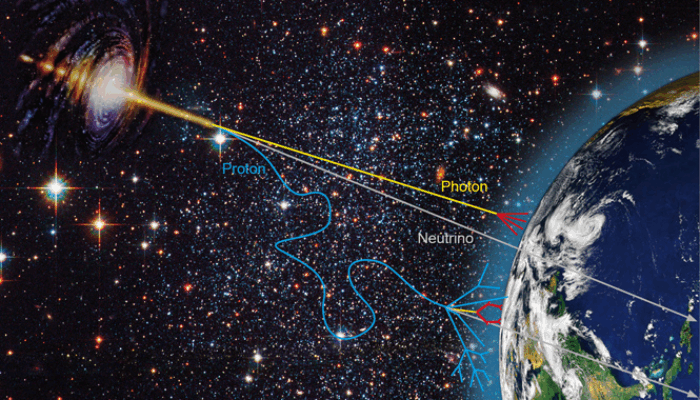
Neutrinos are fundamental subatomic particles characterized by their neutral charge and extremely small mass. They belong to the lepton family, which also includes electrons, muons, and tau particles. Unlike many other particles, neutrinos interact very weakly with matter, allowing them to pass through entire planets virtually undisturbed. These elusive particles are produced in vast quantities through various natural processes, such as nuclear fusion in stars, radioactive decay, and cosmic events like supernovae.
- Neutrality:
Neutrinos carry no electric charge, making them electrically neutral particles. - Mass:
They possess a minuscule but nonzero mass, much smaller than that of electrons. - Interaction:
Their weak interaction with matter makes them difficult to detect. - Types (Flavors):
There are three known neutrino flavors: electron neutrinos, muon neutrinos, and tau neutrinos.
Historical Background and Discovery
The concept of neutrinos originated in the early 20th century as a solution to an energy discrepancy observed in beta decay, a type of radioactive decay. Scientists noticed that the energy emitted during beta decay did not add up, seemingly violating the conservation of energy principle. To resolve this, physicist Wolfgang Pauli proposed in 1930 the existence of an undetectable particle that carried away the missing energy. This particle was later named the neutrino.
Despite Pauli’s theoretical proposal, neutrinos remained hypothetical until 1956, when Clyde Cowan and Frederick Reines successfully detected them experimentally. This breakthrough confirmed neutrinos as real particles, transitioning them from theoretical speculation to established components of particle physics.
Neutrino Oscillation and Its Significance
One of the most remarkable discoveries in neutrino physics is the phenomenon of neutrino oscillation. This process involves neutrinos changing between their three flavors-electron, muon, and tau-as they travel through space. The observation of oscillations provided compelling evidence that neutrinos have a small but finite mass, contradicting earlier assumptions that they were massless.
This revelation has profound implications for the Standard Model of particle physics, prompting scientists to reconsider and extend the model to accommodate neutrino mass. It also opens avenues for exploring new physics beyond the current theoretical framework.
Experimental Efforts and Detection Techniques
Detecting neutrinos requires sophisticated and large-scale experimental setups due to their weak interaction with matter. Several international projects have been established to study neutrinos and their properties:
- Super-Kamiokande (Japan):
A massive underground water Cherenkov detector designed to observe neutrinos from cosmic sources, including supernovae and the Sun. - IceCube Neutrino Observatory (Antarctica):
An array of detectors embedded in Antarctic ice, focusing on detecting high-energy neutrinos originating from distant cosmic phenomena such as active galactic nuclei and gamma-ray bursts.
These experiments utilize innovative technologies like large volumes of ultrapure water or ice and advanced detection methods such as liquid argon time projection chambers to capture the rare interactions of neutrinos with matter.
Distinguishing Hypothetical and Theoretical Particles
It is important to clarify the terminology used in particle physics regarding particle status:
- Hypothetical Particles:
Entities proposed based on theoretical considerations but lacking experimental evidence. - Theoretical Particles:
Particles initially predicted by theory that have been subsequently confirmed through experiments.
Neutrinos initially fell into the hypothetical category when first proposed by Pauli. However, following their experimental detection, they are now classified as theoretical particles with confirmed existence, although ongoing research continues to explore their detailed properties.
Neutrinos in the Cosmos and Their Broader Impact
Beyond particle physics, neutrinos play a crucial role in astrophysics and cosmology. Their production in stellar processes and cosmic events provides valuable information about the universe’s evolution and the mechanisms powering stars and supernovae. Additionally, neutrinos are considered potential probes for understanding dark matter and other fundamental cosmic mysteries.
Their ability to traverse vast distances without significant interaction makes them unique messengers, carrying information from otherwise inaccessible regions of space.
Common Misconceptions About Neutrinos
Neutrinos are massless particles.
Neutrino oscillation experiments have demonstrated that neutrinos possess a small but nonzero mass.
Neutrinos interact frequently with matter.
Neutrinos interact extremely weakly, allowing them to pass through matter almost undisturbed.
Neutrinos were always experimentally confirmed.
Neutrinos were initially hypothetical and only confirmed experimentally decades after their proposal.
Why Understanding Neutrinos Is Crucial
Studying neutrinos is vital for advancing our knowledge of fundamental physics and the universe. Their unique properties challenge existing theories and inspire new models that extend beyond the Standard Model. In technology, neutrino research drives the development of cutting-edge detection methods and instrumentation. In cosmology, neutrinos offer insights into stellar dynamics, cosmic evolution, and the elusive nature of dark matter, making them indispensable to both theoretical and applied scientific endeavors.
FAQ
What are neutrinos?
Neutrinos are fundamental subatomic particles characterized by their neutral charge and extremely small mass.
How were neutrinos discovered?
Neutrinos were proposed in 1930 and confirmed experimentally in 1956 by Clyde Cowan and Frederick Reines.
What is neutrino oscillation?
Neutrino oscillation is the phenomenon where neutrinos change between their three flavors as they travel through space.






Leave a Reply