
Short Answer
Definition of Leptons
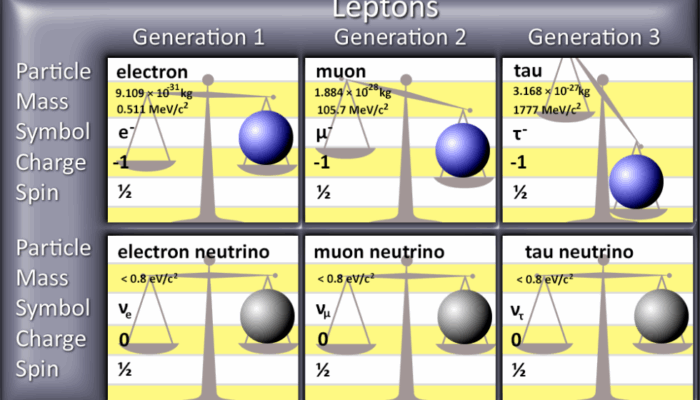
Leptons are a fundamental category of elementary particles within the framework of the Standard Model of particle physics. They are considered indivisible constituents of matter, meaning they are not composed of smaller particles. This class includes particles such as electrons, muons, tau particles, and their associated neutrinos. Leptons belong to the family of fermions, characterized by having half-integer spin values, which influences their statistical behavior and interaction patterns.
- Elementary Particles:
Particles that cannot be broken down into smaller components. - Fermions:
Particles with half-integer spin, following the Pauli exclusion principle. - Lepton Types:
Electron, muon, tau, and their corresponding neutrinos.
Fundamental Characteristics of Leptons
Leptons are distinguished by their lack of internal structure, as confirmed by high-energy particle collision experiments, such as those performed at the Large Hadron Collider (LHC). These experiments have consistently shown no evidence of subcomponents within leptons, supporting their classification as point-like particles with no measurable size. This fundamental nature sets leptons apart from composite particles like protons and neutrons.
Another defining feature of leptons is their electric charge, which plays a crucial role in their interactions. Charged leptons, such as electrons, carry a negative electric charge, while neutrinos are electrically neutral. This charge influences how leptons interact via electromagnetic and weak forces, affecting the behavior of matter at the quantum scale.
Lepton Flavors and Their Significance
Leptons exist in three distinct “flavors”: electron-type, muon-type, and tau-type, each paired with a corresponding neutrino. These flavors are conserved in most particle interactions, meaning that the type of lepton remains unchanged during processes. However, neutrinos exhibit a remarkable phenomenon known as flavor oscillation, where they can transform from one flavor to another as they travel. This behavior challenges traditional conservation laws and provides deep insights into the nature of particle physics.
Role of Leptons in Particle Interactions
Leptons are integral to weak interactions, one of the four fundamental forces of nature. For example, during beta decay-a process where an unstable atomic nucleus emits a beta particle-an electron (a charged lepton) and an electron neutrino are produced as a neutron transforms into a proton. These weak force interactions are essential for nuclear reactions that power stars, including our sun, highlighting leptons’ practical importance beyond theoretical physics.
Historical Context and Discovery
The discovery of leptons has been pivotal in shaping modern physics. The electron was first identified by J.J. Thomson in the late 19th century, marking a revolutionary step in understanding atomic structure. Later, the muon and tau particles were discovered in the 20th century, expanding the known family of leptons and deepening our comprehension of subatomic particles. These discoveries reflect the evolving nature of scientific inquiry into the fundamental building blocks of matter.
Theoretical Frameworks Involving Leptons
Leptons are central to several theoretical models in physics. Quantum electrodynamics (QED), for instance, provides a detailed mathematical description of how charged leptons interact with photons, explaining electromagnetic phenomena with remarkable precision. Additionally, leptons are key components in ongoing efforts to develop grand unified theories (GUTs) that seek to merge the fundamental forces of nature into a single framework, bridging quantum mechanics and general relativity.
Why Understanding Leptons Is Crucial
Studying leptons is vital for advancing our knowledge of the universe. Their fundamental properties and interactions underpin much of particle physics, helping scientists validate existing theories and explore new ones. Insights gained from leptons contribute to technological advancements, deepen our grasp of cosmic phenomena, and inspire philosophical reflections on the nature of matter and existence.
FAQ
What defines leptons as fundamental particles?
Leptons are considered fundamental because they have no detectable internal structure and have not been observed to be composed of smaller particles in high-energy experiments.
Which particles are classified as leptons?
The six leptons include the electron, muon, tau, and their corresponding neutrinos: electron neutrino, muon neutrino, and tau neutrino.
How do leptons interact with other particles?
Leptons primarily engage through the weak and electromagnetic forces. Charged leptons also participate in electromagnetic interactions, while neutrinos interact mainly via the weak force.
What is meant by lepton flavor, and why is it important?
Lepton flavor refers to the different types of leptons and their associated neutrinos. The conservation and oscillation of these flavors are fundamental to understanding particle interactions and the underlying principles of physics.
Why is the study of leptons significant in physics?
Leptons provide critical insights into fundamental forces, support the validation of theoretical models like the Standard Model and quantum electrodynamics, and are essential in research aimed at unifying the fundamental forces of nature.






Leave a Reply