
Short Answer
Definition of Covalent Bonds
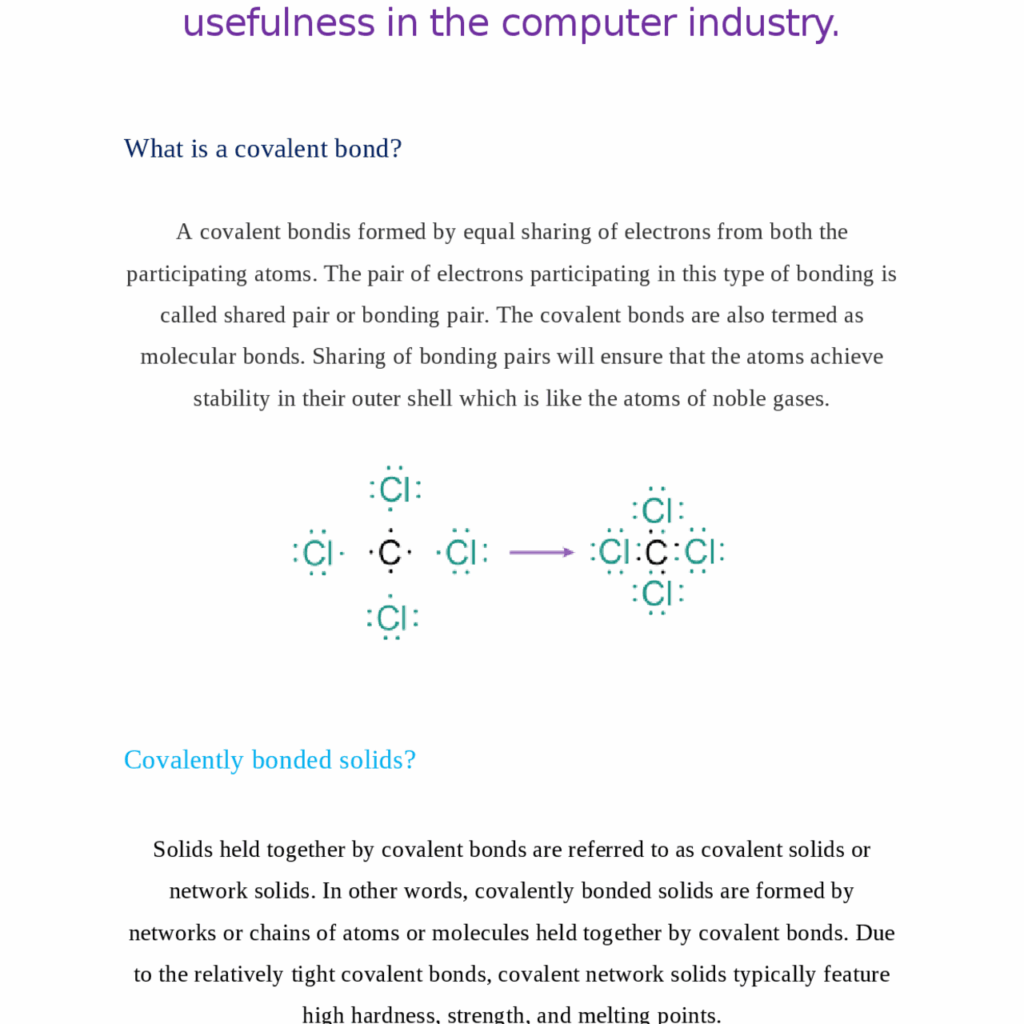
Covalent bonds are fundamental chemical connections formed when two atoms share one or more pairs of electrons. This electron sharing creates a stable balance of forces between the positively charged nuclei and the negatively charged shared electrons, resulting in the formation of molecules. These molecules serve as the essential units of matter, encompassing substances such as water, carbon dioxide, and a vast array of organic compounds crucial for life.
Historical Background and Development
The concept of covalent bonding originated from the efforts of early chemists striving to explain atomic behavior. Pioneers like Gilbert Lewis and Linus Pauling developed theoretical models that clarified how atoms share electrons. Their groundbreaking work transformed the idea of electron sharing from a mere hypothesis into a cornerstone of modern chemistry, providing a framework to understand molecular formation and atomic interactions.
Scientific Evidence Supporting Covalent Bonds
Despite their microscopic scale, covalent bonds are supported by extensive empirical evidence. Advanced techniques such as X-ray crystallography and nuclear magnetic resonance (NMR) spectroscopy allow scientists to visualize molecular structures and confirm the specific spatial arrangements of atoms connected by covalent bonds. These methods reveal unique molecular geometries and properties that validate the presence of covalent interactions.
Observations from Chemical Reactions
Chemical reactions offer practical proof of covalent bonding. For instance, the combustion of hydrocarbons like octane in gasoline involves breaking and forming covalent bonds, producing water and carbon dioxide. The measurable energy changes during these reactions demonstrate that atomic interactions are real phenomena with tangible effects, underpinning numerous applications in material science and pharmaceuticals.
Mathematical and Theoretical Models
Theoretical frameworks such as molecular orbital theory and valence bond theory mathematically describe electron behavior in covalent bonds. These models use complex algebraic equations to predict molecular properties and behaviors, consistently aligning with experimental results. This congruence between theory and observation reinforces the reality and significance of covalent bonds in chemistry.
Philosophical Perspectives on Covalent Bonds
Covalent bonds also invite reflection beyond the scientific realm. The mutual sharing of electrons symbolizes cooperation, drawing parallels to social relationships and collaborative interactions in nature. This analogy highlights how fundamental principles of partnership and balance operate both at the atomic level and within broader societal contexts.
Existential Implications
The dynamic interplay of attraction and repulsion in covalent bonding raises profound questions about stability and transformation in the universe. The ability of atoms to form strong, stable bonds underlies the persistence of complex biological structures, illustrating the delicate balance between fragility and resilience that characterizes life and matter.
Common Misconceptions About Covalent Bonds
Covalent bonds are purely theoretical and do not physically exist.
Although covalent bonds cannot be seen directly, advanced scientific techniques provide concrete evidence of their presence and effects.
Covalent bonds are static and unchanging.
Covalent bonds can break and reform during chemical reactions, demonstrating their dynamic nature.
Importance of Covalent Bonds in Science and Daily Life
Covalent bonds are indispensable to understanding the structure and behavior of matter. They form the basis of countless substances essential to life, technology, and industry. From the water we drink to the medicines we rely on, covalent bonding governs the formation and transformation of molecules, making it a critical concept in chemistry, biology, and materials science.
Summary
Covalent bonds represent a vital intersection of theoretical insight and empirical reality. Supported by historical development, scientific observation, and mathematical modeling, they are fundamental to the molecular architecture of the natural world. Beyond their scientific significance, covalent bonds also inspire philosophical contemplation about cooperation and existence. Collectively, these perspectives affirm that covalent bonds are genuine, essential components of the universe, meriting ongoing study and appreciation.
FAQ
What exactly is a covalent bond?
A covalent bond is the sharing of electron pairs between atoms to form molecules with stable structures.
Can we see covalent bonds directly?
No, covalent bonds are not visible directly but are detected through scientific instruments and experimental data.
How do scientists prove covalent bonds exist?
Through experimental methods like spectroscopy, X-ray crystallography, chemical reaction analysis, and theoretical models aligning with observed data.
Why are covalent bonds important in chemistry?
They determine the shape, stability, and properties of molecules essential for materials, living organisms, and chemical processes.
Are covalent bonds just theoretical concepts?
No, they are theoretical frameworks supported by strong empirical evidence showing they represent real atomic interactions.






Leave a Reply