
Short Answer
Definition of Covalent and Molecular Bonds
In the field of chemistry, bonds between atoms and molecules define the structure and behavior of matter. Two commonly discussed types of bonds are covalent bonds and molecular bonds, which, although related, represent different concepts within chemical interactions.
- Covalent Bonds:
These are strong chemical connections formed when two atoms share one or more pairs of electrons. Typically occurring between nonmetal atoms with similar electronegativities, covalent bonds create the fundamental framework of molecules. - Molecular Bonds:
This term generally refers to the forces acting between separate molecules, known as intermolecular forces. These interactions influence how molecules aggregate and behave in different states of matter, such as solids, liquids, and gases.
Understanding Covalent Bonds
Covalent bonding arises from the mutual sharing of electron pairs between atoms, resulting in a stable association. This electron sharing allows atoms to achieve a more stable electronic configuration, often resembling that of noble gases. Covalent bonds can vary in strength and complexity depending on the number of shared electron pairs.
Types of Covalent Bonds
- Single Bonds:
Involve the sharing of one pair of electrons, forming a basic yet strong link between atoms, as seen in hydrogen gas (H2). - Double Bonds:
Consist of two shared electron pairs, increasing bond strength and affecting molecular properties, such as in oxygen (O2). - Triple Bonds:
Feature three pairs of shared electrons, representing some of the strongest covalent bonds, exemplified by nitrogen gas (N2).
Exploring Molecular Bonds and Intermolecular Forces
Molecular bonds refer to the interactions between distinct molecules rather than within a molecule. These intermolecular forces are generally weaker than covalent bonds but are crucial in determining the physical characteristics of substances.
Types of Intermolecular Forces
- Hydrogen Bonding:
A strong dipole-dipole attraction occurring when hydrogen is bonded to highly electronegative atoms like oxygen, nitrogen, or fluorine. - Dipole-Dipole Interactions:
Attractions between polar molecules due to their permanent dipole moments. - London Dispersion Forces:
Weak, temporary attractions arising from momentary fluctuations in electron density in all molecules, including nonpolar ones.
Distinguishing Intramolecular and Intermolecular Forces
While covalent bonds (intramolecular forces) hold atoms together within a molecule, molecular bonds (intermolecular forces) govern how molecules associate with each other. This distinction is vital for understanding the behavior of substances in different phases.
For example, water molecules are held together internally by covalent bonds between hydrogen and oxygen atoms. However, the unique properties of water, such as its high boiling point and surface tension, arise from hydrogen bonding between separate water molecules.
Polarity and Its Influence on Bonding
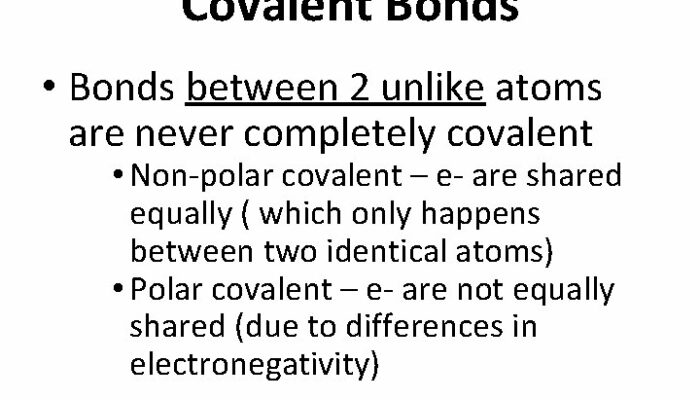
The polarity of molecules, determined by differences in electronegativity between bonded atoms, affects both covalent and molecular bonding. Polar covalent bonds create molecules with uneven charge distribution, enhancing intermolecular attractions.
In water, the oxygen atom’s higher electronegativity causes an unequal sharing of electrons, resulting in a polar molecule. This polarity strengthens hydrogen bonding between water molecules, influencing its physical properties.
Applications in Biochemistry and Materials Science
The interplay between covalent and molecular bonds is fundamental in various scientific fields:
- Biochemistry:
Proteins are formed by covalent bonds linking amino acids into chains, while their three-dimensional shapes and functions depend on intermolecular forces such as hydrogen bonds and van der Waals interactions. - Materials Science:
The physical properties of materials, including melting points, solubility, and conductivity, are influenced by the nature of their bonding. Polymers, for instance, exhibit different characteristics depending on whether covalent networks or intermolecular forces predominate.
Role in Nanotechnology
At the nanoscale, manipulating covalent and molecular bonds enables the creation of materials with novel properties. By controlling these interactions, scientists can engineer nanostructures with enhanced strength, electrical conductivity, or chemical reactivity, driving innovation in technology and materials engineering.
Common Misconceptions About Covalent and Molecular Bonds
Covalent and molecular bonds are identical.
Covalent bonds are intramolecular, holding atoms within a molecule together, whereas molecular bonds refer to intermolecular forces between separate molecules.
Intermolecular forces are as strong as covalent bonds.
Intermolecular forces are generally much weaker than covalent bonds but are crucial for determining physical properties like boiling and melting points.
Significance of Understanding These Bonds
Grasping the differences between covalent and molecular bonds is essential for comprehending the structure and behavior of matter. This knowledge underpins advances in chemistry, biology, materials science, and nanotechnology, enabling the design of new compounds and materials with tailored properties. Recognizing how atoms connect internally and how molecules interact externally provides a comprehensive view of chemical connectivity and its impact on the natural and technological world.
FAQ
What is the main difference between covalent and molecular bonds?
Covalent bonds are intramolecular bonds formed by the sharing of electrons between atoms within a molecule, while molecular bonds generally refer to intermolecular forces that exist between separate molecules.
Can covalent bonds be polar or nonpolar?
Yes, covalent bonds can be polar or nonpolar depending on the electronegativity difference between the bonded atoms.
What role do molecular bonds play in physical properties?
Molecular bonds, such as hydrogen bonding and dipole-dipole interactions, influence physical properties like boiling point, melting point, and solubility by governing interactions between molecules.
Are molecular bonds the same as hydrogen bonds?
Hydrogen bonds are a type of molecular (intermolecular) bond, but molecular bonds also include other forces like dipole-dipole and London dispersion forces.






Leave a Reply