

Short Answer
Definition of Medical Isotope Production Using Particle Accelerators
Medical isotope production through particle accelerators involves generating radioactive isotopes by bombarding stable target materials with high-energy particles, typically protons. These isotopes are indispensable in modern medicine, particularly for diagnostic imaging and targeted cancer therapies. This process leverages advanced physics principles to create isotopes that enable clinicians to visualize and treat diseases at the molecular level.
- Medical Isotopes:
Radioactive atoms used in medical diagnostics and treatments, often emitting radiation detectable by imaging devices or capable of delivering therapeutic doses to diseased tissues. - Particle Accelerators:
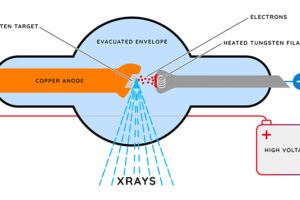
Machines that accelerate charged particles, such as protons, to high velocities to induce nuclear reactions in target materials, producing desired isotopes.
Historical and Technological Background
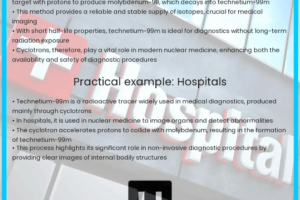
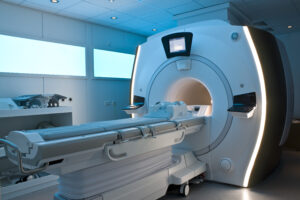
The advent of cyclotron technology in the 20th century marked a pivotal advancement in the production of medical isotopes. Cyclotrons accelerate protons to high energies, directing them onto stable nuclei like lithium or enriched oxygen. This interaction triggers nuclear transformations, converting stable atoms into radioactive isotopes such as Fluorine-18 and Carbon-11, which are essential for Positron Emission Tomography (PET) scans. These imaging techniques allow detailed visualization of metabolic and anatomical processes within the human body.
Mechanism of Isotope Production in Cyclotrons
Within a cyclotron, charged particles are propelled along a spiral path by a combination of magnetic and electric fields, gaining kinetic energy with each revolution. When these accelerated protons collide with a target material, nuclear reactions occur, resulting in the formation of radioactive isotopes. The choice of target and proton energy is carefully optimized to maximize yield and purity of the desired isotope.
Mathematical and Physical Principles
The production of medical isotopes can be described by nuclear reaction equations, where a proton (p) interacts with a target nucleus (X) to produce a radioactive isotope (Y) and other particles (n, α, etc.). For example:
p + X → Y + n
Here, p represents the incoming proton, X the target nucleus, Y the resultant radioactive isotope, and n a neutron emitted during the reaction. The reaction cross-section, energy thresholds, and half-life of the produced isotope are critical parameters influencing production efficiency and clinical utility.
Challenges in Medical Isotope Production
Producing medical isotopes presents several logistical and technical challenges. Many isotopes have very short half-lives, necessitating rapid synthesis and transport to clinical sites to ensure efficacy. For instance, Fluorine-18 decays with a half-life of approximately 110 minutes, requiring tightly coordinated production schedules. Additionally, maintaining the structural integrity and safety of cyclotron operations demands rigorous engineering and adherence to radiation protection standards.
Applications in Diagnostic Imaging and Therapy
Medical isotopes produced in accelerator labs are integral to both diagnostic and therapeutic procedures:
- Diagnostic Imaging:
Isotopes like Fluorine-18 are used in PET scans to detect metabolic activity, aiding in early disease diagnosis and monitoring. - Targeted Radiotherapy:
Radioisotopes can deliver precise radiation doses to malignant cells, minimizing damage to healthy tissues and enhancing treatment outcomes.
This precision medicine approach tailors treatments based on individual patient profiles, improving efficacy and reducing side effects.
Global Production and Supply Considerations
The worldwide demand for medical isotopes is rising due to increased diagnostic and therapeutic applications. The production network includes numerous facilities, research centers, and academic institutions collaborating internationally. However, geopolitical factors and supply chain vulnerabilities have underscored the importance of developing domestic and sustainable isotope production capabilities to ensure uninterrupted access.
Interdisciplinary Collaboration and Future Innovations
The field of medical isotope production exemplifies interdisciplinary cooperation among physicists, chemists, biologists, and clinicians. Ongoing research explores alternative target materials and novel accelerator designs, including compact systems that could decentralize isotope production. These innovations aim to enhance accessibility, reduce costs, and expand the range of available isotopes for medical use.
Ethical and Societal Implications
As medical isotope technologies advance, ethical considerations regarding equitable access become paramount. Ensuring that underserved populations benefit from isotope-based diagnostics and therapies is essential to achieving healthcare equity. The responsible stewardship of these powerful tools requires balancing innovation with social responsibility.
Significance in Modern Healthcare
The integration of particle accelerator technology into medicine has transformed diagnostic imaging and cancer treatment, enabling unprecedented insights into human biology and disease. By producing vital medical isotopes, accelerator labs contribute to improved patient outcomes, foster scientific discovery, and support the development of personalized medicine. This synergy between physics and healthcare continues to drive progress toward more effective and accessible medical solutions.
FAQ
What are medical isotopes?
Medical isotopes are radioactive atoms used in diagnostics and treatments, emitting radiation detectable by imaging devices or capable of delivering therapeutic doses.
How are medical isotopes produced?
Medical isotopes are produced by bombarding stable target materials with high-energy particles, typically protons, in particle accelerators.
What is the significance of Medical Isotope Production?
The production of medical isotopes is crucial for advancements in diagnostic imaging and targeted cancer therapies, enhancing patient care.



Leave a Reply