
Short Answer
Definition of String Theory
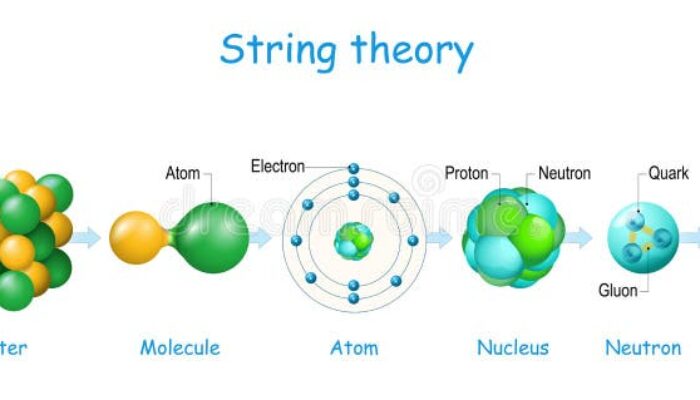
String theory is a groundbreaking concept in theoretical physics proposing that the fundamental constituents of the universe are not zero-dimensional point particles, but rather one-dimensional “strings” that vibrate at distinct frequencies. This framework aims to unify the four fundamental forces of nature-gravity, electromagnetism, the strong nuclear force, and the weak nuclear force-into a single, coherent theory. By interpreting particles as different vibrational modes of strings, string theory offers a novel perspective on the fabric of reality and the underlying structure of matter and energy.
Historical Background and Emergence
Developed in the late 20th century, string theory arose as an innovative response to persistent challenges in particle physics and cosmology. Traditional quantum field theories struggled to incorporate gravity consistently, especially at extremely small scales. String theory emerged as a candidate for a Theory of Everything (ToE), striving to reconcile the principles of quantum mechanics with general relativity. By extending the notion of particles to vibrating strings, it provides a potential framework to explain phenomena such as black holes, the Big Bang, and the fundamental nature of spacetime.
Core Principles and Mechanisms
At its essence, string theory posits that the universe’s fundamental particles are manifestations of one-dimensional strings oscillating in multiple modes. These vibrations determine the particle’s properties, such as mass and charge. Unlike point particles, strings have length but negligible thickness, allowing them to avoid certain infinities that plague quantum field theories. The theory also predicts the existence of additional spatial dimensions beyond the familiar three, which are compactified or hidden at scales beyond current experimental reach.
Extra Dimensions
- Concept:
String theory requires extra spatial dimensions-typically 10 or 11 total dimensions-to maintain mathematical consistency. - Implication:
These dimensions are compactified into complex shapes, such as Calabi-Yau manifolds, making them imperceptible at observable scales.
Mathematical Framework and Formulation
The mathematical structure of string theory is highly sophisticated, involving advanced geometry, topology, and quantum field theory. The fundamental formula relates the string’s vibrational modes to particle properties, often expressed through the string action, such as the Polyakov action:
S = -frac{T}{2} int d^2sigma sqrt{-h} h^{ab} partial_a X^mu partial_b X_mu
- S: The action describing the string’s dynamics.
- T: String tension, representing energy per unit length.
- sigma^a: Coordinates on the two-dimensional string worldsheet.
- X^mu: Embedding of the string in spacetime.
- h^{ab}: Metric on the worldsheet.
This formalism allows physicists to calculate the spectrum of possible string vibrations, corresponding to different particles, including the graviton, which mediates gravity.
The String Landscape and Multiverse Hypothesis
One of the most intriguing yet controversial aspects of string theory is the vast “landscape” of possible solutions, each representing a different vacuum state with unique physical laws and constants. This multiplicity suggests a multiverse scenario, where countless universes exist with varying properties.
- String Landscape:
The enormous number of mathematically consistent vacua, estimated to be around 10^500, each corresponding to a different universe. - Anthropic Principle:
The idea that only certain vacua allow for the emergence of life and consciousness, potentially explaining why our universe has the properties it does.
This raises profound philosophical questions about the scientific testability of string theory and the nature of physical reality.
Challenges in Experimental Verification
Despite its theoretical elegance, string theory faces significant hurdles in empirical testing. The energy scales at which string effects become prominent are far beyond the capabilities of current particle accelerators, such as the Large Hadron Collider (LHC). Consequently, direct experimental evidence remains elusive.
- Energy Scale Barrier:
String phenomena are expected near the Planck scale (~10^19 GeV), vastly exceeding present experimental reach. - Indirect Evidence:
Some hope to find signatures through cosmological observations or subtle effects in particle physics, but no definitive results have emerged.
Relationship with the Standard Model and Higgs Boson
The discovery of the Higgs boson in 2012 was a landmark confirmation of the Standard Model of particle physics, which string theory aims to extend or replace. However, the Higgs boson’s properties neither confirm nor invalidate string theory directly. Instead, they highlight the gap between established experimental frameworks and the speculative nature of string theory.
Philosophical Considerations and Scientific Methodology
The ongoing debate surrounding string theory underscores important philosophical issues in science, particularly regarding falsifiability and the role of empirical evidence. Historically, scientific theories have been validated through experimental confirmation, but string theory challenges this paradigm by existing largely beyond current testability.
- Speculation vs. Falsifiability:
Critics argue that without testable predictions, string theory risks becoming metaphysical rather than scientific. - Evolution of Scientific Inquiry:
Proponents suggest that new methodologies and technologies may eventually bridge the gap between theory and experiment.
Future Prospects and Research Directions
The future of string theory depends on innovative approaches to both theoretical development and experimental detection. Advances in computational techniques, interdisciplinary collaboration, and novel experimental designs may uncover indirect evidence or new phenomena consistent with string theory’s predictions.
- Quantum Gravity Frontier:
String theory remains a leading candidate for a quantum theory of gravity, a major unresolved problem in physics. - Technological Innovations:
Emerging technologies in particle physics and cosmology could provide new avenues for testing string theory.
Significance and Impact
String theory represents a monumental intellectual endeavor with the potential to revolutionize our understanding of the universe. By striving to unify all fundamental forces and particles within a single framework, it challenges and expands the boundaries of physics, mathematics, and philosophy. Its pursuit drives progress in multiple scientific disciplines and inspires ongoing exploration into the deepest questions about the cosmos.
Common Misconceptions About String Theory
String theory has been experimentally confirmed.
To date, string theory remains unverified by direct experimental evidence due to the extreme energy scales involved.
String theory predicts only one possible universe.
The theory allows for a vast “landscape” of possible universes, each with different physical laws.
String theory is purely speculative and lacks mathematical rigor.
String theory is built on a highly sophisticated and mathematically consistent framework, though its physical applicability is still under investigation.
FAQ
What is string theory?
String theory suggests that the fundamental constituents of the universe are one-dimensional strings rather than point particles, with vibrations determining particle properties.
Why can't string theory be tested easily?
Because the energies required to observe string effects exceed current technological capabilities, making direct experimental tests currently impossible.
What is meant by the 'string landscape'?
It refers to the large number of possible solutions in string theory, each corresponding to a different set of physical laws and constants.
How does string theory relate to the Higgs boson discovery?
The Higgs boson confirms aspects of the Standard Model, which string theory aims to supersede, but it neither confirms nor refutes string theory directly.
What philosophical issues does string theory raise?
It challenges the notion of falsifiability and the role of empirical evidence in science, as it currently lacks testable predictions.




Leave a Reply