
Short Answer
Definition of Stellar Evolution
Stellar evolution refers to the life cycle of stars, encompassing their formation, development, and eventual demise. This cosmic process unfolds over millions to billions of years, driven by complex physical phenomena that transform clouds of gas and dust into radiant celestial bodies and ultimately into remnants that seed the universe with new material.
- Star Formation:
The initial stage where dense regions within molecular clouds collapse under gravity to form protostars. - Main Sequence:
The longest phase in a star’s life, characterized by hydrogen fusion in the core, producing energy that balances gravitational forces. - Post-Main Sequence:
The phase where stars exhaust core hydrogen and undergo structural changes, leading to expansion or explosive ends. - Stellar Death:
The final stage, which varies by mass, resulting in white dwarfs, neutron stars, black holes, or supernova remnants.
Mechanisms Behind Star Formation
The birth of a star begins within vast molecular clouds composed primarily of hydrogen and helium, with traces of heavier elements. Gravitational forces cause these clouds to contract, increasing density and temperature in localized regions. This gravitational collapse leads to the formation of protostars, which accumulate mass by drawing in surrounding gas and dust. As the core temperature rises, nuclear fusion ignites, marking the transition from a protostar to a true star.
Main Sequence and Hydrostatic Equilibrium
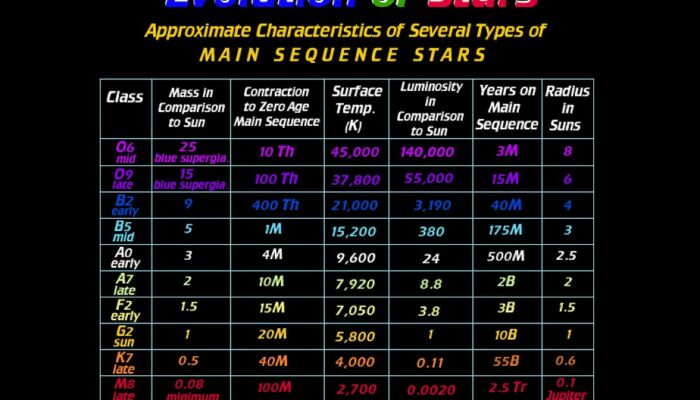
Once nuclear fusion starts, a star achieves hydrostatic equilibrium-a balance between the inward pull of gravity and the outward pressure from fusion-generated energy. During this stable phase, hydrogen nuclei fuse into helium, releasing vast amounts of energy that sustain the star’s luminosity and size. The duration of this phase depends heavily on the star’s initial mass: smaller stars like the Sun burn fuel slowly and steadily, while massive stars consume their fuel rapidly, leading to shorter lifespans.
Advanced Evolutionary Stages
As stars deplete hydrogen in their cores, they leave the main sequence and enter more complex evolutionary phases. Low to intermediate mass stars expand into red giants, cooling and swelling their outer layers. Inside, helium fusion begins, producing carbon and other heavier elements. This stage represents a delicate balance of contraction and expansion, where the star simultaneously approaches its end and contributes essential elements to the cosmos.
In contrast, massive stars undergo more violent transformations. Their cores collapse under immense gravity, triggering supernova explosions. These cataclysmic events generate extreme temperatures that facilitate the creation of elements heavier than iron through rapid neutron capture. The expelled outer layers enrich the interstellar medium, while the core may collapse into a neutron star or black hole, marking a dramatic conclusion to the star’s life.
Cosmic Recycling: The Aftermath of Stellar Death
The remnants of dying stars play a crucial role in shaping the universe. Supernovae and stellar winds disperse heavy elements into space, enriching molecular clouds and enabling the formation of new stars, planets, and potentially life. Nebulae, often visible as colorful clouds, serve as stellar nurseries where this recycled material coalesces into the next generation of celestial bodies. This ongoing cycle exemplifies the concept of cosmic alchemy, where matter is continuously transformed and repurposed across epochs.
Significance of Stellar Evolution in the Universe
Understanding stellar evolution is fundamental to grasping the structure and dynamics of galaxies, the distribution of elements, and the conditions necessary for habitability. The processes within stars forge the chemical building blocks essential for planets and life, linking stellar lifecycles directly to our own existence. Moreover, phenomena such as supernovae and black holes challenge and expand our knowledge of physics, driving scientific inquiry and technological advancement.
Common Misconceptions About Stellar Evolution
Stars live forever.
Stars have finite lifespans determined by their mass and fuel consumption, eventually evolving into remnants or exploding.
All stars end their lives as supernovae.
Only massive stars undergo supernova explosions; smaller stars typically become white dwarfs.
Stellar death is purely destructive.
While destructive, stellar death recycles elements into space, fostering new star and planet formation.
Reflecting on Our Cosmic Connection
The narrative of stellar evolution is a testament to the dynamic and interconnected nature of the universe. Each star’s journey from birth to death contributes to a grand cosmic cycle that shapes galaxies and enables life. Observing the stars is not merely an act of distant admiration but a recognition of our shared origins and ongoing relationship with the cosmos. The light we see from distant stars carries stories of creation, transformation, and renewal, reminding us of the transient yet beautiful nature of existence.
FAQ
What is stellar evolution?
Stellar evolution refers to the life cycle of stars, encompassing their formation, development, and demise.
What are the main stages of a star's life?
The main stages include Star Formation, Main Sequence, Post-Main Sequence, and Stellar Death.
How do stars contribute to the universe after they die?
Stars recycle heavy elements into space through processes like supernovae, enriching molecular clouds and enabling new star formation.



Leave a Reply