
Short Answer
Definition of Dark Energy
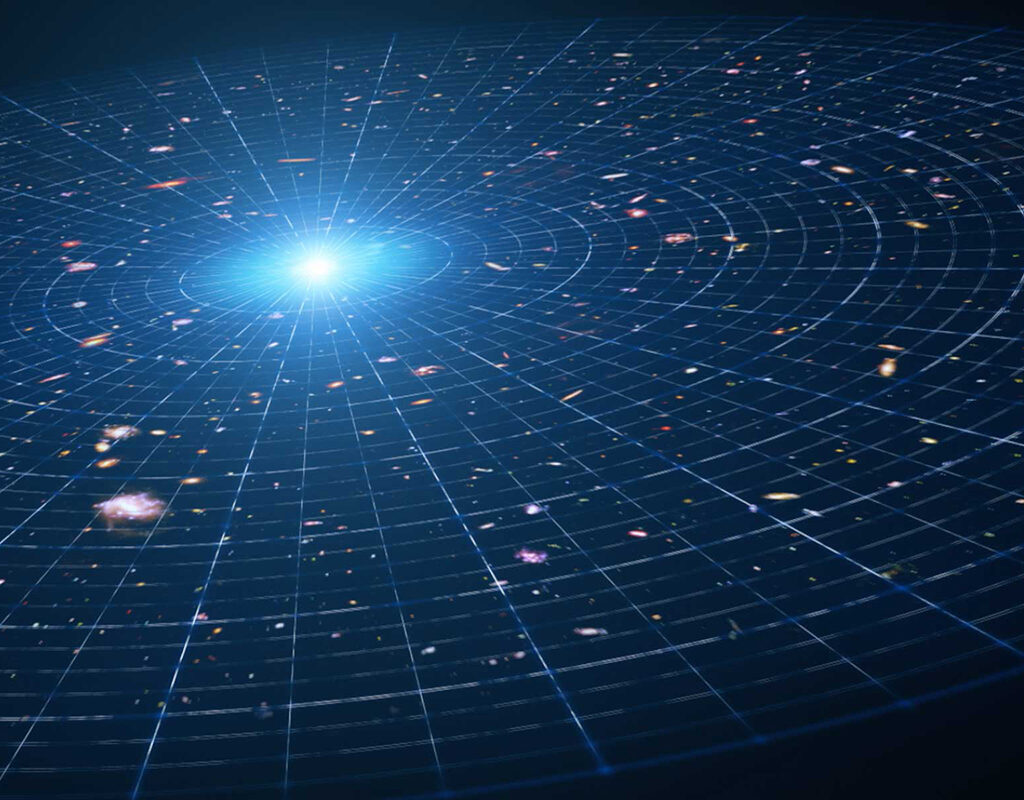
Dark energy is a mysterious and pervasive force that drives the accelerated expansion of the universe. Unlike ordinary matter or dark matter, it does not cluster or form structures but uniformly fills all of space, exerting a repulsive effect that counterbalances gravity. This enigmatic component constitutes a significant portion of the universe’s total energy content and fundamentally influences cosmic evolution.
- Nature:
A form of energy intrinsic to space itself, often associated with vacuum energy or a cosmological constant. - Effect:
Causes the expansion of the universe to speed up rather than slow down. - Distribution:
Homogeneously spread throughout the cosmos, unlike matter which clumps into galaxies and clusters.
Historical Context and Discovery
For much of scientific history, gravity was considered the dominant force shaping the universe’s fate, expected to slow cosmic expansion and possibly reverse it in a “Big Crunch.” However, observations in the late 20th century, particularly those studying distant supernovae, revealed that the universe’s expansion is not decelerating but accelerating. This unexpected discovery necessitated the introduction of dark energy as a new component in cosmological models to explain this acceleration.
Mechanism Behind Cosmic Acceleration
Dark energy operates by expanding the fabric of spacetime itself, rather than pushing galaxies through space. This expansion stretches the metric that defines distances in the universe, causing galaxies to move away from each other at increasing speeds. The repulsive effect of dark energy opposes the attractive force of gravity, leading to a dynamic interplay that governs the universe’s large-scale behavior.
Mathematical Framework and Theoretical Models
The phenomenon of dark energy is deeply rooted in Einstein’s General Theory of Relativity, which describes gravity as the curvature of spacetime. The cosmological constant (Λ), initially introduced by Einstein and later abandoned, has been revived as a simple model for dark energy, representing a constant energy density filling space uniformly.
However, this model raises profound questions:
- Why is the cosmological constant’s value extremely small but not zero?
- Does dark energy remain constant over time, or does it evolve?
Contemporary theories propose that dark energy might be dynamic, represented by a field that changes over cosmic epochs. This evolving nature could influence the universe’s ultimate fate, ranging from perpetual acceleration to scenarios like the “Big Rip,” where cosmic structures are torn apart, or a future where dark energy diminishes, allowing gravity to dominate once more.
Observational Evidence and Measurement Techniques
Determining the properties of dark energy relies on precise astronomical observations. Instruments monitor distant supernovae, galaxy clusters, and the cosmic microwave background to measure the rate of cosmic expansion and refine parameters such as the equation of state of dark energy. Despite advances, the subtle signature of dark energy remains challenging to isolate due to its interplay with matter, dark matter, and radiation.
Evolution of Dark Energy’s Influence Over Time
In the early universe, dark energy’s impact was negligible compared to the dense concentrations of matter and radiation. As the universe expanded and matter became more diffuse, dark energy’s relative contribution grew, driving the acceleration of cosmic expansion. This shift prompts new questions about how cosmic structures like galaxies and clusters formed amid competing forces and how different cosmic components interact over time.
Philosophical and Scientific Implications
Dark energy challenges traditional notions of emptiness by revealing that the vacuum of space is not truly empty but filled with energy that shapes the cosmos. This insight bridges quantum mechanics, where vacuum fluctuations are fundamental, with cosmology, governed by spacetime geometry and gravitation. Understanding dark energy is pivotal in the quest for a unified physical theory, potentially involving string theory, modifications to general relativity, or undiscovered particles and fields.
Significance in Cosmology and Beyond
Dark energy is central to modern cosmology, reshaping our understanding of the universe’s past, present, and future. Its discovery has revolutionized the cosmic narrative, highlighting a dynamic and evolving universe rather than a static one. The accelerating expansion driven by dark energy raises profound questions about the ultimate destiny of matter, life, and information in the cosmos, including the possibility of an isolated, ever-expanding universe.
Common Misconceptions About Dark Energy
Dark energy is the same as dark matter.
Dark energy and dark matter are distinct; dark matter exerts gravitational attraction and forms structures, while dark energy causes cosmic acceleration and is uniformly distributed.
Dark energy pushes galaxies through space.
Dark energy expands space itself, increasing the distance between galaxies without exerting a force that moves them through space.
The cosmological constant fully explains dark energy.
While the cosmological constant is a simple model, dark energy may be dynamic and evolving, requiring more complex theories.
Future Directions and Research
Ongoing and future observational campaigns aim to better characterize dark energy’s properties and behavior. Understanding whether dark energy is constant or dynamic will illuminate the universe’s fate and deepen our grasp of fundamental physics. As research progresses, dark energy remains a frontier of scientific inquiry, promising transformative insights into the nature of reality and the cosmos.
FAQ
What is dark energy?
A force that drives the accelerated expansion of the universe.
How does dark energy differ from dark matter?
Dark energy causes cosmic acceleration, while dark matter exerts gravitational attraction.
What are the implications of dark energy?
It challenges our understanding of the universe's structure and ultimate fate.


Leave a Reply