
Short Answer
Understanding Gravity and Its Traditional Interpretation
Gravity is commonly recognized as the fundamental force that governs the attraction between masses, holding planets, stars, and galaxies together. Historically, Sir Isaac Newton described gravity as a force acting at a distance between objects with mass. Later, Albert Einstein revolutionized this concept through his general theory of relativity, portraying gravity not as a force but as the curvature of spacetime caused by mass and energy. In this framework, massive bodies distort the fabric of spacetime, guiding the motion of other objects much like a heavy weight deforms a stretched rubber sheet.
Definition of Gravity as Spacetime Curvature
At its core, gravity is the manifestation of spacetime geometry bending in response to the presence of mass and energy. This geometric interpretation explains why objects follow curved paths in the presence of massive bodies, a phenomenon that replaces the classical notion of a force acting across empty space.
- Spacetime:
A four-dimensional continuum combining the three dimensions of space with time, which can be warped by mass and energy. - Curvature:
The bending or warping of spacetime that dictates the trajectories of objects under gravity.
The Expanding Universe and Its Implications
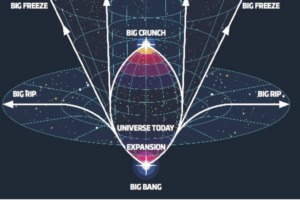
Observations reveal that the universe is not static but continuously expanding since the Big Bang. This expansion causes galaxies to move away from each other as space itself stretches. Dark energy, a mysterious form of energy permeating the cosmos, accelerates this expansion, influencing the large-scale structure and dynamics of the universe.
- Cosmic Expansion:
The increase in distance between distant galaxies due to the stretching of space. - Dark Energy:
An unknown energy component driving the accelerated expansion of the universe.
Exploring the Relationship Between Expansion and Gravity
At first glance, cosmic expansion and gravity appear to be opposing phenomena: expansion pushes objects apart, while gravity pulls them together. However, some theoretical perspectives propose that gravity might emerge as a consequence of the dynamic nature of expanding spacetime rather than being a fundamental force. This idea suggests that the stretching of space could influence microscopic degrees of freedom, leading to macroscopic effects perceived as gravitational attraction.
Emergent Gravity and Theoretical Frameworks
Several modern theories explore gravity as an emergent phenomenon arising from deeper physical principles:
- Entropic Gravity:
Proposes that gravity results from entropic forces linked to information encoded in spacetime, where the expansion reorganizes microscopic states to produce gravitational effects. - Holographic Principle:
Suggests that all information within a volume of space is encoded on its boundary, implying that changes in spatial geometry, including expansion, could give rise to gravity as a statistical outcome.
Scale-Dependent Dynamics: Gravity Versus Expansion
On vast cosmic scales, the expansion of space dominates, causing galaxies to recede from one another. Conversely, on smaller scales such as within galaxies or solar systems, gravity prevails, binding matter together. This scale-dependent behavior hints at a complex interplay where gravity might act as a local counterforce or emergent property balancing the expansive tendencies of spacetime.
Influence of Dark Energy on Gravity and Expansion
Dark energy’s role in accelerating cosmic expansion adds complexity to the potential connection between expansion and gravity. If gravity were directly caused by expansion, one might expect intricate feedback mechanisms between gravitational attraction and accelerated expansion, possibly leading to observable deviations from general relativity. Current observations neither fully confirm nor dismiss these possibilities, leaving room for further investigation.
Challenges in Attributing Gravity to Expanding Space
Despite its appeal, the hypothesis that gravity arises solely from expanding space faces significant conceptual hurdles. Gravity’s well-established properties-such as its universally attractive nature, inverse-square law behavior, and adherence to the equivalence principle-are elegantly explained by general relativity but are difficult to replicate through simple expansion models. Expansion typically induces a repulsive effect, pushing objects apart rather than drawing them together, making it challenging to reconcile with the observed gravitational pull.
Quantum Gravity and the Search for a Unified Explanation
The quest to unify gravity with quantum mechanics has led to theories like loop quantum gravity and string theory, which offer insights into how spacetime geometry and expansion at quantum scales might generate gravitational phenomena. These approaches suggest that gravity could emerge from the quantum properties of spacetime, potentially linking it to the universe’s expansion in ways not yet fully understood.
Why Investigating Gravity’s Origins Matters
Understanding whether gravity is a fundamental force or an emergent effect of expanding spacetime has profound implications for physics and cosmology. It challenges our comprehension of the universe’s structure, the nature of forces, and the interplay between large-scale cosmic behavior and local physical laws. This inquiry pushes the boundaries of scientific knowledge, inspiring new theories and experiments that could reshape our grasp of reality.
Summary and Future Directions
The proposition that gravity might stem from the expansion of space invites a reexamination of long-held assumptions about the universe. While current evidence supports gravity as a curvature of spacetime caused by mass-energy, alternative views enrich scientific discourse by offering fresh perspectives on cosmic phenomena. Ongoing research at the intersection of gravitational theory, cosmology, and quantum physics continues to explore these ideas, promising deeper insights into the fundamental workings of the cosmos.
FAQ
What is the main hypothesis discussed in the article?
The article discusses the hypothesis that gravity may be a result of the expansion of space rather than a fundamental force.
How does dark energy relate to gravity?
Dark energy accelerates the expansion of the universe, which complicates the relationship between gravity and cosmic expansion.
What are emergent theories of gravity?
Emergent theories propose that gravity could arise from deeper physical principles, such as entropic forces or information encoded in spacetime.
Why is understanding gravity's origins important?
It has profound implications for our understanding of the universe's structure and the nature of fundamental forces.


Leave a Reply