
Short Answer
Definition of the Universe’s Mass
The mass of the universe encompasses all matter and energy contained within the cosmos, including both visible and invisible components. Unlike everyday mass, which refers simply to the amount of matter in an object, the universe’s mass integrates ordinary matter, dark matter, and dark energy-each playing a distinct role in the cosmic balance. This total mass-energy content is fundamental to understanding the structure, evolution, and ultimate fate of the universe.
Components of the Universe’s Mass-Energy
The universe’s mass is not limited to the tangible matter we observe but includes several key constituents:
- Baryonic Matter:
This is the “normal” matter made up of atoms such as hydrogen and helium, forming stars, planets, and living beings. The observable universe contains roughly 1080 atoms, with a total baryonic mass estimated at about 1.5 x 1053 kilograms. - Dark Matter:
An invisible form of matter that does not emit or absorb light but exerts gravitational influence. Dark matter accounts for approximately 27% of the universe’s total mass-energy, shaping galaxy formation and cosmic structure. - Dark Energy:
A mysterious force responsible for the accelerated expansion of the universe, comprising about 68% of the total cosmic energy density. Although not mass in the traditional sense, dark energy significantly impacts the universe’s dynamics.
How the Universe’s Mass Influences Cosmic Structure
The distribution and quantity of mass in the universe govern the formation of galaxies, clusters, and large-scale cosmic web structures. Dark matter’s gravitational pull acts as a scaffold around which visible matter accumulates, while dark energy drives the expansion of space itself. The interplay between these components determines the universe’s geometry and evolution.
Measuring the Universe’s Mass
Determining the mass of the universe involves a combination of observational data and theoretical frameworks:
- Cosmic Microwave Background (CMB):
The residual radiation from the Big Bang provides a snapshot of the early universe. Variations in the CMB’s temperature allow scientists to infer the proportions of baryonic matter, dark matter, and dark energy. - Galaxy Surveys and Clustering:
Mapping the distribution of galaxies helps estimate the mass density and the influence of dark matter on large scales. - Gravitational Lensing:
The bending of light by massive objects acts as a natural cosmic scale, revealing the presence and quantity of otherwise invisible mass.
Mathematical Framework: Critical Density and Mass-Energy Balance
The concept of critical density is central to cosmology, representing the precise mass-energy density needed for the universe to be flat and balanced between perpetual expansion and eventual collapse. It is defined as:
ρc = (3H2)/(8πG)
- ρc: Critical density
- H: Hubble constant, the rate of cosmic expansion
- G: Gravitational constant
Current measurements indicate that the actual mass-energy density of the universe closely matches this critical value, implying a flat geometry on cosmic scales.
Implications for the Universe’s Fate
The total mass-energy content directly influences the universe’s long-term trajectory. While gravity from matter tends to slow expansion, the dominance of dark energy causes acceleration, suggesting a future where the cosmos expands indefinitely. This scenario leads to the “heat death,” a state of maximum entropy where stars burn out and matter becomes increasingly diffuse.
Observable Universe vs. Entire Universe
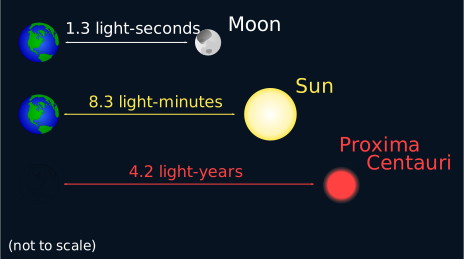
Our measurements are confined to the observable universe, a spherical region about 93 billion light-years across from which light has reached us since the Big Bang. Beyond this horizon, the universe may be infinite, making the total mass potentially limitless and beyond direct quantification. This distinction highlights the challenges in defining the universe’s mass in absolute terms.
Common Misconceptions About the Universe’s Mass
The universe’s mass is composed only of visible matter.
Visible matter constitutes only about 5% of the total mass-energy; dark matter and dark energy make up the vast majority.
Dark energy is a form of mass.
Dark energy is an energy component causing accelerated expansion, not mass in the traditional sense.
The universe’s mass can be directly weighed like an object.
The universe’s mass is inferred through indirect measurements such as gravitational effects and cosmic background radiation.
Significance of Understanding the Universe’s Mass
Grasping the mass composition of the universe is crucial for multiple scientific fields, including cosmology, astrophysics, and fundamental physics. It informs models of cosmic evolution, the behavior of gravity on large scales, and the ultimate destiny of all matter and energy. Moreover, it challenges our understanding of the nature of matter, energy, and the fabric of spacetime itself, driving ongoing research and discovery.
Summary
The mass of the universe is a complex amalgam of ordinary matter, dark matter, and dark energy, each contributing uniquely to the cosmos’s structure and dynamics. While the observable universe provides a measurable snapshot, the full extent of the universe’s mass may be infinite and remains a profound mystery. Through advanced observational techniques and theoretical insights, scientists continue to unravel this cosmic enigma, deepening our appreciation of the universe’s vastness and intricacy.

Leave a Reply