
Short Answer
Definition of Dark Energy and Space
Dark energy is a mysterious form of energy that permeates the universe, driving its accelerated expansion. It constitutes roughly 68% of the universe’s total energy content and exhibits a repulsive effect that counteracts gravitational attraction. Space, traditionally viewed as an empty, passive void, is now considered by some theories to be intrinsically linked with dark energy, suggesting that space itself may be composed of this enigmatic force.
- Dark Energy:
A form of energy causing the universe’s expansion to accelerate, discovered through observations of distant supernovae and cosmic microwave background radiation. - Space:
Once thought to be a mere emptiness, space may possess physical properties due to the presence of vacuum energy, which is closely associated with dark energy.
The Role of Dark Energy in Cosmic Expansion
Contrary to the expectation that gravity should slow the universe’s growth, dark energy exerts a repulsive force that accelerates cosmic expansion. This phenomenon was first inferred from the unexpected dimming of distant supernovae and has since been supported by measurements of the cosmic microwave background. The acceleration implies that the universe is stretching at an ever-increasing rate, reshaping our understanding of its large-scale dynamics.
Quantum Vacuum Energy and Its Connection to Dark Energy
Quantum field theory reveals that even “empty” space is filled with fluctuating quantum fields, producing a baseline energy known as vacuum energy. This vacuum energy is often identified with the cosmological constant in Einstein’s equations, representing a uniform energy density throughout space. If dark energy is indeed vacuum energy, then space is not an inert void but a dynamic entity imbued with this energy, which drives the universe’s accelerated expansion.
Space as a Dynamic Entity
Emerging theories suggest that space is more than a passive backdrop; it is a dynamic fabric whose properties are shaped by dark energy. This perspective aligns with modern physics, which links spacetime geometry to energy fields. Instead of being an empty container, space may be a living canvas, its structure and evolution governed by the energy it contains.
Implications for the Universe’s Fate
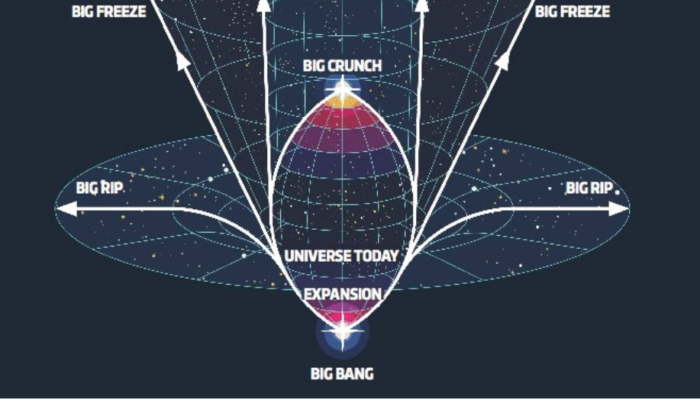
If dark energy uniformly fills space and continues to drive acceleration, the universe is likely to expand forever. This scenario leads to the “Big Freeze” or “Heat Death,” where galaxies drift beyond observable limits, stars burn out, and matter decays into entropy. The intimate relationship between space’s composition and cosmic destiny highlights the profound significance of understanding dark energy.
The Cosmological Constant Problem and Alternative Theories
One of the greatest puzzles in physics is the cosmological constant problem: theoretical calculations of vacuum energy exceed observed values by many orders of magnitude. This discrepancy indicates gaps in our comprehension of dark energy and space. Alternative models, such as quintessence, propose that dark energy is a dynamic field that changes over time and space, complicating the notion of space’s composition and inviting further theoretical development.
Quantum Entanglement, Holography, and the Nature of Spacetime
Advanced concepts in quantum physics, including entanglement and holographic principles, suggest that spacetime itself may emerge from more fundamental quantum information units called qubits. From this viewpoint, dark energy could be an emergent property arising from the underlying quantum structure of spacetime. This radical idea challenges classical views and points toward a future where space is understood as a construct of quantum information rather than a fundamental entity.
Philosophical and Metaphysical Considerations
The hypothesis that space is composed of dark energy blurs the line between emptiness and substance, prompting profound philosophical questions. Is the vacuum truly empty, or is it filled with latent energy that shapes reality at every scale? This inquiry not only advances scientific understanding but also influences our existential perspective on the nature of existence and our place in the cosmos.
Why Understanding Dark Energy and Space Matters
Grasping the relationship between dark energy and space is crucial for cosmology, physics, and our broader comprehension of the universe. It informs predictions about the universe’s ultimate fate, guides the development of new physical theories, and challenges foundational concepts about reality. As observational tools and theoretical frameworks improve, unraveling this mystery will deepen humanity’s insight into the cosmos and the fundamental nature of existence.
Summary
The question of whether space itself is made of dark energy invites a transformative reevaluation of the universe. Dark energy, potentially synonymous with vacuum energy, may imbue space with dynamic properties that drive cosmic acceleration. This perspective reshapes our understanding of space from a passive void to an active participant in cosmic evolution, with profound implications for physics, cosmology, and philosophy. Ongoing research continues to explore this frontier, promising to expand the horizons of human knowledge and imagination.


Leave a Reply