
Short Answer
Definition of Dark Matter
Dark matter is a mysterious form of matter that permeates the universe, constituting approximately 85% of all matter. Unlike ordinary matter, it neither emits nor absorbs light, making it invisible to traditional observational methods. Despite its elusive nature, dark matter plays a crucial role in shaping the structure and evolution of the cosmos, influencing the formation of galaxies and the large-scale arrangement of cosmic matter.
- Invisible Substance:
Dark matter does not interact with electromagnetic radiation, rendering it undetectable by conventional telescopes. - Dominant Mass Component:
It accounts for the majority of matter in the universe, far exceeding the amount of visible matter. - Cosmic Architect:
Its gravitational effects govern the dynamics of galaxies and clusters, acting as an unseen scaffold for cosmic structures.
Observational Evidence and Gravitational Effects
Although dark matter cannot be observed directly, its presence is inferred through its gravitational influence on visible matter and light. Astronomers have long noted discrepancies in the motion of stars within galaxies, where stars orbit at speeds that visible matter alone cannot explain. This anomaly suggests an additional, unseen mass exerting gravitational pull.
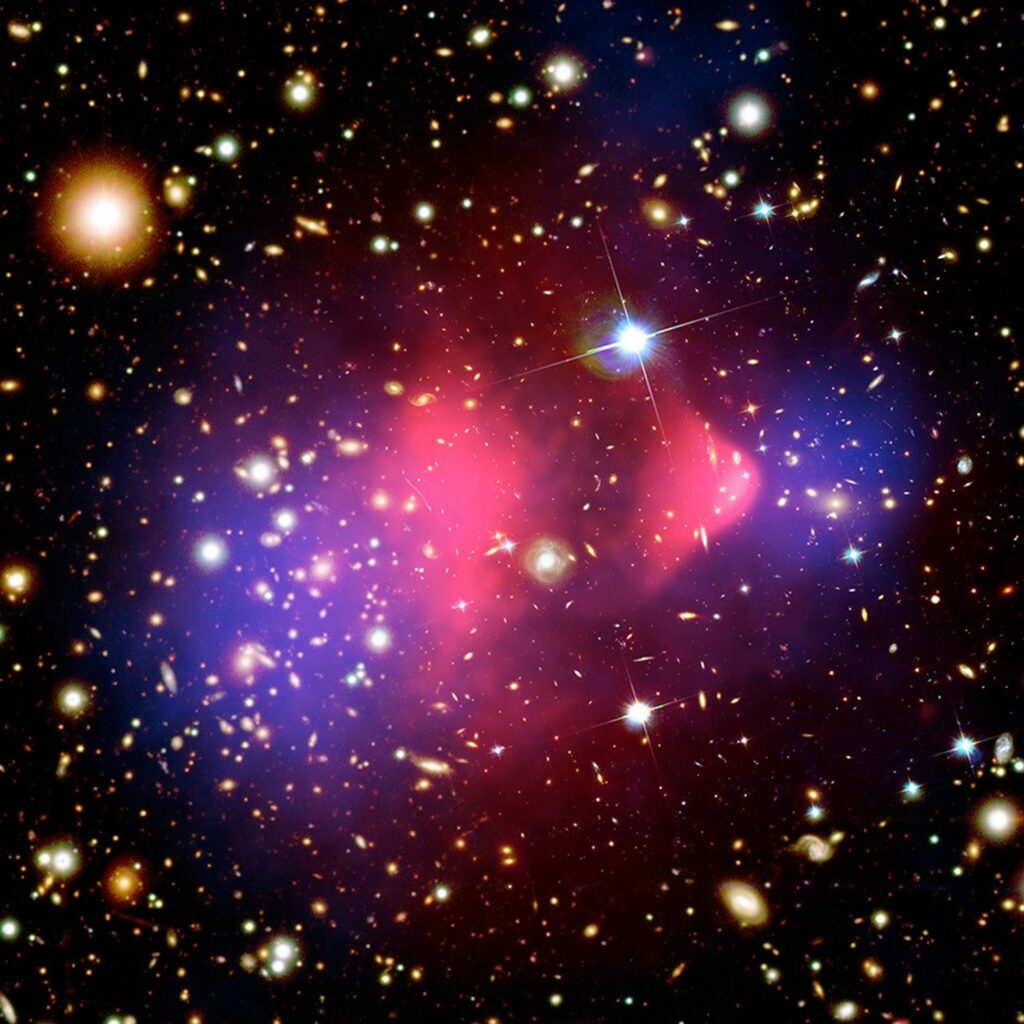
Another compelling piece of evidence comes from gravitational lensing, where light from distant objects bends around massive, invisible structures. This bending reveals the presence of dark matter concentrations that warp spacetime, confirming its role as a significant mass contributor in the universe.
Theoretical Candidates for Dark Matter
Scientists have proposed various particles as potential constituents of dark matter, each with unique properties and detection challenges.
- Weakly Interacting Massive Particles (WIMPs):
Hypothetical particles that interact weakly with normal matter and could have been produced in the early universe. Despite extensive searches using underground detectors, WIMPs remain undetected. - Axions:
Ultra-light particles arising from quantum field theories, which may interact so faintly that current instruments struggle to detect them. - Sterile Neutrinos:
Hypothetical neutrino variants that do not interact via the standard weak force, making them difficult to observe but viable dark matter candidates.
Alternative Theories and Paradigm Shifts
Given the persistent absence of direct detection, some researchers have explored alternatives to particle dark matter. One such approach involves modifying the laws of gravity to account for the observed cosmic phenomena without invoking unseen matter. These modified gravity theories attempt to replicate dark matter’s effects but face significant challenges in explaining all astrophysical data, especially on large scales.
Challenges in Detection and Experimental Efforts
Detecting dark matter particles is an immense technical challenge due to their extremely weak interactions and low expected event rates. Experiments require highly sensitive detectors shielded from cosmic rays and natural radioactivity, often located deep underground or in isolated environments. Despite advances in cryogenic technology and ultra-pure materials, no conclusive dark matter signals have been observed to date.
The vast range of possible particle masses and interaction strengths creates a complex parameter space that scientists must explore. Each experiment narrows down this space, but the true nature of dark matter remains elusive, demanding innovative detection strategies and interdisciplinary collaboration.
Complexity and Potential Nature of Dark Matter
Dark matter might possess properties beyond current theoretical frameworks. It could interact through unknown forces or be composed of composite entities that blur the distinction between particle physics and astrophysics. This complexity adds layers to the challenge of understanding dark matter, situating its study at the intersection of cosmology, particle physics, and astronomy.
Scientific Significance and Broader Impact
The pursuit of dark matter has driven remarkable progress in multiple scientific fields. The development of sophisticated detectors pushes the limits of engineering and materials science, while theoretical investigations expand our grasp of fundamental physics and cosmic evolution. The search for dark matter exemplifies humanity’s quest to comprehend the universe’s hidden dimensions, inspiring new technologies and deepening our cosmic insight.
Conclusion: The Ongoing Quest
Dark matter remains one of the most profound mysteries in modern science, representing an unseen force that shapes the universe’s grand design. Its study challenges our understanding of reality, pushing the boundaries of observation and theory. As researchers continue to probe this cosmic enigma, each discovery brings us closer to unveiling the true nature of the universe, promising transformative insights that could redefine our place in the cosmos.

Leave a Reply