

Short Answer
Definition of the Big Bang Theory and Dark Matter
The Big Bang Theory is a cornerstone scientific model that explains the origin and development of the universe. It describes how the cosmos began from an extremely hot and dense singularity roughly 13.8 billion years ago and has been expanding ever since. Dark matter, on the other hand, is an invisible form of matter that makes up about 27% of the universe’s total mass-energy content. Although it cannot be observed directly through emitted or absorbed light, its presence is inferred from its gravitational effects on visible matter and cosmic structures.
- Big Bang Theory:
A cosmological model describing the universe’s expansion from a primordial singularity and the subsequent formation of cosmic structures. - Dark Matter:
A non-luminous substance that exerts gravitational influence, essential for explaining galaxy rotation curves and large-scale cosmic architecture.
How the Big Bang Theory Accounts for Cosmic Evolution
The Big Bang Theory provides a comprehensive framework for understanding the universe’s expansion and cooling over billions of years. It outlines the timeline from the initial singularity through key phenomena such as the cosmic microwave background radiation (CMB) and the synthesis of light elements. Importantly, the theory sets the initial conditions and physical laws that govern cosmic evolution but does not specify the exact composition of all matter and energy in the universe. This flexibility allows for the incorporation of discoveries like dark matter without contradicting the core principles of the model.
The Role of Dark Matter in Cosmic Structure Formation
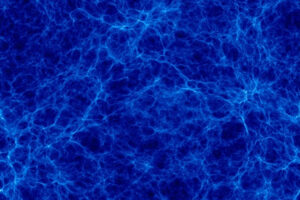
Dark matter plays a pivotal role in shaping the universe’s large-scale structure. Observations of the CMB reveal tiny fluctuations in temperature and density that serve as the seeds for galaxy and cluster formation. However, the gravitational pull from ordinary matter alone is insufficient to explain the growth of these structures. Dark matter acts as an invisible gravitational scaffold, amplifying these primordial perturbations and enabling the formation of the cosmic web observed today. Without dark matter, simulations based on Big Bang cosmology fail to reproduce the universe’s observed complexity.
Scientific Evidence Supporting Dark Matter
The hypothesis of dark matter emerged to resolve discrepancies in galaxy rotation speeds and has since been supported by multiple lines of evidence:
- Galaxy Rotation Curves:
Stars in galaxies orbit faster than can be accounted for by visible matter alone, implying additional unseen mass. - Gravitational Lensing:
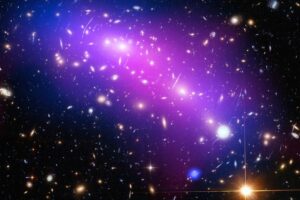
The bending of light around massive objects reveals more mass than what is visible, consistent with dark matter presence. - Cosmic Microwave Background Anisotropies:
Variations in the CMB temperature align with models that include dark matter to explain early universe density fluctuations. - Galaxy Cluster Dynamics:
The motion of galaxies within clusters indicates more mass than detected by electromagnetic observations.
Alternative Theories and Their Challenges
Some alternative models, such as Modified Newtonian Dynamics (MOND), attempt to explain cosmic phenomena without invoking dark matter by altering gravitational laws. However, these theories struggle to comprehensively account for the full range of observational data as effectively as the dark matter-inclusive Big Bang framework. Consequently, the scientific consensus favors dark matter as a more consistent and robust explanation within modern cosmology.
Philosophical and Scientific Significance of Dark Matter
Dark matter not only addresses gaps in our understanding of cosmic structure but also challenges the limits of human perception and knowledge. Approximately a quarter of the universe’s matter is invisible, yet it fundamentally holds galaxies and clusters together. This paradox highlights the profound mysteries still embedded in the cosmos and exemplifies the evolving nature of scientific inquiry, where new discoveries expand and refine existing paradigms rather than discard them.
Why Dark Matter Enhances the Big Bang Theory
Far from undermining the Big Bang Theory, dark matter enriches it by filling in critical gaps and aligning with its predictive framework. The interplay between dark matter and the Big Bang model exemplifies the dynamic relationship between observation and theory in science. This synergy drives ongoing research and deepens our understanding of the universe’s origins, composition, and evolution.
Conclusion: The Continuing Cosmic Journey
In summary, dark matter complements and strengthens the Big Bang Theory by explaining phenomena that visible matter alone cannot. Its discovery underscores the adaptability and resilience of scientific models in the face of new evidence. As research progresses, dark matter remains a beacon guiding physicists and cosmologists toward a more complete picture of the universe, illustrating that the story of the cosmos is far from complete and continues to unfold with each new insight.




Leave a Reply