
Short Answer
Definition of Dark Energy
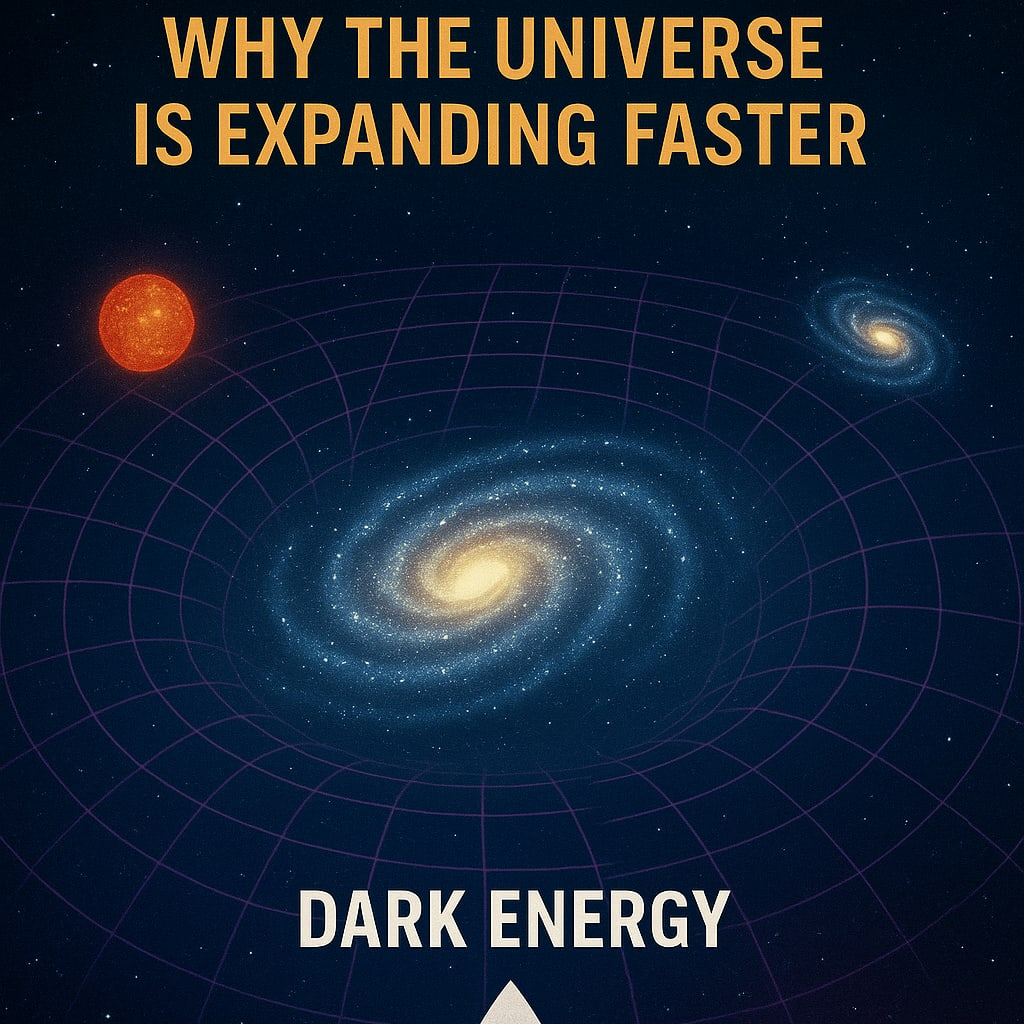
Dark energy is a mysterious and invisible force believed to be responsible for the accelerated expansion of the universe. Unlike ordinary matter or energy, it does not emit, absorb, or reflect light, making it undetectable through direct observation. Instead, its presence is inferred from its gravitational effects on cosmic structures and the large-scale behavior of the universe.
- Nature:
Dark energy is a form of energy that permeates all of space uniformly, exerting a repulsive pressure that counteracts gravity. - Prevalence:
It constitutes approximately 68% of the total energy content of the cosmos, surpassing both visible matter and dark matter. - Significance:
It is the primary driver behind the universe’s accelerating expansion, a phenomenon that challenges conventional physics.
Historical Context and Discovery
For centuries, scientists assumed that the universe’s expansion, initiated by the Big Bang, would gradually slow down due to the gravitational pull of matter. The prevailing expectation was that this deceleration might eventually lead to a contraction or “big crunch.” However, groundbreaking observations in the late 1990s, particularly studies of distant Type Ia supernovae and measurements of the cosmic microwave background radiation, revealed a startling truth: the expansion of the universe is not slowing but accelerating.
This unexpected finding necessitated a radical shift in cosmological models, introducing the concept of dark energy as an unknown force driving this acceleration. The discovery has since become one of the most profound puzzles in modern astrophysics.
Theoretical Models Explaining Dark Energy
The Cosmological Constant
One of the earliest and most widely discussed explanations for dark energy is the cosmological constant, a concept introduced by Albert Einstein in his field equations of General Relativity. Einstein originally proposed it as a constant energy density inherent to empty space, exerting a negative pressure that opposes gravitational attraction.
Although Einstein later abandoned the cosmological constant, calling it his “biggest blunder,” it regained prominence after the discovery of cosmic acceleration. Despite its elegance, this model faces a significant challenge: quantum field theory predicts a vacuum energy density vastly larger than what is observed, leading to a major unresolved discrepancy known as the “cosmological constant problem.”
Quintessence: A Dynamic Field
Another compelling hypothesis treats dark energy as a dynamic, evolving scalar field called quintessence. Unlike the fixed value of the cosmological constant, quintessence can vary over time and space, potentially altering the rate of cosmic expansion as the universe evolves.
This model opens the possibility of detecting changes in dark energy’s properties through future astronomical observations, but it also complicates efforts to precisely characterize the nature of this enigmatic force.
Mechanism Behind Cosmic Acceleration
Dark energy exerts a form of negative pressure that counterbalances the attractive force of gravity on cosmological scales. This repulsive effect causes the fabric of space-time to stretch at an increasing rate, leading to the observed acceleration in the universe’s expansion. The exact mechanism remains elusive, but it fundamentally alters the dynamics of cosmic evolution.
Mathematical Representation
The influence of dark energy is often incorporated into Einstein’s field equations through the cosmological constant (Λ). The modified equation can be expressed as:
Gμν + Λgμν = (8πG/c⁴) Tμν
- Gμν: Einstein tensor describing the curvature of space-time.
- Λ (Lambda): Cosmological constant representing dark energy density.
- gμν: Metric tensor defining the geometry of space-time.
- Tμν: Energy-momentum tensor of matter and radiation.
- G: Gravitational constant.
- c: Speed of light.
The cosmological constant Λ acts as a uniform energy density with negative pressure, driving the accelerated expansion.
Implications for the Universe’s Fate
The presence and properties of dark energy have profound consequences for the ultimate destiny of the cosmos. Several scenarios have been proposed based on how dark energy behaves over time:
- Big Freeze (Heat Death):
If dark energy remains constant or slowly increases, galaxies will drift beyond observable horizons, stars will burn out, and the universe will become a cold, dark, and dilute expanse. - Big Rip:
In more extreme models where dark energy’s strength grows without bound, it could eventually overcome all forces, tearing apart galaxies, solar systems, planets, and even atomic structures. - Stable Expansion:
If dark energy stabilizes, the universe may continue expanding at a steady accelerated rate indefinitely.
Current Research and Observational Efforts
Scientists employ a variety of observational techniques to better understand dark energy, including:
- Supernova Surveys:
Measuring the brightness and redshift of distant supernovae to track expansion history. - Cosmic Microwave Background (CMB):
Analyzing fluctuations in the CMB to infer the universe’s composition and geometry. - Galaxy Redshift Surveys:
Mapping the large-scale distribution of galaxies to detect the influence of dark energy on structure formation. - Gravitational Lensing:
Studying the bending of light by massive objects to probe the distribution of dark energy and dark matter.
Future missions and telescopes, such as the Euclid satellite and the Vera C. Rubin Observatory, aim to provide more precise data to constrain dark energy models.
Challenges and Open Questions
- Misconception: Dark energy is the same as dark matter.
Correction: Dark energy and dark matter are distinct; dark matter exerts gravitational attraction, while dark energy causes repulsion and accelerated expansion. - Misconception: Dark energy can be directly detected with current instruments.
Correction: Dark energy is inferred indirectly through its gravitational effects; it does not interact with electromagnetic radiation. - Misconception: The cosmological constant fully explains dark energy.
Correction: While the cosmological constant is a leading model, alternative theories like quintessence remain viable and under investigation.
Significance of Dark Energy in Science and Cosmology
Understanding dark energy is crucial for comprehending the universe’s large-scale structure, evolution, and ultimate fate. It challenges the foundations of physics, prompting revisions to General Relativity and inspiring new theories that bridge cosmology and particle physics. The study of dark energy exemplifies the dynamic interplay between observation and theory, driving scientific progress and expanding our grasp of the cosmos.
Conclusion: The Ongoing Quest to Unveil Dark Energy
Dark energy remains one of the most profound mysteries in contemporary science, symbolizing the limits of human knowledge and the vast complexity of the universe. Its discovery has revolutionized cosmology, raising fundamental questions about the nature of space, time, and energy. As research advances, the hope is that unraveling the secrets of dark energy will not only illuminate the cosmic expansion but also redefine our understanding of the universe and our place within it.
FAQ
What is dark energy?
Dark energy is a mysterious force that accelerates the universe's expansion and constitutes about 68% of its energy content.
How does dark energy differ from dark matter?
Dark energy causes the universe to expand, while dark matter has gravitational effects on visible matter.
What are the implications of dark energy?
Depending on its behavior, dark energy could lead to scenarios like the Big Freeze or Big Rip.


Leave a Reply