
Short Answer
Definition of Bosonic Entanglement
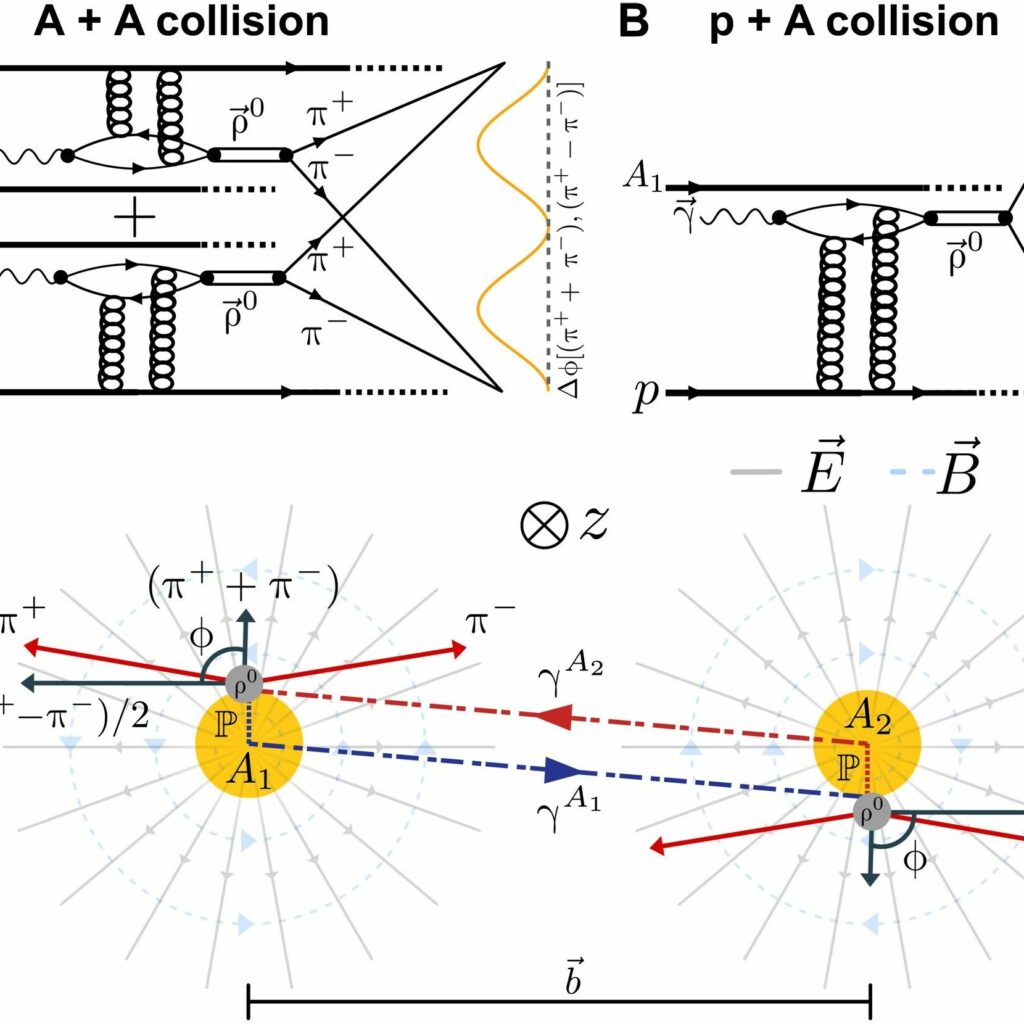
Bosonic entanglement refers to the quantum phenomenon where bosons-particles with integer spin-become interconnected such that the state of each particle cannot be described independently of the others. This entanglement leads to correlations that persist regardless of the spatial separation between the particles, revealing fundamental aspects of quantum mechanics and particle behavior.
- Bosons:
Particles like photons, gluons, and Higgs bosons characterized by integer spin values, which allow them to occupy identical quantum states simultaneously. - Entanglement:
A non-classical linkage between particles where their quantum states are interdependent, defying classical intuitions about locality and individuality. - Quantum Threesome:
A specific entangled state involving three bosons, exhibiting complex multipartite correlations that cannot be reduced to simpler two-particle entanglements.
Fundamental Properties of Bosons
Unlike fermions, which adhere to the Pauli exclusion principle preventing identical particles from sharing the same quantum state, bosons inherently tend to cluster together in the same state. This unique trait enables phenomena such as Bose-Einstein condensation and facilitates the formation of entangled states with multiple bosons occupying identical or symmetrically related quantum configurations.
- Integer Spin:
Bosons possess whole-number spin values (0, 1, 2, etc.), distinguishing them from half-integer spin fermions. - Symmetric Wavefunctions:
The quantum wavefunction describing bosons is symmetric under particle exchange, allowing multiple bosons to coexist in the same quantum state. - Collective Behavior:
This symmetry leads to collective quantum phenomena, such as superfluidity and coherent light emission in lasers.
Mechanism of Bosonic Entanglement
Entanglement among bosons arises when their quantum states become inseparably linked through interactions or shared histories, resulting in a composite system where measurement outcomes on one particle instantaneously influence the others. This phenomenon transcends classical correlations and is a cornerstone of quantum information science.
- Nonlocal Correlations:
The entangled bosons exhibit correlations that cannot be explained by classical physics, persisting even when particles are separated by large distances. - Multipartite Entanglement:
Involving three or more bosons, this form of entanglement creates complex states that cannot be decomposed into simpler pairwise entanglements. - Quantum Threesome Dynamics:
The entanglement of three bosons forms a unique state where each particle’s quantum properties are intricately connected to the others, enabling novel quantum effects.
Mathematical Framework and Formulas
The mathematical description of bosonic entanglement involves symmetric wavefunctions and density matrices that capture multipartite correlations. For three bosons, the state can be represented as:
|Ψ⟩ = Σ c_{ijk} |i⟩|j⟩|k⟩,
where c_{ijk} are complex coefficients symmetric under particle exchange, and |i⟩, |j⟩, |k⟩ denote the single-particle quantum states.
- Symmetry Condition:
c_{ijk} = c_{jik} = c_{ikj} = … ensuring the wavefunction remains unchanged under permutation of bosons. - Genuine Multipartite Entanglement:
A state is genuinely multipartite entangled if it cannot be factored into a product of states involving fewer particles, reflecting inseparability across all three bosons. - Density Matrix Representation:
The density matrix ρ for the system encodes all statistical properties and is used to quantify entanglement measures such as entanglement entropy or negativity.
Applications and Real-World Examples
Entangled bosonic states have practical implications in emerging quantum technologies, including quantum computing, secure communication, and quantum teleportation. Experimental setups often utilize photons-bosons of light-to demonstrate and harness these entangled states.
- Quantum Teleportation:
Using entangled photons, information can be transmitted instantaneously between distant locations, leveraging the multipartite entanglement of bosons. - Quantum Cryptography:
Entangled bosons enable protocols for secure communication that are fundamentally protected by the laws of quantum mechanics. - Bose-Einstein Condensates:
Macroscopic quantum states formed by bosons at ultra-low temperatures exhibit entanglement properties that inform studies of quantum phase transitions and novel states of matter.
Challenges in Understanding and Utilizing Bosonic Entanglement
Despite significant progress, several obstacles hinder the full exploitation of bosonic entanglement in practical applications. Chief among these are issues related to decoherence and measurement-induced disturbances.
- Decoherence:
Interaction with the environment causes loss of quantum coherence, degrading entanglement especially in systems with multiple bosons. - Measurement Difficulties:
Observing entangled states without collapsing them requires sophisticated techniques to preserve quantum correlations. - Scalability:
Extending entanglement to larger numbers of bosons while maintaining coherence remains a significant technical challenge.
Philosophical and Theoretical Implications
The study of bosonic entanglement also prompts profound questions about the nature of individuality and identity in quantum systems. The indistinguishability and delocalization of bosons challenge classical notions of particles as discrete entities.
- Redefining Individuality:
Entangled bosons suggest that particles cannot always be treated as separate, independent objects in quantum theory. - Measurement and Reality:
The outcomes of measurements on entangled bosons depend on the entire system’s state, complicating interpretations of quantum mechanics. - Ontological Questions:
The existence of multipartite entangled states invites reconsideration of what constitutes a “particle” and how quantum information is fundamentally encoded.
Significance in Modern Science and Technology
Understanding bosonic entanglement is pivotal for advancing quantum science and technology. It underpins the development of next-generation quantum devices that promise to revolutionize computation, communication, and sensing.
- Quantum Computing:
Harnessing multipartite entanglement among bosons can lead to more powerful and fault-tolerant quantum processors. - Secure Communication:
Entangled bosons enable protocols that guarantee security based on quantum principles rather than computational complexity. - Fundamental Physics:
Insights into bosonic entanglement deepen our understanding of quantum field theory, phase transitions, and the fabric of reality itself.
FAQ
What is bosonic entanglement?
Bosonic entanglement is a quantum phenomenon where bosons become interconnected such that their quantum states cannot be described independently, resulting in correlated measurement outcomes.
How does bosonic entanglement differ from fermionic entanglement?
Bosons have integer spins and symmetric wavefunctions allowing multiple bosons to occupy the same state, whereas fermions have half-integer spins and obey the Pauli exclusion principle, preventing identical fermions from sharing the same quantum state.
What is a quantum threesome in bosonic entanglement?
A quantum threesome refers to a specific entangled state involving three bosons exhibiting multipartite correlations that cannot be reduced to simpler two-particle entanglements.
What are the practical applications of bosonic entanglement?
Applications include quantum computing, secure quantum communication, quantum teleportation, and studies involving Bose-Einstein condensates.
What challenges exist in utilizing bosonic entanglement?
Challenges include decoherence due to environmental interactions, measurement difficulties without collapsing entangled states, and scalability to larger boson systems.




Leave a Reply