
Short Answer
Definition of Gravitational Waves
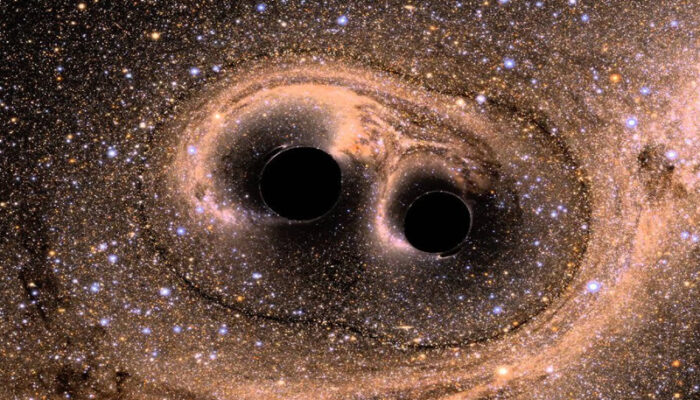
Gravitational waves are ripples in the fabric of spacetime generated by the acceleration of massive celestial objects. These waves propagate outward at the speed of light, carrying information about some of the most energetic and dramatic events in the cosmos, such as the collision of black holes, the merging of neutron stars, or the primordial echoes from the Big Bang.
- Nature:
Disturbances in spacetime curvature caused by accelerating masses. - Origin:
Produced by cataclysmic astrophysical phenomena involving massive bodies. - Propagation:
Travel as waves at light speed, stretching and compressing spacetime as they pass.
How Gravitational Waves Interact with Matter
As gravitational waves traverse the universe, they induce incredibly subtle distortions in spacetime. By the time these waves reach Earth, their effects are extraordinarily faint, causing displacements far smaller than atomic nuclei. This minuscule interaction means that gravitational waves exert an almost imperceptible influence on ordinary matter, including the human body.
- Scale of Distortion:
Changes in length are on the order of fractions of a proton’s diameter. - Effect on Humans:
The waves cause distortions too tiny for biological sensory systems to detect. - Detection Requirements:
Specialized instruments like interferometers are necessary to measure these minute spacetime fluctuations.
Human Sensory Limitations and Gravitational Waves
Human senses have evolved to detect stimuli such as light, sound, touch, taste, and smell-phenomena that involve electromagnetic waves or mechanical vibrations within certain frequency and intensity ranges. Gravitational waves, however, interact with matter so weakly that they fall far outside the detection capabilities of our biological sensory organs.
- Biological Sensory Range:
Optimized for electromagnetic and mechanical signals in everyday environments. - Invisibility to Senses:
Gravitational waves produce distortions too subtle for conscious perception. - Contrast with Electromagnetic Waves:
Unlike light or sound, gravitational waves do not stimulate sensory receptors directly.
Technological Detection of Gravitational Waves
Although humans cannot directly feel gravitational waves, scientific ingenuity has enabled their detection through highly sensitive instruments. Facilities such as the Laser Interferometer Gravitational-Wave Observatory (LIGO) use laser interferometry to measure spacetime distortions thousands of times smaller than a proton’s diameter. These measurements convert imperceptible cosmic signals into data that reveal the dynamics of distant astrophysical events.
- Interferometry:
Technique that detects minute changes in the length of laser paths caused by passing gravitational waves. - Data Interpretation:
Translates tiny spacetime oscillations into meaningful information about cosmic phenomena. - Scientific Impact:
Opens a new window into the universe, allowing observation of events invisible to traditional telescopes.
Hypothetical Sensory Enhancement and Philosophical Implications
Imagining a future where human perception could be augmented-either technologically or through evolutionary processes-to directly sense gravitational waves invites profound philosophical questions. Experiencing these waves as sensations rather than abstract data would blur the line between human consciousness and the dynamic universe, expanding the boundaries of sensory experience and reality itself.
- Technological Augmentation:
Potential devices or implants that could translate spacetime distortions into perceivable signals. - Evolutionary Possibility:
Speculative future adaptations enabling direct gravitational wave perception. - Philosophical Reflection:
Challenges the limits of human experience and our connection to cosmic phenomena.
The Cosmic Context of Human Existence
Despite our inability to feel gravitational waves directly, humans exist immersed in a universe continuously permeated by these subtle vibrations. This awareness fosters a humbling and awe-inspiring perspective: we are not mere spectators but participants in a vast cosmic dance, enveloped by the dynamic fabric of spacetime itself.
- Universal Presence:
Gravitational waves pass through all matter, including every human body, at all times. - Perspective Shift:
Recognizing our embeddedness in cosmic phenomena enhances our understanding of existence. - Interconnectedness:
Highlights the intimate relationship between humanity and the universe’s fundamental processes.
Advancements in Gravitational Wave Astronomy
Ongoing improvements in detection technology, including space-based observatories and novel sensor designs, are dramatically enhancing our ability to ‘listen’ to gravitational waves. Each new detection enriches our knowledge of the universe’s most energetic and mysterious events, demonstrating that human experience and understanding are continually evolving through scientific progress.
- Space-Based Detectors:
Projects like LISA aim to detect lower-frequency gravitational waves from space. - Sensor Innovation:
Development of more sensitive instruments broadens detection capabilities. - Expanding Horizons:
Advances push the limits of what humans can perceive indirectly about the cosmos.
Common Misconceptions About Feeling Gravitational Waves
Humans can physically feel gravitational waves passing through their bodies.
The distortions caused by gravitational waves are far too small to be detected by human senses.
Gravitational waves produce audible or tactile sensations.
These waves do not generate sound or touch sensations; they affect spacetime itself at an imperceptible scale.
Significance of Gravitational Waves in Science and Human Understanding
Gravitational waves hold immense importance in expanding our scientific knowledge and deepening our philosophical appreciation of the universe. They provide a novel means to observe cosmic events invisible through traditional electromagnetic observations, enriching astrophysics and cosmology. Moreover, the quest to detect and interpret these waves exemplifies humanity’s relentless pursuit of understanding beyond sensory limitations, symbolizing the fusion of empirical inquiry with existential wonder.
- Scientific Breakthrough:
Opens new observational windows into the universe’s most violent and energetic processes. - Technological Achievement:
Demonstrates the power of human innovation to transcend natural sensory boundaries. - Cultural Impact:
Inspires philosophical reflection on humanity’s place within the cosmic order.

Leave a Reply