
Short Answer
Definition of Dark Energy and Quantum Vacuum Energy
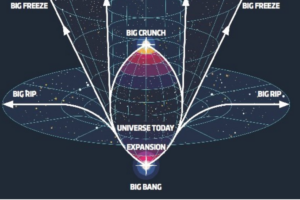
Dark energy is a mysterious force permeating the cosmos, responsible for the accelerated expansion of the universe. It acts as a repulsive influence, pushing galaxies apart and altering the large-scale structure of space-time. A compelling hypothesis proposes that dark energy may originate from the quantum vacuum-the intrinsic energy present in empty space due to quantum fluctuations.
- Dark Energy:
A form of energy causing the universe’s expansion to speed up, counteracting gravitational attraction. - Quantum Vacuum Energy:
The baseline energy arising from transient virtual particles that spontaneously appear and vanish in the vacuum, as described by quantum field theory.
The Quantum Vacuum: An Active Landscape
Contrary to the classical notion of a void, the quantum vacuum is a dynamic environment filled with incessant activity at the subatomic level. Quantum field theory reveals that particles and antiparticles continuously emerge and annihilate in fleeting moments, creating a “quantum foam.” This restless background imparts a fundamental energy to space itself, making the vacuum a seething arena of probabilistic phenomena rather than empty nothingness.
The Cosmological Constant and Its Role
Introduced by Albert Einstein in his field equations of General Relativity, the cosmological constant (Λ) represents a uniform energy density that fills space homogeneously. This constant acts as a repulsive force, counterbalancing gravity and driving the universe’s accelerated expansion. Observational evidence from distant supernovae and the cosmic microwave background supports the existence of a small but positive cosmological constant, consistent with the effects attributed to dark energy.
The Vacuum Catastrophe: A Profound Discrepancy
One of the most perplexing challenges in modern physics is the vast mismatch between theoretical predictions and observational data regarding vacuum energy. Calculations based on quantum field theory estimate vacuum energy density to be up to 10120 times greater than what cosmological measurements indicate. This enormous disparity, known as the “vacuum catastrophe,” raises fundamental questions about the compatibility of quantum mechanics and cosmology, and why the observed dark energy density is so extraordinarily small.
Conceptual Elegance of Quantum Vacuum as Dark Energy
Attributing dark energy to quantum vacuum energy offers a poetic and elegant explanation: the accelerating universe is energized by the inherent fluctuations of empty space itself. This perspective blurs the classical distinction between matter and void, suggesting that the vacuum is a vibrant, fluctuating medium filled with quantum possibilities. It portrays the cosmos as a dynamic interplay between existence and emptiness, where “nothingness” is in fact a source of profound energy.
Mechanism: How Quantum Vacuum Energy Drives Cosmic Expansion
The vacuum can be envisioned as a cosmic orchestra, with quantum fields acting as instruments vibrating at fundamental frequencies. The energy associated with these vibrations remains constant per unit volume, unaffected by the universe’s expansion. Unlike matter or radiation, this vacuum energy does not dilute over time, effectively exerting a persistent negative pressure that stretches space and accelerates cosmic expansion. This intrinsic tension within the vacuum acts as an invisible force pulling the universe apart from within.
Alternative Theories: Beyond the Cosmological Constant
While the cosmological constant provides a simple model, other theories propose dynamic forms of dark energy. For instance, quintessence models introduce hypothetical scalar fields that evolve over time and space, offering a more complex and variable explanation for cosmic acceleration. Despite these alternatives, the quantum vacuum energy hypothesis remains favored for its conceptual simplicity and deep grounding in fundamental physics, linking microscopic quantum phenomena with the universe’s grand-scale behavior.
Experimental Probes into Vacuum Energy
Scientific investigations into vacuum energy span both microscopic and cosmic scales. Experiments such as the Casimir effect demonstrate tangible forces arising from vacuum fluctuations between closely spaced metal plates, providing direct evidence of vacuum energy’s physical reality. On a cosmological level, precise measurements of supernovae, galaxy distributions, and the cosmic microwave background continue to refine our understanding of dark energy’s properties, testing whether it behaves as a constant or varies over time.
Philosophical Implications: Redefining Nothingness
The identification of dark energy with quantum vacuum energy challenges traditional views of empty space as mere absence. Instead, it compels a paradigm shift, recognizing the vacuum as a dynamic and physically significant entity. This redefinition of “nothingness” as a state teeming with energy and potential reshapes our fundamental understanding of existence, suggesting that emptiness is paradoxically full of subtle, underlying activity.
Why Understanding Dark Energy Matters
Deciphering the nature of dark energy is crucial for comprehending the ultimate fate of the universe and the fundamental laws governing reality. It bridges the gap between quantum mechanics and cosmology, offering insights into the unification of physics at all scales. Moreover, understanding dark energy influences technological advancements in observational astronomy and quantum physics, shaping our broader scientific worldview and deepening humanity’s connection to the cosmos.
Summary
Dark energy, potentially arising from the quantum vacuum, represents a profound and elegant solution to the mystery of the universe’s accelerating expansion. This concept unites the restless quantum fluctuations of empty space with the grand cosmic evolution, revealing a universe energized by the subtle pulse of the vacuum itself. Ongoing research and experimentation continue to illuminate this enigmatic force, promising to unlock deeper truths about the fabric of reality.
Leave a Reply