
Short Answer
Definition of Electron Transfer and Quantum Tunneling
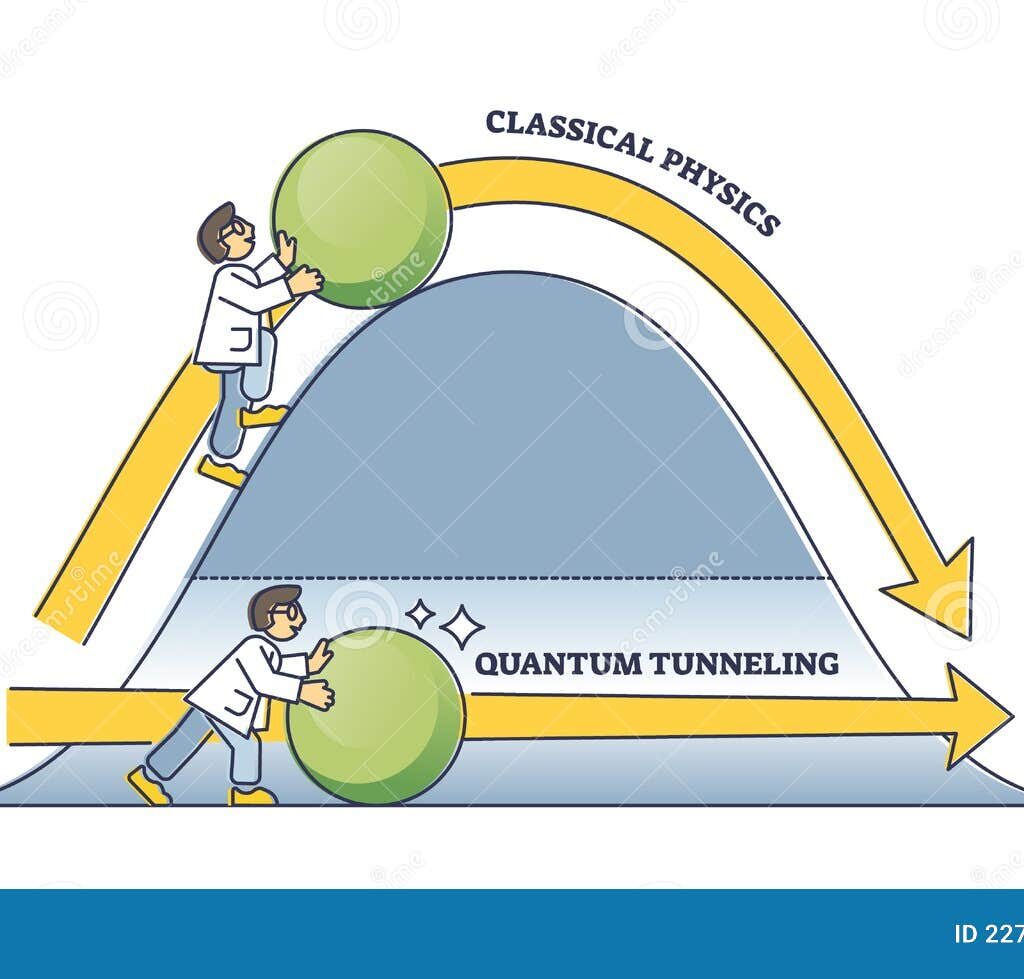
Electron transfer is a critical phenomenon that underpins numerous processes across physics, chemistry, and biology. Traditionally explained through classical mechanics, this process has been reinterpreted in light of quantum mechanics, revealing new insights. Central to this modern understanding is the concept of quantum tunneling, a mechanism that allows electrons to pass through energy barriers that would be insurmountable under classical physics.
- Electron Transfer:
The movement of electrons from one atom, molecule, or ion to another, essential in chemical reactions and biological functions. - Quantum Tunneling:
A quantum mechanical effect where particles such as electrons have a finite probability of crossing energy barriers without possessing the classical energy required to overcome them.
Classical vs. Quantum Perspectives on Electron Transfer
In classical Newtonian mechanics, particles like electrons are expected to behave predictably, requiring enough energy to surmount potential barriers-much like a ball rolling over a hill. This analogy, however, falls short when describing electron behavior at microscopic scales. Quantum mechanics introduces a probabilistic framework where electrons are represented by wave functions rather than fixed trajectories, allowing for phenomena that defy classical intuition.
Mechanism of Quantum Tunneling
Quantum tunneling arises because electrons do not have definite positions or momenta but are described by a wave function that spreads across space. This wave function extends into and beyond potential barriers, creating a nonzero probability that an electron can be detected on the opposite side of a barrier, even if its energy is insufficient to overcome it classically. This phenomenon enables electrons to effectively “tunnel” through barriers, bypassing classical restrictions.
Mathematical Framework: Schrödinger Equation and Tunneling Probability
The Schrödinger equation forms the mathematical foundation for understanding quantum tunneling. It describes how the electron’s wave function evolves in space and time, allowing calculation of the likelihood that an electron will tunnel through a barrier.
- Schrödinger Equation:
( hat{H} psi = E psi ), where ( hat{H} ) is the Hamiltonian operator, ( psi ) the wave function, and ( E ) the energy eigenvalue. - Transmission Coefficient (T):
Represents the probability of tunneling, dependent on barrier height (V), width (d), and electron energy (E). For a rectangular barrier, ( T approx e^{-2 kappa d} ), where ( kappa = sqrt{frac{2m(V – E)}{hbar^2}} ), with ( m ) as electron mass and ( hbar ) the reduced Planck constant.
Applications in Biological Systems
Quantum tunneling plays a vital role in biological electron transfer processes, particularly in enzymatic reactions and photosynthesis.
- Enzymatic Reactions:
Enzymes often catalyze reactions that involve electron transfer steps with energy barriers too high for classical crossing. Quantum tunneling allows electrons to bypass these barriers, accelerating reaction rates and enhancing biological efficiency. - Photosynthesis:
During photosynthesis, electrons move through a chain of protein complexes to convert solar energy into chemical energy. Quantum tunneling facilitates this electron flow, contributing to the remarkable efficiency of energy conversion in plants.
Technological Implications of Quantum Tunneling
Beyond biology, quantum tunneling is foundational in modern electronics and emerging technologies.
- Tunnel Diodes:
These semiconductor devices exploit tunneling to achieve negative resistance, enabling ultra-fast switching and high-frequency applications. - Quantum Computing:
Quantum tunneling supports the operation of qubits, which can exist in superpositions of states. This property is essential for the rapid processing capabilities anticipated in quantum computers, potentially revolutionizing computation.
Experimental Evidence and Visualization Techniques
Advances in experimental methods have allowed direct observation and measurement of quantum tunneling phenomena.
- Scanning Tunneling Microscopy (STM):
STM uses tunneling currents to image surfaces at the atomic level, providing visual confirmation of electron tunneling and enabling manipulation of individual atoms. - Barrier Thickness and Energy Dependence:
Experiments demonstrate how variations in barrier dimensions and electron energies influence tunneling probabilities, validating theoretical models.
Philosophical and Scientific Significance
The existence of quantum tunneling challenges classical notions of determinism and locality, prompting deeper reflection on the nature of reality. It raises fundamental questions about causality and observation, expanding the philosophical discourse surrounding quantum mechanics and its interpretation.
Common Misconceptions About Quantum Tunneling
Electrons physically pass through barriers like tiny balls.
Electrons behave as wave-like entities with probabilistic distributions, allowing them to appear on the other side of barriers without classical traversal.
Quantum tunneling violates energy conservation.
Energy conservation holds; tunneling is a quantum probability effect, not an energy gain or loss.
Importance of Quantum Tunneling in Science and Technology
Quantum tunneling is indispensable for understanding and harnessing processes at the atomic and molecular scale. It elucidates fundamental biochemical reactions, enables cutting-edge electronic devices, and underpins the development of quantum technologies. Its study continues to bridge microscopic quantum phenomena with macroscopic applications, shaping the trajectory of scientific innovation and technological advancement.
FAQ
What role does quantum tunneling play in biology?
Quantum tunneling enables faster electron transfer in enzymatic reactions and photosynthesis, allowing biological processes to occur more efficiently.
How does quantum tunneling impact technology?
Quantum tunneling is used in tunnel diodes for high-speed electronics and is fundamental in the operation of quantum computers.



Leave a Reply