

Short Answer
Definition of Dark Matter
Dark matter is a mysterious form of matter that constitutes about 27% of the universe’s total energy content. Unlike ordinary matter, it neither emits nor absorbs light, making it invisible to traditional astronomical instruments. Its existence is primarily inferred through its gravitational effects on visible matter, radiation, and the large-scale structure of the cosmos.
- Invisible Substance:
Dark matter cannot be detected directly by electromagnetic radiation, which includes visible light, X-rays, and radio waves. - Gravitational Influence:
Its presence is revealed by the gravitational pull it exerts on galaxies and galaxy clusters, affecting their motion and formation.
Cosmic Web: The Structure of Dark Matter
Dark matter is not evenly spread throughout the universe. Instead, it forms an intricate network of filaments and bridges that span vast cosmic distances. These structures connect galaxies and clusters, acting as the scaffolding upon which the visible universe is built.
- Filaments and Bridges:
These are elongated, thread-like formations of dark matter that link galaxies, facilitating gravitational attraction and matter flow. - Cosmic Scaffolding:
This network shapes the large-scale structure of the universe, guiding the distribution and evolution of galaxies.
Formation and Evolution of Dark Matter Filaments
Dark matter filaments originate from the gravitational collapse of tiny density fluctuations in the early universe. As the universe expanded, these fluctuations grew, pulling in baryonic matter-primarily hydrogen and helium-which then condensed to form stars and galaxies along these filaments.
- Primordial Density Fluctuations:
Small variations in matter density shortly after the Big Bang that seeded the formation of cosmic structures. - Baryonic Matter Accretion:
Ordinary matter falls into the gravitational wells created by dark matter, leading to star and galaxy formation.
Observational Techniques Revealing Dark Matter Bridges
Recent advancements in astronomy, such as gravitational lensing and deep-field imaging, have enabled scientists to detect and map dark matter filaments. Gravitational lensing occurs when dark matter bends the light from distant galaxies, making its otherwise invisible presence observable.
- Gravitational Lensing:
The bending of light caused by massive objects like dark matter, which distorts the images of background galaxies. - Deep-Field Imaging:
Long-exposure observations that capture faint and distant cosmic structures, revealing the web-like distribution of dark matter.
Implications for Cosmological Models
The discovery of dark matter bridges challenges traditional cosmological frameworks, particularly the Lambda Cold Dark Matter (ΛCDM) model, which assumes a relatively smooth distribution of dark matter. The filamentary nature of dark matter necessitates revisiting assumptions about its density, spatial arrangement, and interaction dynamics.
- ΛCDM Paradigm Reassessment:
The presence of filaments suggests more complex dark matter behavior than previously modeled. - Gravitational Dynamics:
Understanding how dark matter influences galaxy formation requires refining models of gravitational interactions on large scales.
Dark Matter and Galaxy Formation
The interplay between dark matter and baryonic matter is intricate and dynamic. Dark matter filaments not only provide the gravitational framework for galaxy formation but also influence their shapes, clustering, and evolution over cosmic time.
- Mutual Interaction:
Dark matter and ordinary matter affect each other’s distribution and behavior, shaping galactic morphology. - Galaxy Clustering:
The arrangement of galaxies in clusters and superclusters is guided by the underlying dark matter network.
Alternative Theories and Dark Matter Bridges
The observation of dark matter filaments also fuels debates about the nature of gravity and the validity of alternative theories. Concepts such as Modified Newtonian Dynamics (MOND) and theories involving extra spatial dimensions attempt to explain gravitational phenomena without invoking dark matter.
- Modified Gravity Theories:
Propose changes to Newtonian or Einsteinian gravity to account for cosmic observations. - Extra Dimensions:
Hypotheses suggesting additional spatial dimensions that could influence gravitational behavior. - Role of Dark Matter:
Determining whether dark matter is a distinct entity or a manifestation of modified gravity remains an open question.
Future Prospects in Dark Matter Research
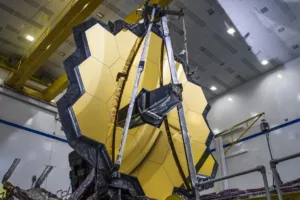
Emerging technologies, including Phase-Array Radio Telescopes and next-generation space observatories, promise to deepen our understanding of dark matter’s filamentary structures. These tools will enable more detailed mapping of dark matter density and distribution, potentially shedding light on its fundamental properties and connections to quantum mechanics and particle physics.
- Advanced Telescopes:
Instruments capable of high-resolution observations across multiple wavelengths. - Quantum and Particle Physics Links:
Investigations into dark matter may reveal new particles or quantum phenomena. - Enhanced Cosmological Insights:
Improved data will refine models of cosmic evolution and structure formation.
Significance of Dark Matter Bridges in Cosmology
The identification of dark matter bridges marks a pivotal advancement in our comprehension of the universe. These structures not only clarify the processes behind galaxy formation but also enrich our broader understanding of cosmic architecture, from the smallest galaxies to the largest clusters. This evolving knowledge continues to inspire scientific inquiry and fuels humanity’s quest to unravel the universe’s deepest mysteries.
FAQ
What are dark matter bridges?
Dark matter bridges are elongated structures formed by dark matter that connect galaxies and clusters, playing a crucial role in the universe’s large-scale structure.
How are dark matter filaments observed?
Dark matter filaments are observed through techniques like gravitational lensing and deep-field imaging, which reveal their presence by bending light from distant galaxies.



Leave a Reply