
Short Answer
Understanding Temperature: A Fundamental Concept
Temperature is a fundamental physical quantity that measures the average kinetic energy of particles within a material. This metric allows scientists to compare thermal energy across diverse environments, from the surfaces of stars to controlled laboratory settings. For instance, the sun’s surface temperature hovers around 5,500 degrees Celsius (9,932 degrees Fahrenheit), while its core, where nuclear fusion takes place, reaches an extraordinary 15 million degrees Celsius (27 million degrees Fahrenheit).
The Large Hadron Collider: An Overview
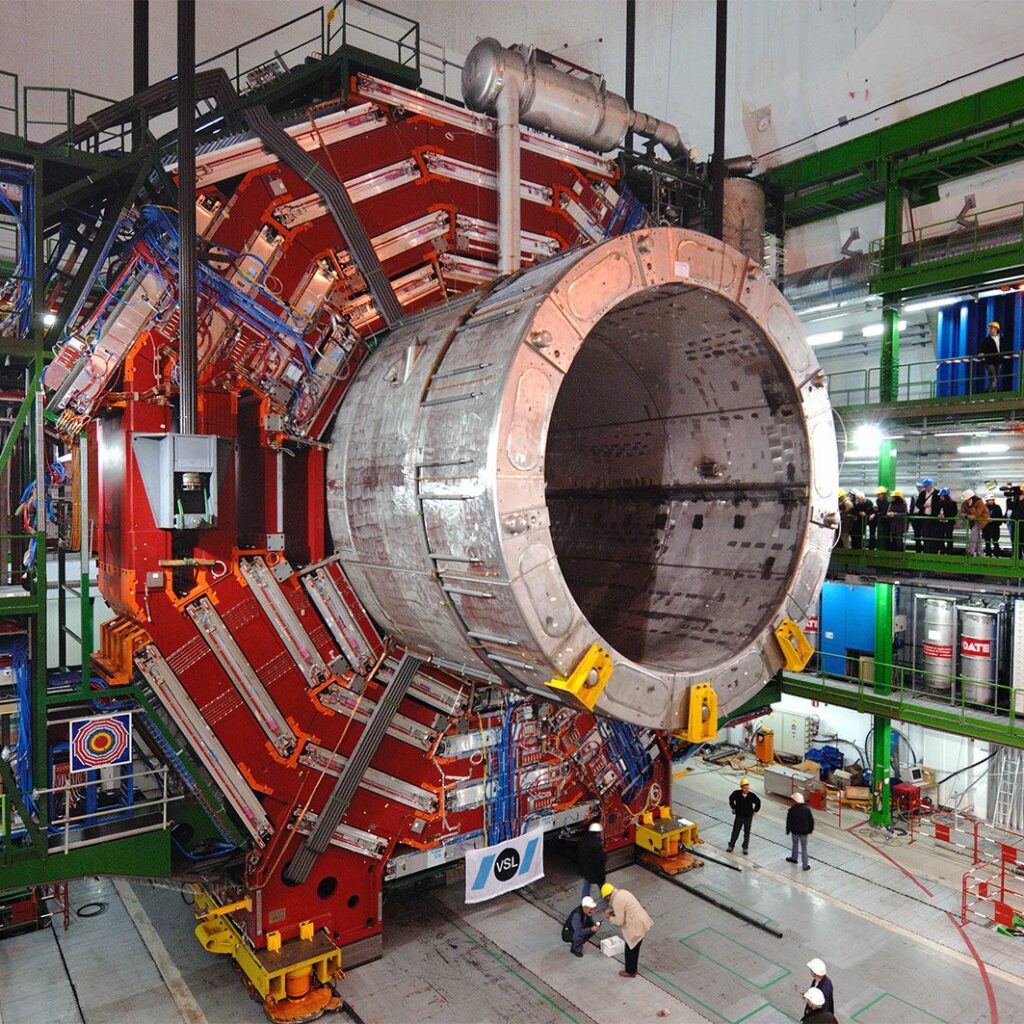
Situated at CERN near Geneva, Switzerland, the Large Hadron Collider (LHC) stands as the world’s most extensive and powerful particle accelerator. This monumental scientific instrument is designed to probe the fundamental particles and forces that constitute the universe. By accelerating protons to velocities approaching the speed of light and colliding them at energies up to 13 tera-electronvolts (TeV), the LHC recreates conditions reminiscent of the universe’s earliest moments, mere fractions of a second after the Big Bang.
Extreme Temperatures in Particle Collisions
During proton-proton collisions at the LHC, temperatures soar to unprecedented levels, reaching approximately 4 trillion degrees Celsius (around 7 trillion degrees Fahrenheit). These fleeting bursts of heat far exceed the core temperature of the sun, albeit existing only for infinitesimal fractions of a second within an extremely confined space. Such extreme conditions enable the formation of exotic states of matter, including quark-gluon plasma-a phase where quarks and gluons, normally confined within protons and neutrons, exist freely.
Quark-Gluon Plasma and Its Significance
At these extraordinary temperatures, ordinary matter transitions into quark-gluon plasma, a state that offers profound insights into the early universe’s conditions. This plasma consists of fundamental particles liberated from their usual bonds, allowing physicists to study the strong nuclear force and the behavior of matter under extreme energy densities. The transient nature of this plasma challenges our understanding of particle physics and the fundamental forces shaping the cosmos.
Comparing the LHC and the Sun: Temperature and Energy Dynamics
- Temperature Magnitude:
The LHC achieves temperatures vastly exceeding those in the sun’s core, but only momentarily and within microscopic volumes. - Duration and Scale:
The sun sustains its immense heat over billions of years, powering the solar system, whereas the LHC’s extreme temperatures last mere fractions of a second. - Energy Density and Gravitational Influence:
The sun’s massive gravitational forces maintain fusion reactions under high pressure, a condition absent in the LHC’s controlled environment. - Radiation Emission:
Solar radiation spans a broad electromagnetic spectrum, while the LHC produces particle radiation and high-energy collisions with different energetic characteristics.
Scientific Objectives of the LHC
The LHC’s experiments delve into the fundamental forces of nature-strong, weak, electromagnetic, and gravitational interactions-by simulating early-universe conditions. Each collision generates a cascade of particles that exist briefly before decaying, enabling the discovery of particles like the Higgs boson, which elucidates the origin of mass. Furthermore, the LHC is instrumental in exploring phenomena such as dark matter and supersymmetry, pushing the boundaries of our understanding of the universe’s unseen components.
Why the LHC’s Temperature Matters
While the LHC’s temperatures surpass those of the sun in a strictly numerical sense, their significance lies in the unique insights they provide into the universe’s fundamental structure. These extreme conditions allow scientists to recreate and study the primordial environment of the cosmos, offering clues about the forces and particles that govern existence. This research not only advances particle physics but also enriches humanity’s comprehension of its cosmic origins and destiny.
Common Misconceptions About the LHC and Temperature
The LHC is hotter than the sun in the same way the sun is hot.
Although the LHC reaches higher temperatures, these exist only momentarily and in tiny volumes, unlike the sun’s sustained and massive heat output.
The LHC’s extreme temperatures pose a danger similar to stellar phenomena.
The LHC’s high temperatures are confined to microscopic scales and brief durations, posing no threat comparable to natural stellar processes.
Conclusion: Bridging Cosmic and Terrestrial Extremes
The question of whether the Large Hadron Collider is hotter than the sun reveals the complex interplay between natural and engineered extremes of temperature and energy. While the LHC achieves temperatures that dwarf those found in the sun’s core, these conditions are ephemeral and localized. Both the sun and the LHC, in their distinct ways, contribute profoundly to our understanding of the universe-one through sustained nuclear fusion powering life on Earth, the other through fleeting particle collisions unveiling the universe’s fundamental laws. This ongoing exploration underscores the importance of temperature and energy in unraveling the mysteries of existence.
FAQ
Is the Large Hadron Collider hotter than the sun?
Yes, in terms of temperature reached during particle collisions, but only for infinitesimal moments and in microscopic volumes.
What is the significance of quark-gluon plasma?
It allows scientists to study matter under extreme energy densities, similar to those just after the Big Bang.
Does the LHC's temperature create any hazards?
No, the extreme temperatures are contained within tiny, brief particle collisions and pose no real danger.
How do LHC and solar temperatures differ in scale and duration?
The sun sustains high temperatures over billions of years and large volumes, whereas the LHC’s extreme heat exists for fractions of a second in microscopic spaces.






Leave a Reply