
Short Answer
Overview of the Large Hadron Collider
The Large Hadron Collider (LHC) stands as a pinnacle achievement in modern particle physics, functioning as the world’s largest and most powerful particle accelerator. Situated underground along the Franco-Swiss border near Geneva, this immense scientific instrument stretches approximately 27 kilometers in circumference. It embodies a monumental collaborative effort involving thousands of researchers, engineers, and institutions worldwide, all united in the pursuit of understanding the universe’s most fundamental building blocks.
Historical Background and Construction
The conception of the LHC dates back to the early 1980s, with its construction completed in 2008. Since then, it has undergone multiple experimental phases that have profoundly expanded our knowledge of particle physics. The LHC was designed to accelerate protons-subatomic particles found in atomic nuclei-to velocities approaching the speed of light. This acceleration is facilitated by an intricate system of superconducting magnets and radiofrequency cavities that energize the particles as they circulate through the underground ring.
Definition and Purpose
The LHC is a particle accelerator that propels charged particles to extremely high energies and causes them to collide. These collisions generate a variety of secondary particles, effectively simulating conditions similar to those just moments after the Big Bang. This allows physicists to investigate the fundamental forces and particles that constitute the universe.
- Particle Acceleration:
Protons are accelerated to near-light speeds using magnetic fields and radiofrequency energy. - Collision Events:
High-energy collisions produce new particles, enabling the study of early-universe physics. - Research Goals:
To explore quantum chromodynamics, fundamental forces, and elusive phenomena such as dark matter.
Operational Mechanism of the LHC
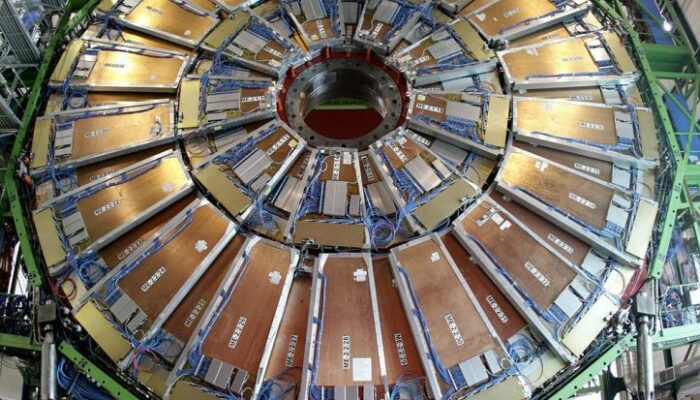
The LHC operates by circulating two beams of protons in opposite directions within its circular tunnel. Superconducting magnets steer and focus these beams, while radiofrequency cavities boost their energy. When the beams intersect at designated points, the protons collide at unprecedented energies, producing a shower of secondary particles. Detectors positioned around these collision points capture data on the resulting particle interactions, which scientists analyze to uncover new physics.
Key Discoveries and Scientific Impact
One of the LHC’s landmark achievements was the 2012 discovery of the Higgs boson, a particle essential to explaining how other particles acquire mass. This breakthrough confirmed the Standard Model of particle physics, a theoretical framework describing elementary particles and their interactions. Despite this success, the discovery also underscored unresolved mysteries, particularly concerning dark matter and dark energy, which together make up about 95% of the universe’s total energy but remain undetectable by conventional instruments.
Exploration Beyond Established Physics
Beyond validating existing theories, the LHC serves as a platform for probing new physics. It tests hypotheses such as supersymmetry, the existence of extra spatial dimensions, and the potential for proton decay. Each experiment holds the promise of revolutionary insights that could reshape our understanding of the cosmos, fueling the scientific community’s anticipation and curiosity.
International Collaboration and Scientific Community
The LHC exemplifies global scientific cooperation, involving over 10,000 scientists from diverse disciplines including theoretical physics, experimental physics, and engineering. This multidisciplinary collaboration fosters innovation and the exchange of ideas, creating a dynamic environment where complex challenges are addressed collectively.
Data Generation and Computational Advances
The LHC produces an enormous volume of data, estimated at around 25 petabytes annually. Managing and analyzing this data requires advanced computational methods, including Big Data analytics and machine learning algorithms. These technologies enable researchers to sift through vast datasets to identify meaningful signals amid background noise, illustrating the synergy between physics and computer science in contemporary research.
Philosophical and Societal Implications
The LHC’s investigations extend beyond scientific discovery, touching on profound philosophical questions about the nature of reality and humanity’s place in the universe. By dissecting matter into its most elementary components, the LHC invites reflection on the interconnectedness of all things and challenges our understanding of existence.
Moreover, the technological innovations developed through LHC research have practical applications that benefit society. Advances originating from particle physics have contributed to medical imaging technologies, data processing techniques, and other industrial applications, demonstrating the broader impact of fundamental research on everyday life.
Future Prospects and Continuing Research
As the LHC undergoes periodic upgrades and maintenance, the scientific community eagerly anticipates new experimental runs. Upcoming phases aim to delve deeper into phenomena beyond the Standard Model, such as detecting dark matter particles or the hypothetical graviton. This ongoing quest epitomizes humanity’s enduring desire to expand the frontiers of knowledge.
Conclusion: The LHC as a Symbol of Human Endeavor
The Large Hadron Collider transcends its role as a mere scientific instrument; it symbolizes the fusion of human ambition, collaboration, and intellectual curiosity. By enabling exploration of the universe at its most fundamental level, the LHC embodies our relentless pursuit of understanding the cosmos and our place within it. Its vast scale and sophisticated capabilities continue to inspire and propel humanity toward deeper insights into the fabric of reality.
FAQ
What is the Large Hadron Collider?
The LHC is a large particle accelerator used to collide protons at high energies to study fundamental physics.
Why was the LHC built?
To explore the fundamental constituents of matter and test theories like the Standard Model.
What is the significance of the Higgs boson discovery?
It confirmed how particles acquire mass, validating a key part of the Standard Model.
How does the LHC accelerate particles?
Using superconducting magnets and radiofrequency cavities to boost protons to near light speed.
What future discoveries might the LHC enable?
Potential evidence for dark matter, supersymmetry, extra dimensions, and other new physics.






Leave a Reply