
Short Answer
Definition of the Strong Nuclear Force
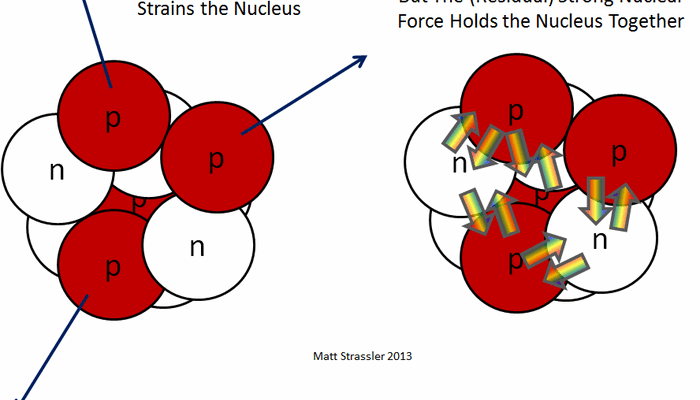
The strong nuclear force, also known as the strong interaction, is a fundamental force of nature responsible for holding protons and neutrons together within atomic nuclei. Operating at the subatomic scale, it is one of the four fundamental forces alongside gravity, electromagnetism, and the weak nuclear force. This force is essential for the stability and structure of matter, ensuring that atomic nuclei remain intact despite the repulsive electromagnetic forces between positively charged protons.
Fundamental Particles and Mediators
The strong force is primarily transmitted by gluons, which act as exchange particles between quarks-the elementary constituents of protons and neutrons. Unlike electromagnetic forces that depend on electric charge, the strong nuclear force functions independently of electric charge. Instead, it is governed by a property known as color charge, a unique quantum characteristic intrinsic to quarks.
Color Charge and Quantum Chromodynamics
Color charge is a concept arising from quantum chromodynamics (QCD), the theory describing strong interactions. Quarks carry one of three color charges: red, green, or blue. The strong force requires a balanced combination of these colors to maintain particle stability, analogous to mixing primary colors to create a harmonious palette. This balance ensures that particles such as baryons (three-quark systems) and mesons (quark-antiquark pairs) remain stable.
Mechanisms Governing the Strong Force
The behavior of the strong nuclear force is characterized by two key phenomena: confinement and asymptotic freedom. Confinement means that quarks cannot exist in isolation; they are perpetually bound within larger particles like protons and neutrons. Asymptotic freedom refers to the fact that quarks behave almost as free particles only at extremely high energies, such as those produced in particle accelerators. These principles explain why quarks are always found in composite particles and never observed independently.
Charge Independence of the Strong Nuclear Force
Despite the electric charge differences between protons (positively charged) and neutrons (neutral), the strong nuclear force binds them with nearly equal strength. The binding energy generated by this force is largely unaffected by the electric charge of the nucleons. This indicates that the strong force’s effectiveness in maintaining nuclear cohesion is independent of electric charge, distinguishing it from electromagnetic interactions.
Role of Baryons and Mesons in Nuclear Stability
The interactions within the nucleus can be likened to a symphony, where baryons and mesons play distinct roles under the direction of gluons. Gluons orchestrate the strong force interactions, ensuring a stable and cohesive nuclear structure. In this analogy, the electric charge plays a minor role, overshadowed by the dominant influence of the strong interaction in maintaining nuclear integrity.
Interplay Between Strong and Electromagnetic Forces
While the strong nuclear force itself does not depend on electric charge, electromagnetic forces do influence nuclear phenomena, especially in processes involving charged particles. For example, electromagnetic interactions affect the scattering behavior of protons and other charged particles within the nucleus. However, these effects do not alter the fundamental role of the strong force as the primary agent of nuclear stability.
Summary and Broader Implications
In conclusion, the strong nuclear force operates independently of electric charge, relying instead on color charge and the principles of quantum chromodynamics. Its charge independence is crucial for the cohesion of atomic nuclei, enabling the formation of matter as we know it. Understanding this distinction enriches our comprehension of the fundamental forces shaping the universe and highlights the complex interplay between different interactions at the subatomic level.
Why Understanding the Strong Nuclear Force Matters
The strong nuclear force is foundational to nuclear physics, chemistry, and the formation of matter. Its unique properties underpin the existence of atoms, which constitute all visible matter in the universe. Insights into this force have practical applications in nuclear energy, particle physics research, and cosmology. Moreover, studying the strong force deepens our philosophical and scientific appreciation of the universe’s fundamental laws and the intricate balance that sustains matter.
FAQ
What is the strong nuclear force?
The strong nuclear force is a fundamental force that holds protons and neutrons together in atomic nuclei, operating independently of electric charge.
How does color charge relate to the strong nuclear force?
Color charge is a property of quarks that governs the strong nuclear force, contrasting with electric charge in electromagnetic interactions.
What are the implications of the strong nuclear force's independence from electric charge?
This independence ensures the stability of atomic nuclei, allowing matter to exist despite the repulsive forces between positively charged protons.






Leave a Reply