
Short Answer
Definition of Cosmic Rays
Cosmic rays are highly energetic particles originating from outer space that continuously bombard the Earth. These particles primarily consist of protons but also include heavier atomic nuclei and, less frequently, high-energy electrons. Their study is crucial for understanding both fundamental physics and the broader workings of the universe.
- Composition:
Mainly protons, with a smaller fraction of heavier nuclei and electrons. - Energy Range:
Cosmic rays span a wide energy spectrum, from relatively low energies associated with solar activity to ultra-high energies exceeding one million million electronvolts (eV). - Sources:
They originate from both solar and extraterrestrial astrophysical phenomena.
Classification and Origins of Cosmic Rays
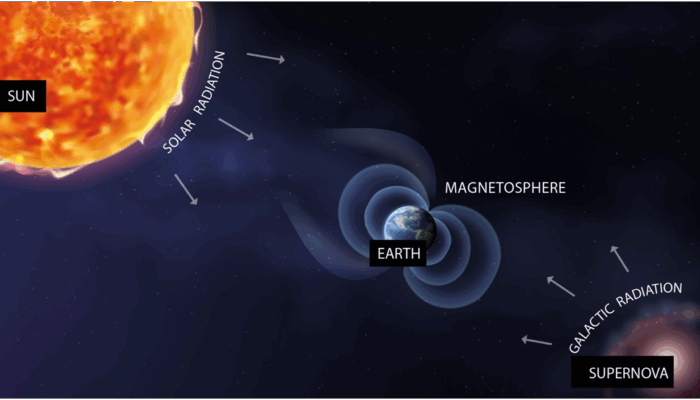
Cosmic rays can be broadly divided into two categories based on their source: solar cosmic rays and those from extraterrestrial origins.
Solar Cosmic Rays
Particles emitted by the Sun, especially during solar flares and coronal mass ejections (CMEs), form the solar component of cosmic rays. The solar wind-a steady stream of charged particles flowing from the Sun’s corona-also contributes to this flux. Although solar cosmic rays are significant near Earth, they represent only a small portion of the overall cosmic ray population, particularly at higher energies.
Extraterrestrial Cosmic Rays
The majority of cosmic rays come from beyond our solar system, generated by powerful astrophysical events and objects:
- Supernovae:
Explosions marking the death of massive stars release enormous energy, creating shock waves that accelerate particles to near-light speeds. This process, known as the Fermi acceleration mechanism, boosts protons and heavier nuclei to ultra-high energies. - Active Galactic Nuclei (AGNs):
The centers of some galaxies contain supermassive black holes surrounded by accreting material. These regions emit intense radiation and produce relativistic jets that can accelerate particles to high energies, influencing cosmic ray distribution across intergalactic space. - Gamma-Ray Bursts (GRBs):
Among the most energetic phenomena in the universe, GRBs occur during massive star collapses or neutron star mergers, releasing vast amounts of energy that can accelerate particles and contribute to the cosmic ray population.
Mechanisms of Cosmic Ray Acceleration
The acceleration of cosmic rays involves several astrophysical processes, with shock waves and magnetic fields playing pivotal roles.
- Fermi Acceleration:
Particles gain energy by repeatedly crossing shock fronts, such as those produced by supernova explosions, gradually reaching relativistic speeds. - Relativistic Jets:
AGNs emit jets of charged particles moving at speeds close to light, which can accelerate cosmic rays over vast distances. - Magnetic Field Interactions:
Magnetic fields in interstellar and intergalactic space influence cosmic ray trajectories, causing deflections and scattering that complicate tracing their origins.
Propagation and Interactions in Space
After acceleration, cosmic rays travel through the cosmos, interacting with magnetic fields and the interstellar medium.
- Magnetic Deflection:
Charged cosmic rays are bent and scattered by magnetic fields, which alters their paths and obscures their source locations. - Interstellar Collisions:
Cosmic rays collide with gas and dust in space, producing secondary particles such as pions and muons. These secondary particles contribute to the radiation detected by cosmic ray observatories.
Energy Spectrum and Its Significance
The cosmic ray energy spectrum follows a power-law distribution, characterized by a decrease in particle flux with increasing energy. This pattern reveals the presence of multiple acceleration mechanisms dominating different energy ranges.
- The “Knee”:
A notable feature in the spectrum where the slope changes, indicating a transition between different cosmic ray sources or acceleration processes. - Ultra-High-Energy Cosmic Rays (UHECRs):
Particles with energies exceeding 1018 eV, whose origins and acceleration mechanisms remain subjects of active research.
Cosmic Rays and Particle Physics
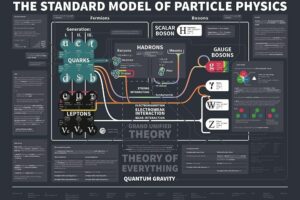
Cosmic rays provide a natural laboratory for studying fundamental particle interactions at energies beyond those achievable by human-made accelerators. Their collisions with atmospheric particles mimic conditions explored in quantum chromodynamics (QCD) and other areas of high-energy physics, offering insights into the behavior of matter under extreme conditions.
Common Misconceptions About Cosmic Rays
Cosmic rays are only produced by the Sun.
While the Sun contributes to low-energy cosmic rays, the majority originate from distant astrophysical sources such as supernovae, AGNs, and gamma-ray bursts.
Cosmic rays travel in straight lines from their sources.
Interstellar and intergalactic magnetic fields deflect cosmic rays, making it difficult to trace their exact origins.
Importance of Studying Cosmic Rays
Understanding cosmic rays is vital for multiple scientific disciplines. They shed light on high-energy astrophysical processes, contribute to our knowledge of particle physics, and influence space weather, which can affect satellite operations and astronaut safety. Moreover, cosmic rays help us probe the structure and evolution of the universe, revealing the dynamic and energetic phenomena shaping the cosmos.
FAQ
What are cosmic rays?
Cosmic rays are highly energetic particles originating from outer space, consisting mainly of protons and heavier atomic nuclei, that constantly bombard the Earth.
Where do cosmic rays come from?
Cosmic rays originate from solar activity such as solar flares and coronal mass ejections, as well as from powerful astrophysical sources like supernovae, active galactic nuclei, and gamma-ray bursts.
How are cosmic rays accelerated to high energies?
Cosmic rays are accelerated through mechanisms including Fermi acceleration at shock fronts from supernovae, relativistic jets from active galactic nuclei, and interactions with magnetic fields in space.
Do cosmic rays travel in straight lines?
No, cosmic rays are deflected and scattered by magnetic fields in interstellar and intergalactic space, making their exact origins difficult to trace.
Why is studying cosmic rays important?
Studying cosmic rays helps us understand high-energy astrophysical processes, particle physics beyond human-made accelerators, space weather impacts, and the structure and evolution of the universe.


Leave a Reply