
Short Answer
Definition of Gamma Radiation
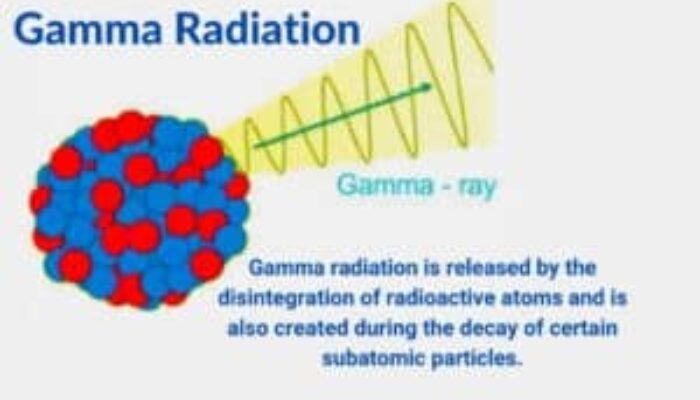
Gamma radiation is a highly energetic form of electromagnetic radiation that originates from atomic nuclei. Unlike alpha and beta particles, gamma rays are massless and electrically neutral photons. They possess extremely short wavelengths, typically ranging from 0.01 to 10 nanometers, placing them at the extreme high-energy end of the electromagnetic spectrum, beyond X-rays and ultraviolet light. This intense energy allows gamma rays to penetrate various materials, making them both scientifically intriguing and practically valuable across multiple disciplines.
Fundamental Characteristics
- Nature:
Gamma rays are photons with no mass or charge, distinguishing them from particulate radiation such as alpha and beta particles. - Wavelength and Energy:
Their wavelengths fall between 0.01 and 10 nanometers, corresponding to very high photon energies. - Penetration Ability:
Due to their high energy, gamma rays can traverse dense materials, which is why they are used in medical imaging and industrial inspection.
Natural Origins of Gamma Radiation
Gamma radiation primarily arises from radioactive decay processes within unstable atomic nuclei. Radioisotopes such as cobalt-60 and cesium-137 naturally emit gamma rays as they transition from excited nuclear states to more stable configurations. This spontaneous emission reflects fundamental nuclear stability dynamics and has been observed since the early days of nuclear physics.
Artificial Generation of Gamma Rays in Laboratories
While gamma radiation is commonly associated with natural radioactive decay, it can also be produced artificially under controlled laboratory conditions. The development of particle accelerators in the 20th century enabled scientists to generate gamma rays by accelerating charged particles to high speeds and inducing nuclear reactions.
Particle Accelerators and Gamma Ray Production
Particle accelerators use electromagnetic fields to propel charged particles, such as protons or electrons, to near-light speeds. When these accelerated particles collide with target nuclei, the resulting nuclear reactions can emit gamma photons. This method is central to experimental nuclear physics and allows precise control over gamma ray production.
Photonuclear Reactions
One laboratory technique involves photonuclear reactions, where high-energy gamma photons bombard a target material. The incoming gamma photons transfer enough energy to the atomic nuclei to overcome nuclear binding forces, causing nuclear excitation and subsequent emission of additional gamma photons. The efficiency of this process depends heavily on the nuclear properties of the target isotopes.
Positron-Electron Annihilation
Another mechanism for generating gamma rays involves the annihilation of positrons and electrons. When a positron-the antimatter equivalent of an electron-encounters an electron, their mutual annihilation produces pairs of gamma photons. This phenomenon not only serves as a gamma ray source but also provides valuable insights into matter-antimatter interactions and fundamental symmetries in physics.
Safety and Regulatory Considerations
Due to the penetrating nature and biological risks associated with gamma radiation, its production and use are subject to stringent safety protocols. Regulatory agencies at national and international levels enforce guidelines to ensure that laboratories handling radioactive materials and high-energy radiation operate with maximum safety and ethical responsibility. Protective measures include shielding, controlled access, and continuous monitoring to minimize exposure risks.
Applications and Significance of Gamma Radiation
Gamma rays have a broad spectrum of applications and scientific importance:
- Medical Uses:
In nuclear medicine, gamma radiation is employed for diagnostic imaging and targeted cancer therapies, exploiting its ability to penetrate tissues and deliver precise doses. - Industrial Applications:
Gamma rays are used for non-destructive testing, such as inspecting welds and structural components for defects. - Astrophysical Phenomena:
Gamma radiation plays a crucial role in understanding cosmic events like supernovae, gamma-ray bursts, and the behavior of dark matter, offering insights into the universe’s origins and evolution.
Scientific Importance and Ongoing Research
The study and artificial generation of gamma radiation continue to push the boundaries of nuclear physics and cosmology. Laboratory-produced gamma rays enable detailed exploration of nuclear interactions, while astrophysical observations of gamma radiation reveal the dynamics of extreme cosmic environments. This dual perspective enriches our comprehension of both microscopic atomic processes and vast universal phenomena.
Summary
Generating gamma radiation in laboratory settings, though complex, exemplifies the intersection of advanced technology and fundamental physics. Through particle accelerators, photonuclear reactions, and positron-electron annihilation, scientists can produce gamma rays to investigate nuclear behavior and support diverse applications. The profound implications of gamma radiation-from its natural origins to its cosmic significance-continue to inspire research and innovation across multiple scientific fields.
FAQ
How is gamma radiation produced in a laboratory?
Gamma radiation is produced in laboratories mainly by accelerating charged particles in particle accelerators to induce nuclear reactions or by positron-electron annihilation generating gamma photons.
What distinguishes gamma rays from other types of radiation?
Gamma rays have no mass or electric charge and are high-energy photons with very short wavelengths, allowing them to penetrate most materials.
Why is safety important when generating gamma radiation?
Due to their high penetration capability and potential to cause biological damage, gamma rays require strict safety measures and regulatory oversight during production and use.





Leave a Reply