
Short Answer
Definition of Gluons
Gluons are fundamental particles that act as the force carriers responsible for binding quarks together within atomic nuclei. They operate within the framework of quantum chromodynamics (QCD), the theory describing the strong interaction, one of the four fundamental forces of nature. Unlike other force carriers, gluons are unique in their ability to interact with each other, playing a crucial role in maintaining the cohesion of protons, neutrons, and other hadrons.
- Role:
Gluons mediate the strong force that holds quarks tightly bound inside hadrons. - Nature:
They are massless particles with high energy, facilitating interactions at the subatomic scale. - Distinctive Feature:
Gluons carry a property called color charge, enabling them to self-interact, unlike photons in electromagnetism.
Fundamental Concepts: Quarks and the Strong Force
To understand gluons, it is essential to first grasp the nature of quarks and the strong interaction. Quarks are elementary particles that come in six flavors, with up, down, and strange being the most common within ordinary matter. These quarks never exist in isolation due to a phenomenon called confinement; instead, they are perpetually bound within composite particles known as hadrons.
The strong force, mediated by gluons, is the most powerful of the fundamental forces, surpassing electromagnetic, weak, and gravitational forces at the scale of atomic nuclei. This force ensures the stability of protons and neutrons by continuously exchanging gluons among quarks, effectively “gluing” them together.
Mechanism of Gluon Interaction
Gluons function as the exchange particles that transmit the strong force between quarks. Unlike other force carriers, gluons themselves carry color charge, which allows them to interact not only with quarks but also with other gluons. This self-interaction leads to complex dynamics within hadrons, contributing to the confinement of quarks and gluons inside particles.
The interaction can be visualized as a dynamic dance where quarks and gluons constantly exchange color charges, maintaining the integrity of the particle. This continuous exchange results in a force that becomes stronger as quarks move further apart, preventing their separation.
Color Charge and Asymptotic Freedom
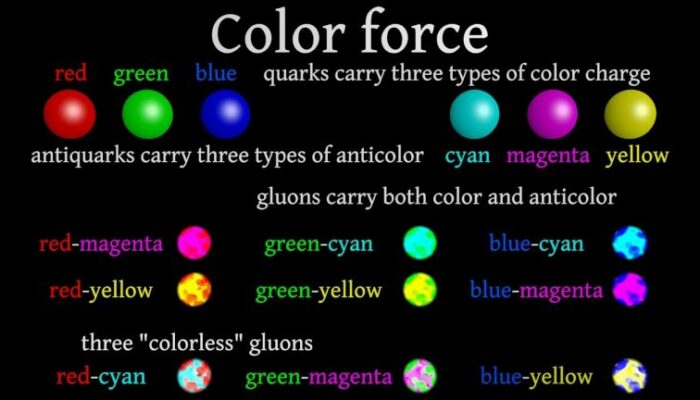
Color charge is a quantum property analogous to electric charge but related to the strong force. Gluons carry combinations of color and anticolor charges, which govern their interactions. This property leads to two remarkable phenomena:
- Asymptotic Freedom:
At very short distances, quarks and gluons interact weakly, allowing them to behave almost as free particles. - Confinement:
At larger distances, the strong force intensifies, preventing quarks and gluons from existing independently outside hadrons.
These effects are fundamental to the stability of matter and are unique to the strong interaction mediated by gluons.
Theoretical and Cosmological Significance
Beyond their role in particle physics, gluons have profound implications in cosmology and astrophysics. Theoretical models suggest that gluons influenced the early universe’s conditions, contributing to the formation of matter shortly after the Big Bang. Their interactions may also be linked to phenomena such as cosmic inflation and the uniformity observed in the Cosmic Microwave Background (CMB).
Moreover, gluons might provide insights into the nature of dark matter and dark energy, mysterious components that dominate the universe’s mass-energy content but remain poorly understood. By studying gluonic behavior, scientists hope to unravel these cosmic enigmas.
Applications and Technological Impact
Research into gluons extends beyond theoretical physics, offering potential advancements in technology. Understanding gluon dynamics is crucial for the development of high-energy particle accelerators, which probe the fundamental structure of matter. Additionally, insights from gluon interactions may inform emerging fields such as quantum computing, where controlling quantum states and forces at the subatomic level is essential.
These applications highlight the broader significance of gluons, linking fundamental science to practical innovations that could shape future technologies.
Common Misconceptions About Gluons
Gluons have mass.
Gluons are massless particles, although they carry energy and momentum.
Quarks can exist freely outside hadrons.
Due to confinement, quarks are never found isolated; they are always bound within hadrons by gluons.
Color charge relates to visible colors.
Color charge is a quantum property unrelated to visual color; it describes the type of strong force charge gluons and quarks carry.
Why Gluons Are Essential
Gluons are indispensable to our understanding of the universe at its most fundamental level. They not only hold the building blocks of matter together but also embody the complex interactions that define the strong force. This force shapes the structure of atomic nuclei, influences cosmic evolution, and underpins the stability of all visible matter.
By studying gluons, scientists gain deeper insights into the fundamental laws of physics, enabling progress in both theoretical frameworks and practical technologies. Their unique properties and interactions continue to challenge and expand our comprehension of the subatomic world and the cosmos at large.
FAQ
What are gluons?
Gluons are elementary particles that act as carriers of the strong nuclear force, responsible for binding quarks together inside atomic nuclei.
How do gluons interact with quarks?
Gluons carry color charge, allowing them to exchange color between quarks, effectively 'gluing' them together within hadrons.
Why can't quarks be isolated?
Due to the property called confinement, the strong force mediated by gluons prevents quarks from existing freely outside hadrons.
What is asymptotic freedom?
Asymptotic freedom is the phenomenon where quarks and gluons interact weakly at very short distances, behaving almost like free particles.
What role do gluons play in cosmology?
Gluons influenced the early universe's matter formation and may be linked to phenomena like cosmic inflation and dark matter research.






Leave a Reply