
Short Answer
Definition of Composite Particles
Composite particles are fundamental components within the atomic nucleus, essential to the structure and behavior of matter. These particles are not elementary but are formed by the binding of smaller constituents, primarily quarks, held together by the strong nuclear force. Understanding composite particles is crucial for comprehending how atoms maintain their integrity and how matter interacts at the subatomic level.
- Composite Particles:
Particles made up of two or more quarks bound together by the strong interaction. - Quarks:
Elementary particles that combine in various ways to form composite particles. - Strong Nuclear Force:
The fundamental force responsible for holding quarks together within composite particles.
Classification of Composite Particles
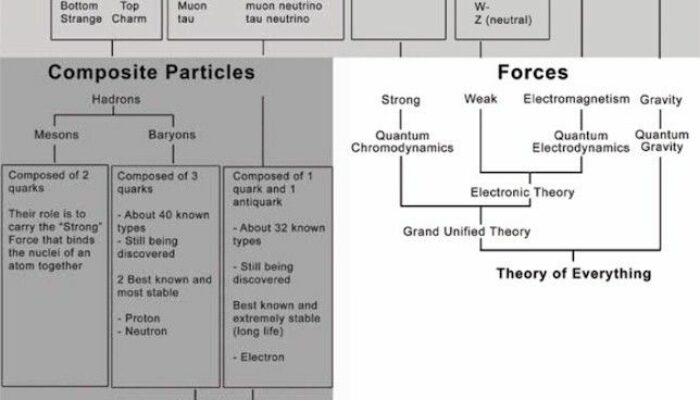
Composite particles are primarily categorized into two main groups: baryons and mesons. These classifications reflect the different quark compositions and the roles these particles play within atomic nuclei.
Baryons: Three-Quark Assemblies
Baryons consist of three quarks bound tightly by gluons, the carriers of the strong force. The most familiar baryons are the proton and neutron, which form the core of atomic nuclei. Protons determine the chemical identity of elements through their positive charge, while neutrons, electrically neutral, contribute to nuclear stability and mass.
- Quark Flavors in Baryons:
Six types of quarks-up, down, charm, strange, top, and bottom-combine in various ways to form different baryons. - Proton Composition:
Two up quarks and one down quark. - Neutron Composition:
One up quark and two down quarks.
Stability and Resonant States
While protons and neutrons are relatively stable, many baryons exist as transient resonances that decay quickly into lighter particles. These short-lived states provide insight into the complex dynamics of quantum chromodynamics (QCD), the theory describing the strong interaction. Studying these resonances helps physicists understand particle behavior under extreme conditions.
Mesons: Quark-Antiquark Pairs
Mesons are composite particles made from a quark and an antiquark pair. They act as force carriers between baryons, mediating the strong nuclear force that binds protons and neutrons within the nucleus. Each meson is characterized by specific quantum numbers such as spin and parity, which influence their interactions and lifetimes.
- Pseudoscalar Mesons:
Examples include pions, which play a vital role in nuclear force mediation. - Vector Mesons:
Such as rho mesons, which have different spin configurations and interaction properties.
Exotic Composite Particles
Beyond the conventional baryons and mesons, physicists have discovered exotic composite particles like tetraquarks and pentaquarks, which contain four and five quarks respectively. These unusual configurations challenge traditional particle classification and expand our understanding of the strong force and quark interactions.
- Tetraquarks:
Particles composed of two quarks and two antiquarks. - Pentaquarks:
Particles consisting of four quarks and one antiquark.
The study of these exotic states pushes the boundaries of the Standard Model and opens avenues for discovering new physics phenomena.
How Composite Particles Function
Composite particles arise from the binding of quarks through gluon exchange, governed by the strong nuclear force. This force is unique in its strength and short range, enabling quarks to remain confined within particles despite their intrinsic properties. The interactions between quarks and gluons are described by quantum chromodynamics, which explains how these particles form stable or resonant states.
Mathematical Framework: Quantum Chromodynamics (QCD)
QCD is the theoretical foundation that models the strong interaction binding quarks inside composite particles. The key elements include:
- Quark Fields (q):
Represent the quark constituents with specific flavors and colors. - Gluon Fields (G):
Mediate the strong force between quarks, carrying color charge. - Color Charge:
Analogous to electric charge in electromagnetism but comes in three types, ensuring quark confinement.
The QCD Lagrangian encapsulates these interactions, and the complexity of the equations often requires computational methods such as lattice QCD to predict particle properties and behaviors.
Practical Examples of Composite Particles
Composite particles are fundamental to the matter that constitutes the observable universe. Examples include:
- Protons and Neutrons:
Building blocks of atomic nuclei, essential for all known matter. - Pions:
Mesons that mediate nuclear forces, influencing nuclear reactions and stability. - Exotic Particles in Particle Accelerators:
Tetraquarks and pentaquarks observed in high-energy collisions provide insights into quark dynamics.
Common Misconceptions About Composite Particles
Protons and neutrons are indivisible.
Both are composite particles made of quarks bound by gluons.
Mesons are stable particles.
Most mesons are unstable and decay rapidly into lighter particles.
Only baryons and mesons exist as composite particles.
Exotic states like tetraquarks and pentaquarks also exist, expanding the classification.
Significance of Composite Particles
Composite particles are central to the structure of matter and the forces that govern the universe. Their study enhances our understanding of atomic nuclei, the formation of elements, and the fundamental interactions in nature. Advances in this field drive progress in particle physics, nuclear physics, and cosmology, influencing technologies ranging from medical imaging to energy production. Moreover, exploring exotic composite particles challenges and refines the Standard Model, potentially leading to groundbreaking discoveries in fundamental physics.
FAQ
What are composite particles?
Composite particles are made of two or more quarks bound together by the strong interaction, including baryons and mesons.
What is the difference between baryons and mesons?
Baryons consist of three quarks, while mesons are made of a quark and an antiquark.
What are exotic composite particles?
Exotic composite particles, such as tetraquarks and pentaquarks, contain four and five quarks, respectively.





Leave a Reply