
Short Answer
Definition of Computational Mathematics
Computational mathematics is a scientific discipline that integrates mathematical theories with computational techniques to solve complex problems across various domains. It serves as a foundational toolset that enables the analysis, modeling, and simulation of phenomena that are otherwise difficult to address through purely analytical methods.
- Mathematical Theory:
The abstract principles and frameworks that underpin problem-solving approaches. - Computational Techniques:
Algorithms and numerical methods implemented via computers to perform calculations and simulations. - Interdisciplinary Nature:
Combines elements of mathematics, computer science, and domain-specific knowledge to tackle real-world challenges.
Core Applications Across Disciplines
Engineering and Structural Design
In engineering, computational mathematics is instrumental in the design, analysis, and optimization of structures and systems. Numerical methods, such as finite element analysis (FEA), enable engineers to simulate physical behaviors like stress, strain, and thermal effects under various conditions. This capability ensures the safety and efficiency of constructions ranging from bridges to skyscrapers, pushing the limits of architectural innovation and material science.
Financial Modeling and Risk Assessment
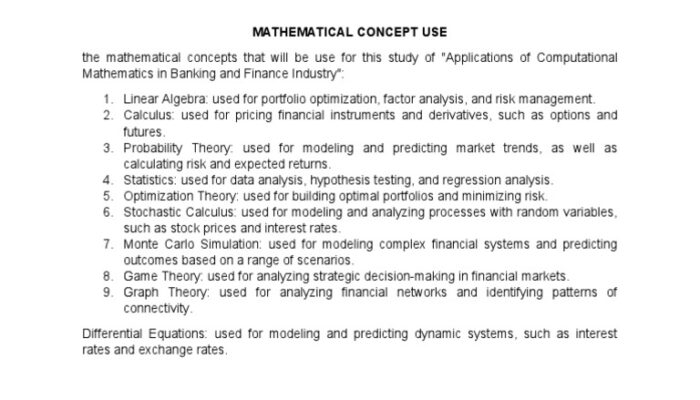
The financial industry extensively utilizes computational mathematics to predict market behavior and manage risk. Techniques like Monte Carlo simulations allow analysts to evaluate the probability of diverse investment outcomes, aiding in portfolio optimization and derivatives pricing. These mathematical models provide a framework for navigating the uncertainties inherent in financial markets, supporting informed decision-making.
Data Science and Artificial Intelligence
With the exponential growth of data, computational mathematics underpins the algorithms that extract meaningful insights from vast datasets. Machine learning models, including neural networks, replicate aspects of human cognition to identify patterns and make predictions. These advancements have practical applications in autonomous vehicles, personalized healthcare, and beyond, demonstrating the transformative power of computational methods in everyday technology.
Environmental and Climate Modeling
Addressing environmental challenges requires sophisticated mathematical models to simulate complex systems such as atmospheric dynamics and ocean currents. Computational mathematics enables researchers to process extensive environmental data, producing predictive simulations that inform climate policy and sustainability efforts. These models are critical for understanding and mitigating the impacts of climate change.
Healthcare Innovations
In medicine, computational mathematics enhances diagnostic and therapeutic techniques. Imaging technologies like computed tomography (CT) and magnetic resonance imaging (MRI) rely on algorithms to reconstruct detailed images from raw data. Additionally, computational methods accelerate drug discovery by analyzing molecular databases to identify promising pharmaceutical candidates, thereby streamlining the development of new treatments.
Operations Research and Logistics Optimization
Optimization algorithms derived from computational mathematics improve efficiency in supply chain management, transportation, and resource allocation. Methods such as linear and integer programming help organizations reduce costs and enhance operational workflows, turning complex logistical challenges into manageable, data-driven strategies.
Computational Physics and Fundamental Research
Computational mathematics is vital in physics for simulating phenomena that are analytically intractable. From particle physics experiments at facilities like the Large Hadron Collider to astrophysical simulations and quantum mechanics, numerical methods enable scientists to analyze massive datasets and explore the fundamental laws of nature.
Educational Integration and Future Prospects
Recognizing its significance, educational institutions have incorporated computational mathematics into curricula across science, engineering, and economics disciplines. This interdisciplinary approach equips students with the skills necessary to innovate and solve complex problems, preparing them to contribute to technological and scientific advancements.
Why Computational Mathematics Is Essential
Computational mathematics is a cornerstone of modern science and technology, providing the tools to model, analyze, and solve problems that span numerous fields. Its applications ensure the safety of infrastructure, optimize financial and logistical systems, advance healthcare, and deepen our understanding of the universe. By bridging theoretical mathematics and practical computation, it empowers informed decision-making and fosters innovation, making it indispensable in addressing contemporary challenges and shaping the future.
FAQ
What is computational mathematics?
Computational mathematics is a field that combines mathematical theories with computational techniques to solve complex problems.
What are some applications of computational mathematics?
Applications include engineering design, financial modeling, data science, climate modeling, and healthcare innovations.
Why is computational mathematics important?
It provides tools for analysis and modeling, enabling informed decision-making and innovation across various sectors.





Leave a Reply