
Short Answer
Definition of Dirac Semimetals
Dirac semimetals represent a distinctive phase of matter in condensed matter physics, where the electronic band structure features unique nodal points known as Dirac points. These materials embody a fascinating intersection of relativistic quantum mechanics and solid-state physics, exhibiting electronic behaviors that challenge traditional frameworks. Understanding Dirac semimetals requires exploring the complex relationship between symmetry, topology, and electron dynamics within the crystal lattice.
Electronic Band Structure and Dirac Points
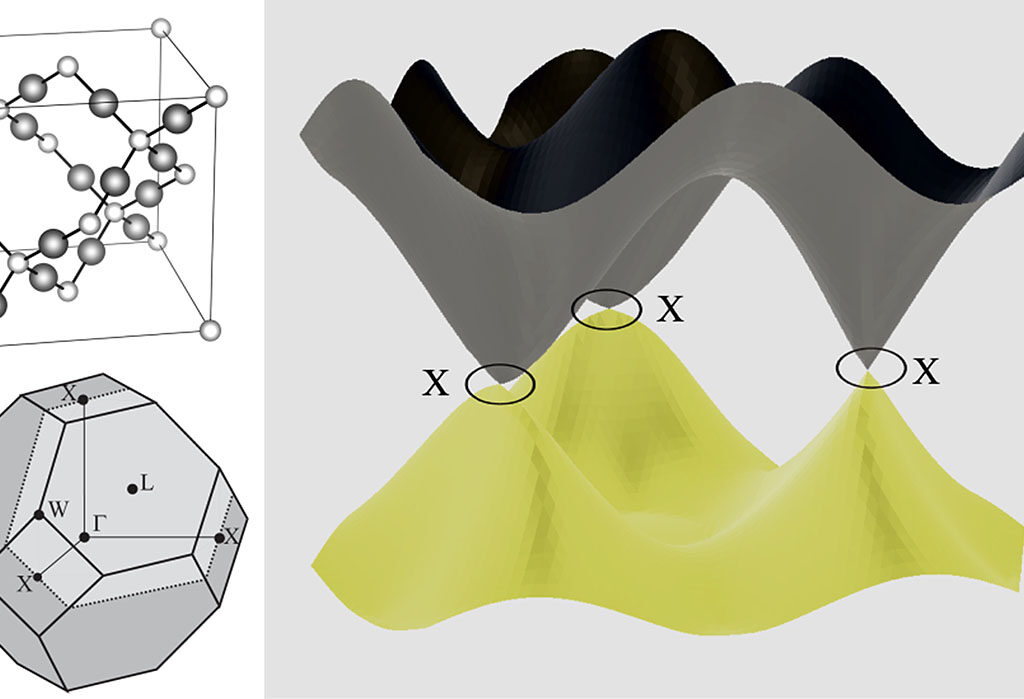
The core attribute of Dirac semimetals lies in their band structure, which can be visualized as an energy landscape navigated by electrons. Unlike typical semiconductors with a band gap, Dirac semimetals display conduction and valence bands that converge at discrete points called Dirac points. At these intersections, electron-like and hole-like states meet, creating a zero band gap condition. This unique configuration leads to electrons behaving as if they are massless, mirroring relativistic particles described by the Dirac equation.
- Dirac Points:
Specific points in momentum space where conduction and valence bands touch, enabling massless electron behavior. - Zero Band Gap:
The absence of an energy gap between bands, allowing continuous electron flow and high conductivity. - Symmetry Protection:
Time-reversal and inversion symmetries preserve the stability of Dirac points against certain perturbations.
Relativistic Electron Dynamics in Dirac Semimetals
Near the Dirac points, electrons exhibit a linear energy-momentum relationship, which can be mathematically described as:
E(k) = ±ħvF |k|
In this formula, E denotes the electron energy, k is the wavevector, ħ is the reduced Planck constant, and vF represents the Fermi velocity. This linear dispersion relation implies that electrons behave as massless relativistic particles, similar to photons, resulting in exceptional electron mobility and enhanced electrical conductivity.
Topological Characteristics of Dirac Semimetals
Beyond their electronic properties, Dirac semimetals are deeply connected to the field of topological materials. Their band structures possess non-trivial topological features that give rise to protected surface states, which remain robust against external disturbances. These topological protections act like a shield, maintaining the integrity of electronic states even under perturbations.
The Dirac points serve as a transitional link between conventional semiconductors and three-dimensional topological phases. Under external influences such as magnetic fields or structural changes, Dirac semimetals can transform into other exotic quantum states, making them a rich platform for investigating new quantum phenomena.
Distinctive Physical Properties
Dirac semimetals exhibit several extraordinary physical phenomena that attract both theoretical and experimental interest:
- Anabelian Quantum Hall Effect:
A quantized charge transport mechanism that deviates from traditional quantum Hall effects, enabling novel electronic behaviors. - Spin-Momentum Locking:
The coupling between electron spin and momentum facilitates spin polarization, a key feature for spintronic applications. - High Electron Mobility:
The massless nature of electrons near Dirac points leads to exceptional conductivity and rapid charge transport.
Applications and Future Directions
The unique properties of Dirac semimetals position them as promising candidates for next-generation technologies, particularly in electronics and photonics. Their ability to maintain high electron mobility at ambient conditions makes them ideal for developing advanced transistors that prioritize speed and energy efficiency. Additionally, their distinctive optical responses open possibilities for innovative photonic devices such as sensors and modulators.
Ongoing research aims to discover new Dirac semimetal materials and refine fabrication techniques. Advanced experimental methods, including angle-resolved photoemission spectroscopy (ARPES), are instrumental in mapping their complex phase diagrams and uncovering novel quantum states. These efforts could lead to breakthroughs in material science and quantum technology.
Common Misconceptions About Dirac Semimetals
Dirac semimetals are simply metals with high conductivity.
While they do exhibit high conductivity, their defining feature is the presence of Dirac points and relativistic electron behavior, which distinguishes them from ordinary metals.
The Dirac points are easily destroyed by any perturbation.
Dirac points are protected by specific symmetries such as time-reversal and inversion, making them stable against many types of disturbances.
Dirac semimetals are purely theoretical constructs.
Several Dirac semimetal materials have been experimentally realized and studied, confirming their physical existence and properties.
Significance of Dirac Semimetals in Science and Technology
Dirac semimetals hold a pivotal role in advancing our understanding of quantum materials by bridging concepts from relativistic physics and solid-state science. Their unique electronic and topological properties not only challenge existing theories but also pave the way for innovative applications in electronics, spintronics, and photonics. As research progresses, these materials may revolutionize device engineering, offering faster, more efficient, and versatile technologies that impact everyday life and future scientific exploration.
FAQ
What are Dirac semimetals?
Dirac semimetals are materials with unique electronic properties characterized by Dirac points in their band structure.
What is the significance of Dirac points?
Dirac points are where conduction and valence bands touch, allowing electrons to behave as massless particles.
How are Dirac semimetals used in technology?
They are promising for applications in electronics, photonics, and spintronics due to their high conductivity and unique properties.






Leave a Reply