

Short Answer
Definition of Graphene and Its Mathematical Significance
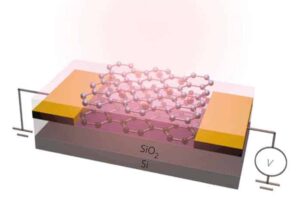
Graphene is a groundbreaking material consisting of a single atomic layer of carbon atoms arranged in a two-dimensional honeycomb lattice. Since its discovery in 2004, it has captivated scientists due to its extraordinary electrical, thermal, and mechanical properties. Beyond its physical attributes, Graphene has sparked interest in the mathematical community, particularly regarding its relationship with fundamental constants such as π (pi), a number historically linked to circular geometry and irrationality.
- Graphene:
A two-dimensional allotrope of carbon with a hexagonal lattice structure. - π (Pi):
An irrational mathematical constant approximately equal to 3.14159, traditionally associated with the ratio of a circle’s circumference to its diameter.
Historical Context: The Legacy of π in Mathematics
In 1788, Johann Carl Friedrich Gauss famously referred to mathematics as the “queen of the sciences,” highlighting its foundational role in scientific inquiry. Over the centuries, π has remained a central figure in mathematics, symbolizing the complexity and beauty of irrational numbers. Its presence permeates geometry, trigonometry, and physics, especially in contexts involving circular and spherical shapes. However, the advent of novel materials like Graphene challenges us to reconsider the universality and application of π in modern scientific frameworks.
Quantum Mechanical Framework of Graphene
The theoretical understanding of Graphene is deeply rooted in quantum mechanics and condensed matter physics. Its electronic properties are often described using advanced concepts such as Berry’s phase, which relates to the geometric phase acquired over a cycle in quantum state space. This geometric aspect introduces a fresh perspective on how π appears in physical systems.
Moreover, Graphene’s electrons behave as massless Dirac fermions, exhibiting linear energy-momentum dispersion rather than the parabolic bands typical of conventional materials. This unique behavior necessitates a reevaluation of traditional mathematical constants and their roles in describing physical phenomena.
Mathematical Formulations in Graphene’s Electronic Structure
Band theory, which explains electron behavior in solids, traditionally incorporates π in the representation of wavefunctions due to the periodicity of lattice structures. In Graphene, the honeycomb lattice and its symmetry give rise to Dirac cones in the band structure, where electrons mimic relativistic particles. This leads to mathematical models that extend beyond classical interpretations of π, suggesting a more intricate relationship between geometry, topology, and quantum mechanics.
Applications and Technological Implications
Graphene’s exceptional strength-to-weight ratio and conductivity have propelled it into numerous technological fields, including aerospace engineering, flexible electronics, and biomedical devices. These applications often involve complex geometrical and topological considerations, where π traditionally plays a role in design and analysis. The integration of Graphene into these domains raises questions about whether classical mathematical constants remain sufficient or if new paradigms are emerging.
Geometrical and Topological Considerations
When incorporating Graphene into three-dimensional structures and metamaterials, the geometric principles underlying its behavior become increasingly significant. Topological features reminiscent of circular and spherical geometries-where π is fundamental-are essential in understanding phenomena such as negative refractive indices and electromagnetic wave manipulation. This intersection of geometry and material science enriches the ongoing discourse on the role of π in advanced materials.
Impact of Defects and Disorder on Mathematical Models
Real-world Graphene samples often contain imperfections and structural defects that influence their properties. These irregularities introduce stochastic elements into the system, complicating the predictability traditionally governed by constants like π. The study of such disorder involves percolation theory and other mathematical frameworks that describe how collective behaviors emerge from complex interactions, highlighting Graphene’s role as a model system for complex systems mathematics.
Reevaluating the Role of π in the Era of Graphene
The exploration of Graphene’s unique properties invites a reconsideration of the dominance of π in mathematical and physical descriptions. While π remains a cornerstone constant, the novel behaviors observed in Graphene suggest that additional or alternative mathematical constructs may be necessary to fully capture the nuances of emerging materials. This evolving narrative encourages interdisciplinary collaboration and innovative theoretical approaches.
Why Understanding Graphene’s Mathematical Landscape Matters
Graphene represents a frontier where materials science, physics, and mathematics converge, offering insights that could redefine fundamental scientific principles. Its study not only advances technology but also challenges and enriches our mathematical frameworks, potentially leading to new constants or refined interpretations of existing ones like π. Embracing this complexity is crucial for future innovations and deepening our comprehension of the natural world.
Common Misconceptions About π and Graphene
π is irrelevant in the study of Graphene.
While Graphene introduces new mathematical challenges, π still underpins many geometric and quantum mechanical aspects of its structure.
Graphene replaces π as a fundamental constant.
Graphene’s properties expand the mathematical landscape but do not supplant π; instead, they complement and extend its applications.
Real-World Examples of Graphene’s Mathematical Influence
In practical terms, Graphene’s unique electronic properties have been harnessed in the development of ultra-fast transistors, flexible touchscreens, and highly sensitive sensors. These devices rely on precise mathematical modeling of electron behavior, where concepts related to π and quantum geometry play critical roles. Additionally, the design of metamaterials incorporating Graphene exploits topological principles that echo classical geometric constants, demonstrating the material’s broad impact.
FAQ
What is Graphene?
Graphene is a single atomic layer of carbon atoms arranged in a two-dimensional honeycomb lattice known for its extraordinary properties.
How does π relate to Graphene?
While Graphene introduces new mathematical challenges, π remains fundamental in many geometric and quantum mechanical aspects of its structure.



Leave a Reply