
Short Answer
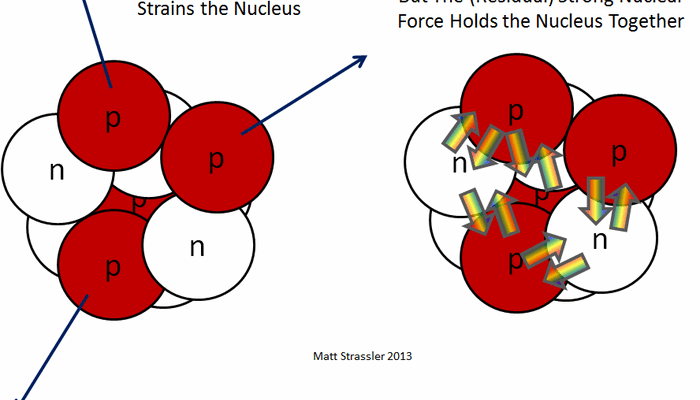
Definition of the Strong Nuclear Force
The strong nuclear force is a fundamental interaction that governs the behavior of subatomic particles, primarily responsible for binding protons and neutrons within atomic nuclei. This force is essential for the stability and structure of matter, operating with immense strength over extremely short distances. Its unique characteristics and underlying mechanisms are central to understanding the composition and interactions of atomic nuclei.
Fundamental Principles and Theoretical Framework
The strong nuclear force is best described by the theory of quantum chromodynamics (QCD), which explains how quarks-the elementary constituents of protons and neutrons-are held together. According to QCD, gluons act as the exchange particles or force carriers that mediate the strong interaction between quarks. The force’s behavior can be modeled through potential energy functions that combine short-range attraction with long-range repulsion, reflecting its complex dependence on the distance between particles.
Quantum Chromodynamics and Color Charge
QCD introduces the concept of color charge, a property of quarks analogous to electric charge in electromagnetism but with three types instead of one. The strong force arises from the exchange of gluons, which themselves carry color charge, leading to a non-linear and self-interacting force. This non-abelian nature distinguishes the strong interaction from other fundamental forces and results in phenomena such as confinement and asymptotic freedom.
Mathematical Representation of the Strong Force
One classical approach to modeling the strong nuclear force is through the Yukawa potential, which captures its short-range attractive nature. The Yukawa potential is mathematically expressed as:
V(r) = -g² * e-μr / r
- r: Distance between nucleons (protons or neutrons).
- g: Coupling constant representing the interaction strength.
- μ: Parameter related to the mass of the exchanged meson particle.
The exponential decay term e-μr illustrates how the force rapidly diminishes as the distance increases, confining the strong force’s effective range to approximately one femtometer (10-15 meters). This potential explains why nucleons remain tightly bound within the nucleus but do not exert significant influence beyond this scale.
Advanced Concepts: Asymptotic Freedom and Confinement
While the Yukawa potential provides insight into the short-range behavior of the strong force, it does not fully capture the complexities observed at the quark level. Quantum chromodynamics reveals two remarkable phenomena:
- Asymptotic Freedom: At extremely short distances, quarks interact weakly, allowing them to behave almost as free particles. This counterintuitive effect means the strong force’s strength decreases as quarks come closer.
- Confinement: As quarks move apart, the force between them intensifies, preventing their isolation. This leads to the formation of bound states such as protons and neutrons, as quarks are perpetually confined within these particles.
Lattice QCD and Numerical Simulations
To better understand the non-linear and complex nature of the strong force, physicists employ lattice QCD, a computational method that discretizes space-time into a grid. This approach allows for numerical simulations of quark and gluon interactions, revealing the force’s behavior beyond simple analytical models. Lattice QCD confirms the non-abelian characteristics of the strong force and provides quantitative insights into confinement and the energy dynamics of quark interactions.
Long-Range Behavior: The Linear Potential Model
At larger distances, the strong force can be approximated by a linear potential, expressed as:
V(r) = σr
- σ (String Tension): Represents the energy per unit length associated with the force between quark-antiquark pairs.
This linear relationship indicates that the energy required to separate quarks increases proportionally with distance, effectively preventing their isolation. When the energy becomes sufficient, new quark-antiquark pairs are created, maintaining the confinement of quarks within hadrons.
Implications and Broader Significance
The dual nature of the strong nuclear force-transitioning from a Yukawa-type short-range potential to a linear confining potential-provides a comprehensive understanding of nuclear stability and particle interactions. Beyond atomic nuclei, these principles influence the behavior of matter under extreme conditions, such as those found in neutron stars and the early universe.
Connections to Fundamental Physics
The strong force’s gauge invariance and symmetry properties link it to broader theoretical pursuits, including the quest for a grand unified theory that integrates all fundamental forces. Its study deepens our comprehension of quantum field theory and the fundamental laws governing the cosmos.
Summary
The strong nuclear force is a cornerstone of particle physics, characterized by a complex functional form that combines the Yukawa potential’s short-range attraction with a linear confining potential at longer distances. Governed by quantum chromodynamics, it exhibits unique phenomena such as asymptotic freedom and confinement, which are critical to the structure of matter. Ongoing research, including lattice QCD simulations, continues to unravel the intricacies of this fundamental interaction, highlighting its profound role in shaping the universe.
FAQ
What is the strong nuclear force?
The strong nuclear force is the fundamental interaction responsible for holding protons and neutrons together within atomic nuclei, ensuring the stability of matter.
How is the strong nuclear force mathematically described?
It is described by the Yukawa potential at short distances and a linear potential at longer distances, reflecting the force's short-range attraction and confinement properties.
What does asymptotic freedom mean in particle physics?
Asymptotic freedom refers to the decreasing interaction strength between quarks as they come extremely close together, a key feature of the strong force.
Why can't quarks be isolated individually?
Because of quark confinement, the strong force grows stronger as quarks separate, preventing them from existing freely outside of hadrons.






Leave a Reply