
Short Answer
Definition of Gravity
Gravity is a fundamental natural phenomenon characterized by the mutual attraction between masses. It is the invisible force that keeps objects anchored to the Earth, governs the motion of celestial bodies, and shapes the large-scale structure of the universe. This force acts universally, influencing everything from the smallest particles to the largest galaxies.
- Universal Attraction:
Gravity causes all matter to pull on other matter, regardless of size or distance. - Omnipresence:
It operates everywhere in the cosmos, from everyday life on Earth to the farthest reaches of space.
Historical Perspectives on Gravity
The understanding of gravity has evolved significantly over centuries. Initially, Sir Isaac Newton formulated the Universal Law of Gravitation in the 17th century, describing gravity as a force proportional to the product of two masses and inversely proportional to the square of the distance between them. This law provided a mathematical framework to explain phenomena such as the falling of objects and planetary orbits.
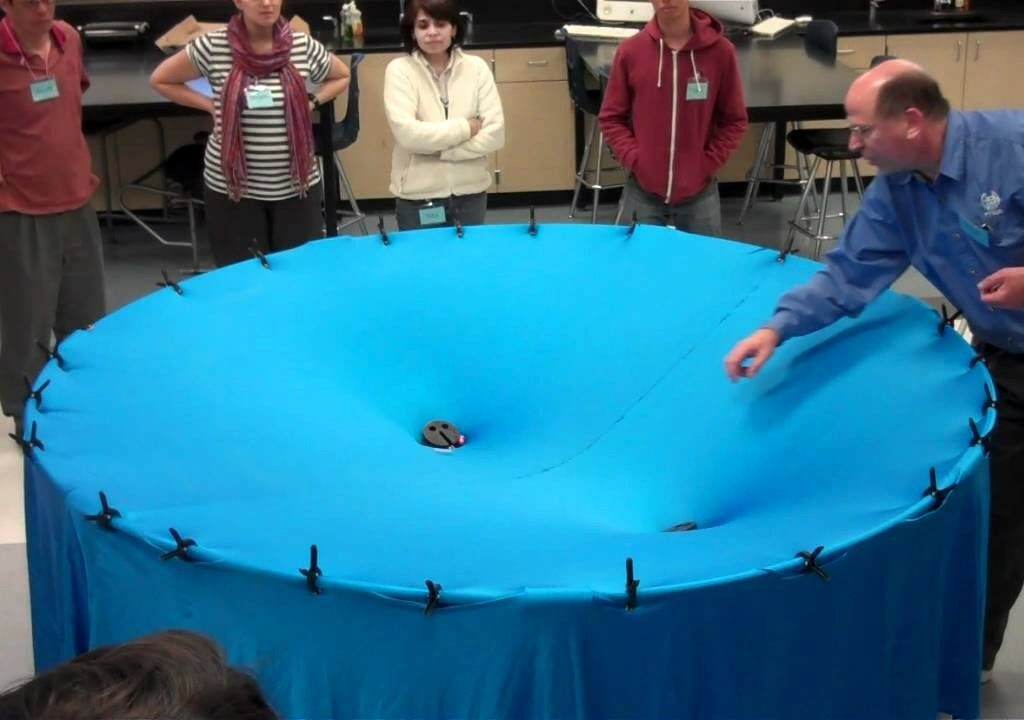
Later, Albert Einstein revolutionized the concept by introducing the theory of General Relativity in the early 20th century. He proposed that gravity is not merely a force but a manifestation of the curvature of space and time caused by mass and energy. This geometric interpretation transformed gravity into a property of the fabric of the universe itself.
How Gravity Operates
Gravity functions as an attractive force between masses, drawing objects toward one another. Newton’s law quantifies this interaction, while Einstein’s theory explains the underlying mechanism as the bending of space-time. Massive objects create depressions in the four-dimensional fabric of the universe, and other objects move along these curves, which appear as gravitational attraction.
- Newtonian View:
Gravity acts as a force pulling masses together, with strength depending on mass and distance. - Einsteinian View:
Gravity results from the warping of space-time, guiding the motion of objects along curved paths.
Mathematical Description of Gravity
The classical formula for gravitational force, as established by Newton, is:
F = G × (m₁ × m₂) / r²
- F: Gravitational force between two masses
- G: Gravitational constant, a fixed value that quantifies the strength of gravity
- m₁, m₂: The masses of the two objects
- r: The distance separating the centers of the two masses
Einstein’s General Relativity replaces this force with the concept of space-time curvature, described by complex tensor equations that relate mass-energy to the geometry of space-time.
Gravity in the Cosmos: Real-World Examples
Gravity’s influence is evident across a vast range of scales:
- Everyday Life:
Gravity keeps us grounded, causes objects to fall, and governs the flow of water in rivers and waterfalls. - Planetary Orbits:
The Moon remains in orbit around Earth due to gravitational attraction, while planets revolve around the Sun in stable paths. - Galactic Dynamics:
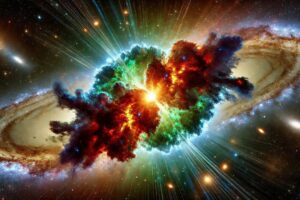
Gravity orchestrates the movement and interaction of stars within galaxies and the merging of galaxies themselves. - Gravitational Lensing:
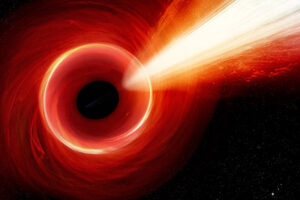
Massive objects like black holes bend light, allowing astronomers to observe distant galaxies otherwise hidden from view.
Common Misunderstandings About Gravity
- Misconception: Gravity is a force that only acts on objects with mass.
Correction: While gravity primarily affects mass, it also influences light by bending its path through curved space-time. - Misconception: Gravity can push as well as pull.
Correction: Gravity is exclusively an attractive force; it never repels. - Misconception: Gravity is fully understood and unified with other forces.
Correction: Despite its importance, gravity remains the least understood fundamental force, especially in relation to quantum mechanics.
The Significance of Gravity
Gravity is essential not only for maintaining the structure and stability of the universe but also for enabling life as we know it. It governs the formation of stars and planets, influences cosmic evolution, and provides the framework within which all physical processes occur. The ongoing quest to reconcile gravity with quantum theory promises to deepen our understanding of the universe’s origins and may lead to groundbreaking technological advances.
Philosophical and Scientific Reflections on Gravity
Beyond its scientific implications, gravity inspires a profound sense of connection and wonder. It links every atom in our bodies to the stars and galaxies, reminding us of our place within the vast cosmic web. This invisible force is both a grounding presence and a symbol of the intricate harmony that underpins existence.
Summary
In essence, gravity is the universal pull between masses, shaping the cosmos from the smallest scales to the grandest structures. It is the subtle sculptor of reality, guiding the motion of planets, stars, and galaxies, and anchoring us to our home planet. From Newton’s mathematical laws to Einstein’s geometric vision, gravity remains a cornerstone of physics and a source of endless fascination.
FAQ
What is gravity?
Gravity is the force of attraction between masses that keeps objects anchored to Earth and governs the motion of celestial bodies.
Who discovered gravity?
Sir Isaac Newton formulated the Universal Law of Gravitation, while Albert Einstein expanded the concept through General Relativity.
How does gravity affect space?
Gravity influences the motion of planets, stars, and galaxies, and it shapes the structure of the universe.

Leave a Reply